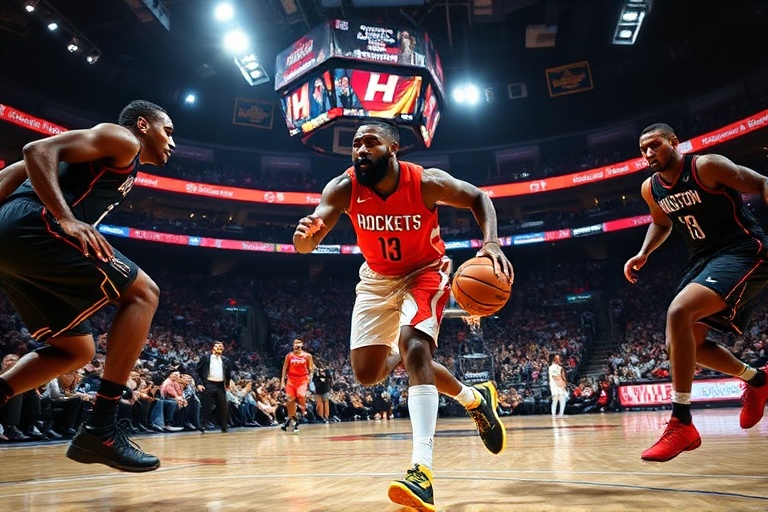
James Harden’s career has been defined by offensive brilliance, statistical dominance, and an unparalleled ability to generate points. With a resume that includes an MVP award, multiple scoring titles, and a place among the NBA’s all-time greats, Harden’s numbers tell the story of a player who redefined how the game is played. From his early days as a sixth man to his peak years as a franchise cornerstone, his stats provide a window into his impact on the court.
Career Averages and Milestones
Harden’s career averages are staggering, particularly in scoring, assists, and efficiency. Over his 15-plus seasons in the NBA, he has maintained an average of 25.2 points per game while shooting 44.1% from the field and 36.3% from three-point range. His free-throw shooting, a hallmark of his offensive game, stands at an elite 85.4%. These numbers place him among the most productive scorers in league history, with a career total of over 25,000 points.
Beyond scoring, Harden’s playmaking has also set him apart. He ranks among the NBA’s all-time leaders in assists per game for a guard, with a career average of 7.0. His ability to create for teammates while still being the primary scorer is a rare combination. Harden has also been a consistent threat from beyond the arc, with over 2,000 made three-pointers in his career, further solidifying his role in modern basketball.
Harden’s statistical milestones include multiple seasons leading the league in scoring, assists, and player efficiency rating (PER). He has been named to ten All-Star teams and six All-NBA First Team selections, underscoring his sustained excellence. His 2017-18 season, where he averaged 30.4 points, 8.8 assists, and 5.4 rebounds, remains one of the most dominant individual campaigns in recent memory.
Peak Seasons and Signature Performances
Harden’s peak years came during his time with the Houston Rockets, where he evolved into one of the league’s most unstoppable offensive forces. The 2017-18 season was a career-defining year, as he led the Rockets to a 65-win season and was named league MVP. That year, he set career highs in scoring, averaged a triple-double, and shot 36.1% from three-point range while leading the league in free throws made per game.
Another standout season was 2018-19, when he averaged 36.1 points per game—the highest scoring average since Michael Jordan in 1986-87. Harden’s ability to score in isolation, in the pick-and-roll, and from deep made him nearly unguardable. His 61-point game against the New York Knicks that season remains one of the highest-scoring performances in NBA history.
Harden’s 2019-20 season was equally impressive, as he led the league in assists with 8.0 per game while still averaging 34.3 points. His partnership with Russell Westbrook in Houston created one of the most dynamic duos in the league, though their tenure together ended in a blockbuster trade that sent Harden to the Brooklyn Nets.
Advanced Metrics and Efficiency
Beyond traditional stats, Harden’s advanced metrics highlight his efficiency and impact. His career Player Efficiency Rating (PER) of 24.1 places him among the top guards in NBA history. His usage rate, often exceeding 30%, reflects his role as the primary offensive hub for his teams. Harden’s true shooting percentage (TS%) of 61.1% is elite, indicating his ability to score efficiently despite high volume.
Defensive metrics have been a point of criticism throughout Harden’s career, particularly in terms of his on-ball defense and effort. However, his offensive contributions often outweigh these concerns. Harden’s ability to draw fouls—he ranks second all-time in free throws made—has also been a subject of debate, with some arguing that his flair for contact has led to an overreliance on the charity stripe.
Despite these criticisms, Harden’s offensive impact is undeniable. His ability to generate points in transition, in the half-court, and from deep makes him one of the most versatile scorers ever. His offensive win shares per 48 minutes (OWS/48) of 0.185 further underscores his value as a primary creator.
Comparisons and Legacy
Harden’s statistical profile places him in the conversation with other all-time greats like Michael Jordan, Kobe Bryant, and LeBron James. While his defensive limitations set him apart, his offensive output is unmatched in modern basketball. His ability to dominate games without needing to be the primary facilitator—unlike LeBron—highlights his unique skill set.
Here’s a quick comparison of Harden’s career averages with other top scorers:
- Michael Jordan: 30.1 PPG, 6.2 RPG, 5.3 APG, 49.7% FG
- Kobe Bryant: 25.0 PPG, 5.2 RPG, 4.7 APG, 44.7% FG
- LeBron James: 27.1 PPG, 7.5 RPG, 7.4 APG, 50.5% FG
- James Harden: 25.2 PPG, 6.3 RPG, 7.0 APG, 44.1% FG
Harden’s career three-point shooting and free-throw accuracy further differentiate him from these legends. His ability to stretch defenses while maintaining high scoring averages is a testament to his adaptability in an evolving NBA.
As Harden continues to play at a high level in his later years, his legacy is already secure. Whether it’s his scoring titles, MVP award, or his influence on modern basketball, his stats tell a story of relentless offensive production. For fans looking to dive deeper into his career, Sports and Analysis sections on Dave’s Locker provide additional context and discussions on his impact.
Conclusion
James Harden’s stats paint a picture of one of the most prolific scorers in NBA history. From his early days as a sixth man to his peak years as a franchise cornerstone, his numbers reflect a career built on offensive brilliance. While his defensive contributions have been a point of debate, his impact on the game is undeniable. As Harden continues to add to his legacy, his stats will remain a benchmark for future generations of players.