by Dave’s Locker Staff | Published June 12, 2024
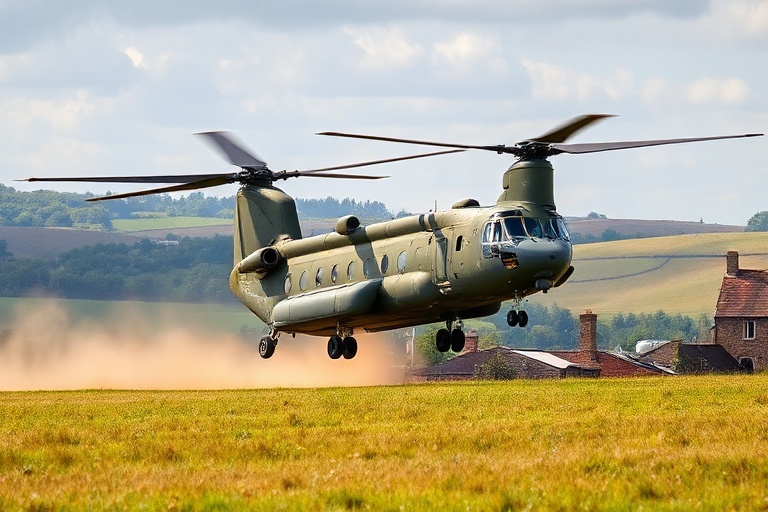
The recent landing of an RAF Chinook helicopter near Bromyard, Herefordshire, underscores the enduring operational relevance of the UK’s heavy-lift rotorcraft fleet. The twin-rotor, tandem-rotor aircraft touched down in a rural field, a routine yet symbolically significant moment that highlights the versatility of modern military aviation. While the exact purpose of the landing remains undisclosed, it serves as a reminder of the Chinook’s critical role in rapid deployment, disaster response, and logistical support across the British Isles and beyond.
The Chinook’s appearance in the Welsh Marches is not an isolated incident. Over the past year, RAF Chinooks have conducted training exercises, emergency evacuations, and humanitarian missions across the UK. From transporting troops in the Scottish Highlands to delivering medical supplies during flooding in Wales, the aircraft’s adaptability remains unmatched. The Bromyard landing, while minor in scale, reflects a broader pattern of operational flexibility that keeps the fleet ready for both domestic and international contingencies.
The Chinook’s Operational Versatility in Modern Defense
Introduced to RAF service in the 1980s, the Boeing Chinook HC6 has evolved into the backbone of Britain’s heavy-lift helicopter capability. Its tandem-rotor design allows for heavy payloads—up to 55 troops or 10 tonnes of cargo—while maintaining stability in challenging conditions. The recent upgrades to the HC6 variant, including improved avionics and defensive systems, have extended its service life well into the 2040s.
Recent deployments demonstrate the aircraft’s broad utility:
- Disaster Response: Delivering supplies during floods in South Wales and snowstorms in the Lake District.
- Training Operations: Conducting air assault exercises with the Parachute Regiment and Royal Marines.
- International Missions: Supporting NATO exercises in Eastern Europe and UN peacekeeping efforts.
- Domestic Security: Assisting in counter-terrorism drills and VIP protection protocols.
The Bromyard landing, while modest, fits into a wider strategy of maintaining readiness through dispersed operations. By occasionally operating from rural or unprepared sites, crews practice the kind of flexibility required in low-threat or austere environments—scenarios increasingly relevant in the post-Afghanistan era.
Strategic Context: Why Chinooks Matter in 2024
The UK’s defense posture is shifting. With the 2023 Integrated Review emphasizing resilience, contested logistics, and expeditionary capability, the Chinook fleet has become even more central. The aircraft’s ability to operate from unprepared landing zones makes it ideal for supporting dispersed forces—an approach now prioritized in response to peer-state threats in Europe and beyond.
Domestically, the Chinook plays a quiet but vital role in civil contingency planning. During Storm Ciarán in late 2023, RAF Chinooks were deployed to deliver generators and blankets to isolated communities in Cornwall. Such missions often go unnoticed, but they reinforce the military’s dual-role identity: protecting citizens while training for high-intensity operations.
“The Chinook is one of the few platforms that can truly bridge the gap between warfighting and humanitarian assistance. Its endurance and payload make it indispensable in scenarios where speed and reliability are non-negotiable.” — Wing Commander (Ret’d) David Reay, former RAF Chinook pilot
The Bromyard landing, therefore, is not just a training event—it’s a statement of operational intent. In an era where global supply chains are vulnerable and domestic infrastructure faces climate-driven stress, the RAF’s heavy-lift capacity remains a strategic asset.
Broader Implications: Readiness, Public Perception, and Future Procurement
The presence of a Chinook near Bromyard carries implications beyond the immediate tactical scenario. First, it signals ongoing investment in rotary-wing aviation at a time when some Western nations are reducing their helicopter fleets. The UK’s decision to upgrade its Chinook fleet—including the planned HC7 variant—demonstrates confidence in the platform’s future.
Second, such operations help maintain public visibility of the RAF. While fighter jets often dominate headlines, it is platforms like the Chinook that embody the RAF’s ethos of service to the nation. Each landing in a rural field or town square reinforces the idea that the military is not just a distant force but an accessible and responsive institution.
Third, the Bromyard event raises questions about infrastructure. The UK has fewer dedicated military helicopter bases than in previous decades. The ability to operate from civilian or temporary sites—like fields, sports pitches, or car parks—reduces dependency on fixed infrastructure, a lesson reinforced during the Cold War and now being relearned in Europe.
Looking ahead, the RAF is expected to continue procuring additional Chinooks to replace aging HC4 models and meet increased demand. With the US Army also expanding its Chinook fleet, the platform remains a cornerstone of heavy-lift aviation globally. For the UK, this means sustaining a capability that few allies can match.
Conclusion: The Chinook’s Quiet Legacy
The RAF Chinook’s landing near Bromyard may have been brief, but its significance is sustained. It stands as a microcosm of the RAF’s broader mission: to be ready, adaptable, and responsive. In an age of geopolitical uncertainty and climate volatility, the Chinook’s ability to deliver people, supplies, and hope—often in the same sortie—remains unparalleled.
As the RAF modernizes, the Chinook will likely remain in service for decades to come. Its story is not one of speed or stealth, but of endurance and reliability. And in that, it reflects the enduring values of the Royal Air Force itself.
For those who witnessed the Chinook’s rotors stirring the air over Herefordshire, it was more than a passing aircraft—it was a reminder of what it means to be prepared.
Further Reading:
- Defence & Military News — Stay updated on RAF operations and defense developments.
- Aviation & Aerospace — Explore insights into military and civilian aircraft technology.