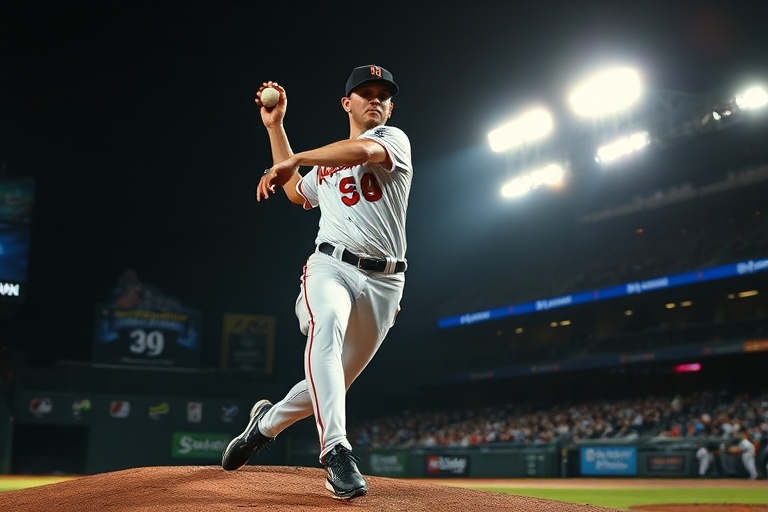
Spencer Strider: How MLB’s Pitching Revolution is Reshaping Baseball
Spencer Strider has quickly become one of the most electrifying names in Major League Baseball, transforming from a developmental prospect into a dominant force on the mound. Since his debut with the Atlanta Braves in 2022, Strider has rewritten expectations for young pitchers, blending elite velocity with precision control. His rapid ascent raises intriguing questions about the future of pitching mechanics, team development strategies, and the evolving metrics used to evaluate talent.
From Draft Day to MLB Dominance
Selected by the Braves in the fifth round of the 2020 MLB Draft out of Clemson University, Strider was not a household name entering pro ball. His draft stock was modest compared to elite college arms, but the Braves saw potential in his explosive fastball and developing slider. By 2021, he was already making waves in the minors, posting a 2.26 ERA and 152 strikeouts in 129 innings across two levels. That performance earned him a late-season call-up to Atlanta, where he made a memorable debut.
Strider’s transition to the majors was seamless. In his rookie campaign, he struck out 164 batters in 131.2 innings while posting a 2.67 ERA, finishing third in National League Rookie of the Year voting. His 2023 season was even more staggering: Strider led the NL in strikeouts (202) and posted a 3.86 ERA over 186.2 innings despite battling injuries. What’s most remarkable is his ability to maintain elite strikeout rates while limiting walks—a rare combination in today’s power-driven MLB.
Key Factors Behind Strider’s Success
Several elements contribute to Strider’s dominance, but three stand out:
- Velocity and Movement: Strider routinely sits in the mid-to-high 90s with his four-seam fastball, which averages over 97 mph with elite spin rates. His slider, thrown in the mid-80s, generates whiffs at an astonishing rate due to its sharp break and deception. The combination forces hitters into weak contact or strikeouts.
- Mechanical Efficiency: Unlike many power pitchers who sacrifice control for velocity, Strider maintains a repeatable delivery that allows him to locate his fastball with precision. His high leg kick and strong lower-half drive generate power without compromising command.
- Pitching Arsenal: While Strider’s fastball and slider are his signature offerings, he has developed a changeup that keeps hitters honest. His ability to tunnel pitches—making them look similar out of his hand before breaking sharply—adds another layer of difficulty for opposing lineups.
The Broader Impact on MLB Pitching
Strider’s success is more than just individual achievement; it reflects broader trends in MLB pitching. Teams are increasingly prioritizing velocity and spin rates, often at the expense of traditional pitching development. Strider embodies this shift, as his fastball velocity ranks among the highest for starting pitchers in recent history. His ability to succeed despite a relatively modest frame (6’2”, 215 lbs) challenges conventional wisdom about pitcher durability and workload.
His dominance also raises questions about the role of analytics in player development. The Braves have been at the forefront of using data to optimize pitch selection, defensive positioning, and even rest days. Strider’s development aligns with this approach, suggesting that teams willing to invest in advanced metrics and high-tech training may gain a competitive edge.
Yet, Strider’s rise also underscores the risks of relying too heavily on power pitchers. His 2023 season was cut short by a forearm strain, a common ailment among pitchers who max out velocity. While he has avoided serious injury so far, his workload—including a high pitch count in key games—has drawn scrutiny. The Braves must balance his long-term durability with his immediate impact, a challenge many teams face with young phenoms.
What’s Next for Strider and the Braves?
At just 25 years old, Strider is entering the prime of his career. The Braves have already locked him into a long-term contract, reflecting their commitment to building around him. With Max Fried and Kyle Wright also in the rotation, Atlanta boasts one of the most formidable starting cores in baseball. If Strider can stay healthy, he could anchor a Braves dynasty for years to come.
Beyond his individual accolades, Strider’s presence elevates the entire pitching staff. His competitiveness and work ethic set a standard for teammates, while his ability to overpower hitters reduces pressure on the bullpen. The Braves’ front office has built a team designed to contend annually, and Strider is the cornerstone of that vision.
Lessons for Prospects and Organizations
Strider’s journey offers several takeaways for both young pitchers and MLB organizations:
- Velocity alone isn’t enough; command and secondary pitches are critical for sustained success.
- Mechanical efficiency can offset physical limitations, allowing pitchers to maximize their potential.
- Analytics-driven development can accelerate player growth, but human intuition and coaching remain irreplaceable.
- Durability is the ultimate wildcard; teams must manage workloads carefully to avoid burnout or injury.
As Strider continues to refine his craft, baseball fans and analysts alike will watch closely. His ability to adapt to league adjustments and maintain his dominance will determine whether he joins the pantheon of all-time great pitchers—or if his career is a cautionary tale about the perils of over-reliance on power.
Conclusion
Spencer Strider represents the new wave of MLB pitching: a blend of raw power, precision, and analytics-driven development. His rapid rise from draft day obscurity to Cy Young contender status is a testament to the Braves’ innovative approach to player development. Yet, his career is still unfolding, with questions about longevity and workload looming large.
For now, Strider is a must-watch spectacle on the mound, a pitcher who makes every start an event. Whether he becomes a franchise icon or a cautionary tale, his story is a defining narrative of modern baseball—one where data, athleticism, and sheer will converge to redefine what’s possible.
As the Braves and other teams chase championships, Strider’s development will serve as both a blueprint and a warning. For pitchers dreaming of reaching his level, his career is a masterclass in turning potential into dominance. For the rest of MLB, it’s a reminder that the game is evolving, and those who adapt fastest will thrive.
Visit our Sports section for more MLB coverage and analysis.
Explore in-depth Analysis on player development and team strategies.