Global Trade at the Crossroads: The Strait of Hormuz and Rising Military Tensions
The Strait of Hormuz remains one of the world’s most critical chokepoints for maritime trade, a narrow waterway through which nearly a third of the world’s seaborne oil passes. As geopolitical rivalries intensify, this strategic corridor has become a flashpoint for military posturing, cyber threats, and proxy conflicts. Recent years have seen a steady escalation in tensions, with incidents involving naval standoffs, drone strikes, and attempts to disrupt shipping lanes. The region’s importance cannot be overstated—its stability directly influences global energy prices, supply chains, and international diplomacy.
The Strait’s geography alone makes it vulnerable. Just 21 miles wide at its narrowest point, it is bordered by Iran to the north and Oman and the United Arab Emirates to the south. This narrow passage, flanked by mountainous terrain and shallow waters, creates natural bottlenecks that are both a strategic asset and a liability. Any disruption here can send ripples across global markets, affecting everything from gasoline prices in Los Angeles to heating costs in Tokyo. The region’s history of conflict, coupled with its role as a crossroads of civilizations, adds layers of complexity to an already volatile situation.
The Historical Roots of Tension
Disputes over the Strait of Hormuz are not new. They trace back decades, rooted in territorial claims, sectarian divisions, and the legacy of colonial-era borders. The 1980s saw direct confrontations during the Iran-Iraq War, when both sides targeted each other’s oil tankers in a bid to cripple economic lifelines. The so-called “Tanker War” demonstrated how easily the Strait could become a battleground, with mines, missiles, and sabotage shaping the conflict. These tactics have since evolved, incorporating modern technologies like drones and cyber warfare.
Iran has long positioned itself as the de facto guardian of the Strait, framing its military presence as a deterrent against foreign interference. The Islamic Republic’s 1979 revolution and subsequent hostage crisis at the U.S. embassy in Tehran solidified its defiance of Western influence, a stance that continues to shape its foreign policy. Meanwhile, regional allies like Saudi Arabia and the UAE view Iran’s actions as provocative, leading to a proxy war in Yemen and heightened naval patrols in the area. The 2019 attacks on Saudi oil facilities and the 2021 drone strike on a U.S. base in Iraq underscored how quickly tensions can escalate into direct conflict.
Modern Flashpoints and Military Posturing
In recent years, the Strait of Hormuz has witnessed a series of high-stakes incidents that highlight the fragility of its security. In 2019, a series of attacks on oil tankers—including those from Japan and Norway—were widely attributed to Iran, though Tehran denied involvement. The same year, Iran shot down a U.S. drone, nearly triggering a military response from Washington. These events occurred against the backdrop of the U.S. withdrawal from the Iran nuclear deal and the reimposition of sanctions, which further strained relations.
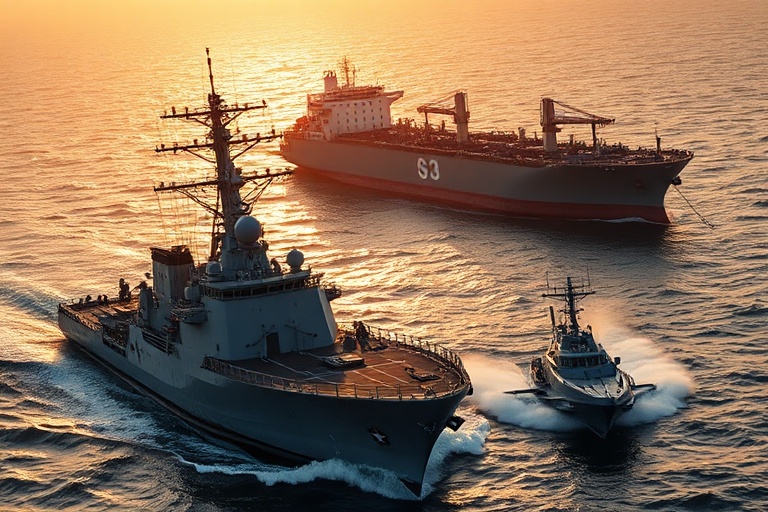
Naval forces from multiple nations now patrol the Strait, adding to the tension. The U.S. Fifth Fleet, based in Bahrain, conducts regular exercises to ensure the free flow of commerce. Meanwhile, Iran’s Islamic Revolutionary Guard Corps (IRGC) has expanded its maritime capabilities, deploying fast-attack boats and anti-ship missiles. The IRGC’s tactics, including the harassment of commercial vessels, have drawn condemnation from the international community but also serve as a reminder of Iran’s asymmetric warfare strategies.
The involvement of non-state actors has further complicated the situation. Houthi rebels in Yemen, backed by Iran, have launched missile and drone attacks on Saudi Arabia and the UAE, including strikes near the Strait. These attacks are often framed as retaliation for coalition airstrikes in Yemen, but their proximity to the Strait raises concerns about broader regional destabilization. The presence of Russian and Chinese naval ships in the area has also introduced a new dynamic, as both powers seek to assert influence in a region traditionally dominated by the U.S.
Economic and Geopolitical Consequences
The economic fallout from a prolonged conflict in the Strait of Hormuz could be catastrophic. Oil prices, already volatile due to the war in Ukraine and sanctions on Russia, would likely surge, straining global supply chains. Countries heavily reliant on Middle Eastern oil—such as China, India, and Japan—would face immediate shortages and price spikes. The International Energy Agency has warned that a 5% reduction in oil flows through the Strait could push prices up by 20%, triggering a recession in energy-dependent economies.
Beyond oil, the Strait is a critical route for liquefied natural gas (LNG) shipments, particularly for Europe as it seeks alternatives to Russian gas. Disruptions here could derail efforts to stabilize energy markets and accelerate the transition to renewable energy. The global shipping industry, which relies on just-in-time delivery systems, would also suffer, with delays and higher insurance premiums becoming the norm. Insurers have already begun adjusting rates for vessels transiting the region, reflecting the heightened risk.
The geopolitical consequences extend beyond energy. A military confrontation could force the U.S. and its allies to reassess their commitments in the Middle East, potentially leading to a power vacuum. Iran, meanwhile, could use the crisis to rally domestic support, framing its actions as a defense against foreign aggression. The region’s proxy conflicts—from Syria to Lebanon—could intensify, drawing in more players and prolonging instability. The 2023 normalization talks between Saudi Arabia and Iran, brokered by China, offer a rare glimmer of hope, but progress remains fragile.
What Lies Ahead for the Strait of Hormuz
Predicting the future of the Strait of Hormuz is fraught with uncertainty. Diplomatic efforts have so far failed to produce lasting solutions, and the risk of miscalculation remains high. The region’s militarization shows no signs of slowing, with new technologies like hypersonic missiles and autonomous underwater vehicles adding to the complexity. Meanwhile, climate change and water scarcity in the Gulf states could exacerbate tensions, as competition for resources intensifies.
One potential path forward is the revival of multilateral agreements that guarantee the Strait’s neutrality. The 1982 United Nations Convention on the Law of the Sea (UNCLOS) already provides a framework for international maritime law, but enforcement remains weak. Regional initiatives, such as the 2021 maritime security dialogue between Iran and Gulf states, have shown promise but lack concrete outcomes. The involvement of external powers like China and Russia could either stabilize the region or further entrench divisions, depending on their intentions.
The international community must also address the humanitarian toll of the conflict. The Strait is not just a strategic asset but a home to thousands of fishermen, traders, and families who rely on its waters for their livelihoods. The environmental risks—from oil spills to unregulated shipping—pose long-term threats to marine ecosystems. Any military action risks exacerbating these challenges, turning a geopolitical crisis into an ecological and humanitarian disaster.
For now, the world watches as diplomatic channels remain open but fragile. The Strait of Hormuz stands as a reminder of how interconnected global security and prosperity truly are. Whether it becomes a flashpoint for war or a symbol of cooperation may well determine the economic and political trajectory of the 21st century.
For more on how regional conflicts intersect with global trade, explore our Analysis section, where experts dissect the intersection of politics and economics. To understand the broader implications of maritime security, visit our Politics coverage for in-depth reporting on international relations.