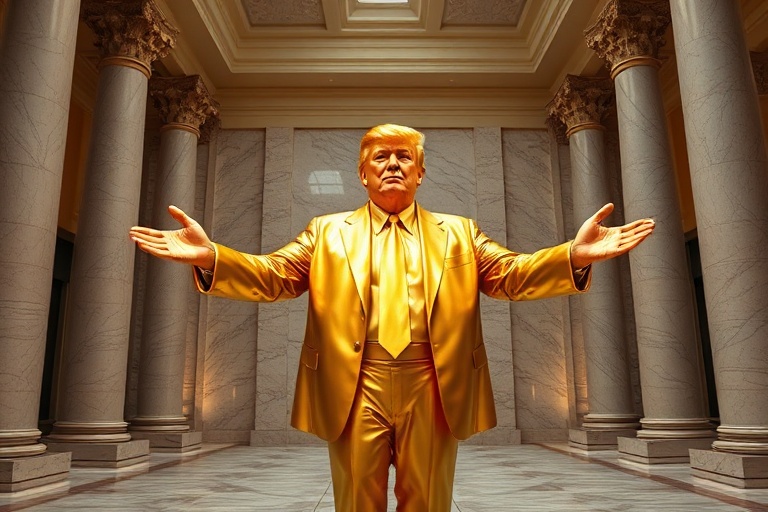
The Trump gold statue, created by artist Dan Brooks in 2016, remains one of the most polarizing pieces of political art in recent memory. Standing at 6 feet tall and weighing 70 pounds, the statue depicts Donald Trump in a dynamic pose, holding a golden sword in one hand and a globe in the other. Crafted entirely from 24-karat gold leaf applied to a resin base, the piece was initially intended as a satirical commentary on wealth and power in American politics.
Brooks, a former Republican political consultant, described the work as a “visual metaphor for the cult of personality surrounding Trump.” The statue first gained attention when it was displayed at the Republican National Convention in Cleveland. Its reception was immediate and divided—some viewers praised its bold aesthetic, while others condemned it as glorification of a divisive figure. The controversy only intensified when the piece was auctioned in 2017 for $20,000, far exceeding its estimated value.
The Artistic Vision Behind the Statue
Dan Brooks’ Trump gold statue is not merely a caricature; it is a deliberate fusion of classical statuary and contemporary symbolism. The use of gold leaf is particularly significant, historically reserved for religious and imperial iconography. By applying this technique to a political figure, Brooks challenges viewers to consider the intersection of power, wealth, and public perception.
The sword and globe held by the statue carry layered meanings. The sword could symbolize strength or aggression, while the globe suggests global influence—both themes central to Trump’s political narrative. Brooks has stated that the pose was inspired by depictions of ancient rulers like Alexander the Great, drawing a parallel between historical authoritarianism and modern populism. Critics, however, argue that the statue’s opulence undermines its satirical intent, transforming critique into celebration.
The technical execution of the piece also invites analysis. The resin base provides durability, while the gold leaf ensures the statue’s reflective, almost divine quality. This duality—between permanence and fragility—mirrors the tensions in Trump’s own public image: a figure both revered and reviled.
Public Reception and Cultural Significance
Reactions to the Trump gold statue have varied widely depending on political affiliation and artistic sensibility. Supporters of Trump often view the piece as a bold, unapologetic celebration of his achievements. Some collectors and art enthusiasts have praised its craftsmanship and audacity, comparing it to works by Jeff Koons or Damien Hirst in its provocative use of materials.
Opponents, however, see the statue as emblematic of the excesses and moral failings associated with Trump’s presidency. Protesters at art exhibitions featuring the piece have vandalized it on multiple occasions, spraying paint or attempting to deface it. These incidents raise broader questions about the role of art in political discourse: Is it acceptable to destroy art that offends, or does such action itself become a form of censorship?
The statue’s cultural footprint extends beyond galleries. It has been referenced in political cartoons, late-night comedy shows, and even memes. Its image has been repurposed in countless parodies, from Trump riding the golden statue like a mechanical bull to it being melted down in satirical animations. This digital proliferation speaks to the statue’s status as a cultural Rorschach test—each viewer projects their own biases onto its gleaming surface.
Controversies and Legal Issues
The Trump gold statue has been embroiled in multiple legal and ethical disputes. In 2018, a group of protesters disrupted an art fair where the statue was displayed, leading to a confrontation that required police intervention. The artist later filed a complaint against the protesters for damages, reigniting debates about artistic freedom versus public protest.
Another controversy arose when the statue was scheduled for display at the Museum of Contemporary Art in Los Angeles. Local activists demanded its removal, arguing that it violated the museum’s commitment to inclusivity. The museum ultimately allowed the exhibition but added disclaimers about the piece’s contested nature. This incident highlights the challenges museums face in balancing artistic expression with social responsibility.
Where Is the Trump Gold Statue Now?
After its initial auction in 2017, the Trump gold statue changed hands several times, eventually finding a home in a private collection. Unlike many political artworks that fade into obscurity, this piece has maintained its relevance, partly due to Trump’s continued prominence in public life. Speculation about its current location persists, with rumors placing it in a high-security vault or a private gallery accessible only to select visitors.
Brooks, the artist, has stated that he does not plan to create additional versions of the statue, though he has produced smaller replicas and prints. He views the original as a singular statement tied to a specific moment in time. Whether the statue will ever resurface publicly remains uncertain, but its legacy endures in the conversations it continues to provoke.
For those interested in exploring more about political art or its intersection with pop culture, consider visiting Dave’s Locker Entertainment section or the Culture archives for related discussions.
Why This Statue Matters in the Broader Art World
The Trump gold statue occupies a unique place in the landscape of political art. Unlike traditional protest art, which often relies on stark imagery and slogans, Brooks’ work employs luxury and grandeur to critique the very systems that produce such wealth. This approach forces viewers to confront uncomfortable questions: Can art that uses opulent materials ever truly subvert the power structures it depicts?
Moreover, the statue’s journey—from satirical statement to auctioned commodity—mirrors the broader commodification of political figures and their associated symbols. In an era where politics is increasingly monetized, the Trump gold statue serves as a case study in how art, money, and ideology collide.
Its enduring relevance also underscores the power of visual symbolism in shaping public memory. Decades from now, historians may look back at this statue as a defining artifact of the early 21st century, a period marked by populism, polarization, and the relentless pursuit of visibility in the public sphere.
Final Thoughts
The Trump gold statue is more than a provocative curiosity; it is a mirror held up to society, reflecting our collective obsessions with power, wealth, and image. Whether viewed as a masterstroke of satire or a troubling glorification of divisive politics, its impact is undeniable. As debates about art, censorship, and political expression continue to evolve, this golden figure will likely remain a touchstone for discussions about the boundaries of creativity and the responsibilities of the artist.
For now, the statue’s physical whereabouts may be a mystery, but its cultural footprint is indelible. It challenges us to ask not just what art should be, but what we, as a society, choose to elevate—and what we are willing to destroy.