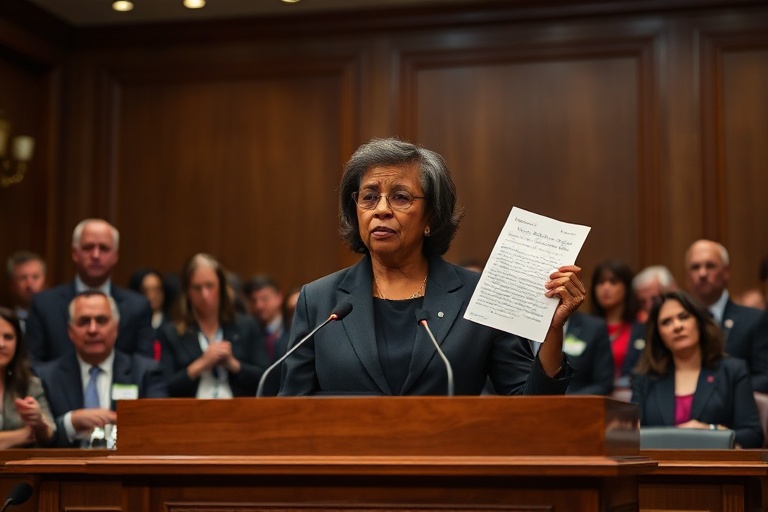
The recent letter from U.S. Representative Virginia Foxx, addressing proposed changes to higher education funding and accreditation standards, has sent shockwaves beyond Capitol Hill. While the letter targets domestic policy reforms, its implications resonate internationally, particularly in nations where education systems rely heavily on U.S.-style accreditation frameworks. Foxx, a long-standing figure in American politics and former chair of the House Education and Labor Committee, has framed her argument around concerns over academic freedom, institutional autonomy, and the financial burden on taxpayers.
Her intervention arrives at a critical juncture. Global education systems are grappling with the aftermath of the COVID-19 pandemic, rising tuition costs, and growing skepticism toward standardized evaluation metrics. In Europe, where the Bologna Process emphasizes cross-border academic recognition, Foxx’s letter has triggered discussions about whether U.S. policy shifts could disrupt international student mobility. Meanwhile, in Asia, where universities increasingly seek U.S. accreditation to enhance global standing, educators are monitoring the debate closely.
The Core Arguments in Virginia Foxx’s Letter
Foxx’s letter, addressed to Secretary of Education Miguel Cardona, centers on three primary concerns. First, she argues that proposed increases in federal oversight over accrediting agencies could stifle innovation in higher education. Second, she warns that expanded Pell Grant eligibility might dilute the value of federal aid without improving student outcomes. Finally, she expresses unease over potential restrictions on religiously affiliated institutions, which she claims could infringe on their right to maintain faith-based curricula.
These points reflect broader ideological divides in American education policy. Supporters of Foxx’s position often emphasize local control, market-driven solutions, and skepticism toward centralized bureaucratic oversight. Critics, however, argue that her stance overlooks systemic inequities in access to higher education and the need for accountability in student loan policies.
Across the Atlantic, European policymakers have taken note. The European University Association (EUA) released a statement expressing concern that any rollback of federal oversight in the U.S. could create inconsistencies in cross-border academic recognition. “If U.S. accreditation standards become more fragmented, it could complicate the mobility of students and faculty within the European Higher Education Area,” noted EUA Secretary General Amanda Crowfoot.
A Global Perspective: How U.S. Policy Shapes International Education
The influence of U.S. higher education policy extends far beyond its borders. American accreditation agencies—such as the Middle States Commission on Higher Education and the Western Association of Schools and Colleges—are trusted by universities in over 100 countries. When U.S. policies shift, these institutions often follow suit, adjusting their own standards to maintain alignment.
Consider the case of Australia. The country’s Tertiary Education Quality and Standards Agency (TEQSA) has historically mirrored aspects of U.S. accreditation models. When Foxx’s letter gained traction, Australian education officials convened an emergency meeting to assess potential impacts. “We cannot afford to create barriers for Australian students seeking to study in the U.S. or for U.S. institutions operating here,” said TEQSA CEO Peter Coaldrake.
In Africa, where many universities partner with U.S. institutions for research and curriculum development, the debate has sparked conversations about dependency. “There is a growing movement toward self-sufficiency in African higher education,” explained Dr. Wanjiru Kamau-Rutenberg, Director of African Women in Science. “But when U.S. policies shift, it forces us to question how much we rely on external validation.”
This global interconnectedness highlights a paradox: while U.S. policies often set the tone for international education trends, they can also create instability when they undergo rapid changes. Foxx’s letter is not just a domestic issue; it is a test case for how education systems worldwide adapt to shifting geopolitical and ideological currents.
The Cultural Divide: Academic Freedom vs. Accountability
The tension between academic freedom and accountability is not unique to the U.S. In fact, it is a defining feature of global higher education debates. In countries like Germany, where tuition is largely free, the focus is on ensuring high-quality education without excessive bureaucracy. In contrast, nations like South Korea prioritize rigorous evaluation systems to maintain global competitiveness.
Foxx’s letter taps into this cultural divide. Her emphasis on protecting religious and ideological freedoms resonates with conservative education advocates in Europe and Latin America. Meanwhile, progressive educators in Canada and Scandinavia view her arguments as a threat to inclusive, equitable education systems.
This ideological clash is evident in the reactions from international think tanks. The London-based Higher Education Policy Institute (HEPI) published a report arguing that Foxx’s proposals could exacerbate inequities in student access. “If accreditation becomes more decentralized, it risks creating a two-tier system where elite institutions thrive while under-resourced schools struggle,” noted HEPI Director Nick Hillman.
On the other side, the Brussels-based Centre for European Policy Studies (CEPS) has expressed cautious support for Foxx’s concerns about federal overreach. “There is merit in questioning whether centralized accreditation truly serves the public good,” said CEPS Senior Research Fellow Claire Dhéret. “But the solution is not less oversight—it’s smarter oversight.”
What’s Next? The Path Forward for Global Education Policy
As Foxx’s letter continues to generate debate, the question remains: What happens next? Domestically, the letter has galvanized both supporters and critics. Progressive advocacy groups, such as Education for All, have launched campaigns to counter Foxx’s arguments, emphasizing the need for increased federal investment in historically Black colleges and minority-serving institutions. Meanwhile, conservative think tanks, including the Heritage Foundation, have praised Foxx’s stance as a necessary defense against what they describe as “bureaucratic overreach.”
Internationally, the conversation is likely to evolve in two key ways. First, universities outside the U.S. may begin to diversify their accreditation strategies, seeking alternatives to U.S.-based agencies. The International Network for Quality Assurance Agencies in Higher Education (INQAAHE) has already begun discussions on creating a more globally balanced system. Second, governments may take a more proactive role in shaping education policies that align with local values rather than importing foreign models.
The outcome of this debate could redefine the future of global higher education. Will the world move toward a more decentralized, culturally diverse system? Or will U.S. influence continue to dominate, albeit with increasing scrutiny and resistance?
One thing is certain: the ripple effects of Virginia Foxx’s letter will be felt for years to come. As education systems worldwide navigate the complexities of funding, accreditation, and academic freedom, the stakes could not be higher.
Key Takeaways from Virginia Foxx’s Letter
- Federal Oversight: Foxx argues that increased federal control over accreditation could stifle innovation.
- Pell Grant Expansion: She warns that broader eligibility might not improve student outcomes.
- Religious Institutions: Foxx expresses concern that policy changes could restrict faith-based education.
- Global Impact: The letter has triggered discussions in Europe, Asia, and Africa about the future of education standards.
- Cultural Divide: The debate highlights tensions between academic freedom and accountability worldwide.
As the conversation unfolds, one question lingers: Can global education systems find a balance between local values and international standards? Virginia Foxx’s letter may not provide the answer, but it has undeniably pushed the world closer to asking the right questions.