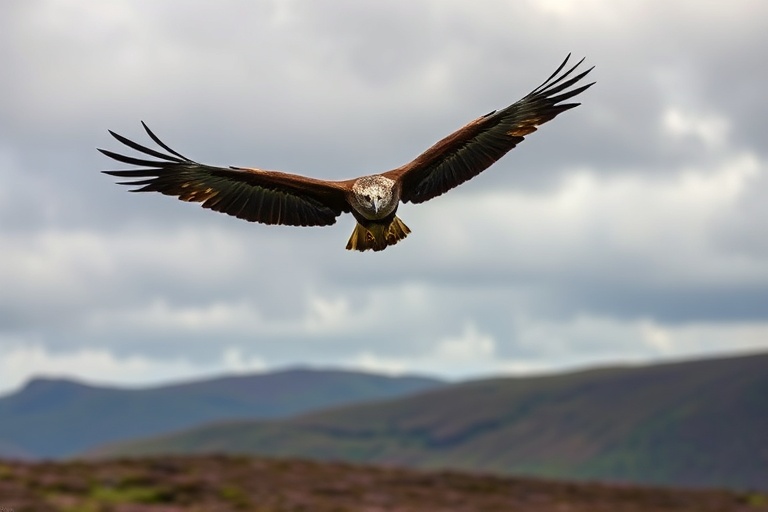
White-tailed Eagles Return to Exmoor After 240-Year Absence
The windswept moorlands of Exmoor National Park have become an unlikely battleground for one of Britain’s most ambitious wildlife restoration projects. In a carefully planned operation, conservationists have reintroduced white-tailed eagles to this historic landscape, a species absent from England for more than 240 years. This landmark initiative represents not just a triumph of ecological engineering, but a cultural reckoning with humanity’s fraught relationship with apex predators.
The project, led by the Roy Dennis Wildlife Foundation and Natural England, follows successful reintroductions in Scotland and the Isle of Wight. For Exmoor, a region known for its rugged beauty and rich biodiversity, the return of the white-tailed eagle—Europe’s largest bird of prey—marks a pivotal moment in rewilding efforts across the UK. But the initiative has sparked more than just scientific interest; it has ignited debates about land use, local livelihoods, and the very meaning of wilderness in a crowded island nation.
From Extinction to Reintroduction: The Eagle’s Long Absence
White-tailed eagles, or sea eagles, once soared over much of Britain, their wingspans reaching nearly eight feet. Yet by the late 18th century, they had vanished from England, hunted to local extinction through a combination of persecution, habitat loss, and poisoning. The last recorded nesting pair in England was recorded in the Lake District in 1780. For generations, the species existed only in memory—embedded in folklore and place names, but absent from the living ecosystem.
The Royal Society for the Protection of Birds (RSPB) has long championed the return of lost species, including the white-tailed eagle. Their research shows that apex predators play a crucial role in maintaining ecological balance by regulating prey populations and preventing overgrazing. On Exmoor, where red deer and sheep numbers are tightly managed, the eagle’s presence could help diversify natural predation patterns and reduce pressure on ground-nesting birds.
“This isn’t just about bringing back a bird,” said a spokesperson from the Roy Dennis Wildlife Foundation. “It’s about restoring a missing piece of our natural heritage. These eagles were once part of the rhythm of these hills. Their absence left a silence we’re only now beginning to understand.”
How the Reintroduction Unfolded: Science, Strategy, and Secrecy
The reintroduction began in earnest in August 2023, when 16 young white-tailed eagles—raised in a controlled environment in Scotland—were released into a secluded valley on Exmoor. The birds were fitted with GPS trackers and monitored around the clock. The first two weeks were critical: many young eagles face high mortality rates as they learn to hunt and avoid human activity.
To minimize disturbance, the release site was chosen for its remoteness and low visitor numbers. The project team worked closely with local landowners and the Exmoor National Park Authority to establish buffer zones and public awareness campaigns. Rangers conducted guided walks to explain the eagles’ ecological role and addressed concerns about livestock predation.
According to Natural England’s reintroduction protocol, the project follows a phased approach:
- Phase 1: Initial release and monitoring (2023–2025)
- Phase 2: Nesting support and habitat enhancement (2025–2028)
- Phase 3: Population establishment and public engagement (2028–2035)
Early data shows promising signs. Several eagles have already explored neighboring counties, with one individual traveling as far as Dorset. Satellite tracking reveals they are feeding primarily on rabbits and carrion—minimizing conflict with livestock. “The birds are behaving exactly as we hoped,” said Dr. Helen Riley of the University of Exeter, a lead researcher on the project. “They’re avoiding urban areas and focusing on natural prey.”
Community Reactions: From Skepticism to Support
Not everyone on Exmoor greeted the eagles with enthusiasm. Farmers and shepherds voiced concerns about potential attacks on lambs, despite evidence from Scotland showing white-tailed eagles rarely target live livestock. The National Farmers’ Union (NFU) issued a cautious statement calling for full compensation schemes and independent monitoring.
Local tourism operators, however, see the eagles as a potential draw. Wildlife tour companies on Exmoor have begun offering eagle-spotting excursions, positioning the birds as a new flagship species for nature-based tourism. Early bookings suggest strong interest from birdwatchers and photographers keen to witness the return of a lost giant.
A survey conducted by the Exmoor Society in early 2024 found that 62% of residents supported the reintroduction, up from 45% in 2022. The shift reflects growing awareness of the ecological and economic benefits of large predators. “People are starting to see this not as a risk, but as an opportunity,” said a local guide who leads walks near the release site. “The eagles give us a story to tell—one that connects us to the land in a deeper way.”
Rewilding the Mind: Beyond the Birds
The white-tailed eagle project is part of a broader movement reshaping conservation in the UK. Rewilding initiatives—once controversial—are gaining traction as climate change and biodiversity loss demand radical action. The Knepp Estate in Sussex and the Wild Ennerdale project in the Lake District have shown that restoring natural processes can revitalize landscapes and economies.
On Exmoor, the eagles are being used as a flagship species to catalyze habitat restoration. Woodland regeneration, wetland creation, and reduced grazing pressure are all expected to benefit from the presence of such a high-profile predator. Conservationists hope the project will inspire similar reintroductions elsewhere in England, including the proposed return of lynx to the Forest of Dean.
Yet challenges remain. Climate change is altering prey availability, and illegal persecution—though declining—still threatens birds of prey in the UK. The project team has emphasized education and enforcement, including a dedicated hotline for reporting disturbances.
As the first breeding season approaches, all eyes are on Exmoor. Will the eagles stay? Will they nest? And perhaps most importantly, will people learn to live alongside them? The answers may well define the future of conservation in Britain.
The white-tailed eagle’s return is more than a scientific experiment—it is a quiet revolution in how we see our place in nature. In a land where humans have long claimed dominion, these birds remind us that we are not separate from the wild, but part of it. Their wings, cutting through the mist over Exmoor, carry a message older than any policy or plan: that restoration is possible, if we dare to try.