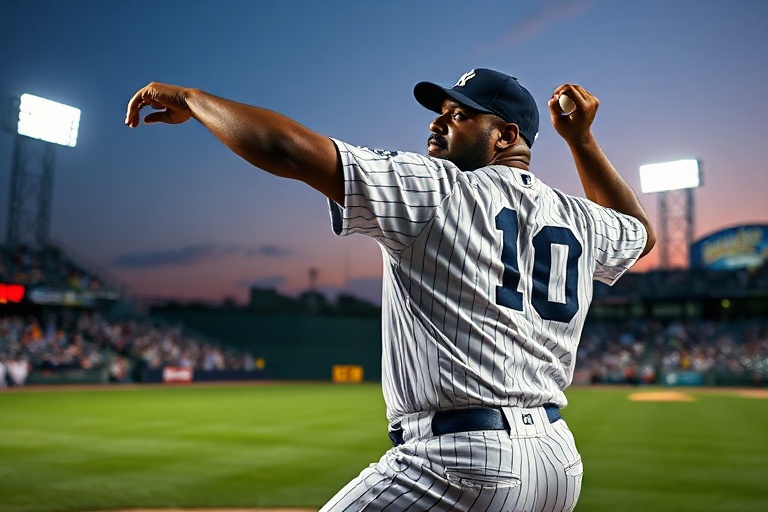
Few pitchers in Major League Baseball history have left as indelible a mark on the game as C.C. Sabathia. Over two decades, Sabathia transitioned from a dominant young starter in Cleveland to a World Series champion in the Bronx, becoming a cultural touchstone for baseball fans across generations. His career was defined not just by statistics or accolades, but by his ability to adapt, lead, and inspire—qualities that resonated far beyond the diamond.
Sabathia’s journey began in California, where he emerged as one of the most promising pitching prospects in the late 1990s. Drafted 20th overall by the Cleveland Indians in 1998, he quickly proved himself as a force to be reckoned with. By age 21, he was already a staple in the Indians’ rotation, posting a 10-5 record with a sparkling 3.42 ERA in his rookie season. His fastball-slider combination overwhelmed hitters, and his poise on the mound belied his youth.
The Cleveland Years: Establishing a Legacy
Sabathia spent seven seasons in Cleveland, where he became the face of the franchise. During that time, he evolved from a promising young arm into one of baseball’s most consistent aces. In 2003, he posted a 17-10 record with a 3.60 ERA, but it was his 2001 campaign that truly announced his arrival. That year, he went 17-5 with a 4.39 ERA, striking out 147 batters in 180.1 innings. More importantly, he led the Indians to the playoffs, a sign of things to come.
By the mid-2000s, Sabathia had cemented his reputation as one of the game’s most durable and dominant pitchers. He logged over 200 innings in five consecutive seasons, a rarity in an era where pitch counts and innings limits were increasingly emphasized. His ability to pitch deep into games made him invaluable to the Indians, who relied on his leadership in a rotation that often lacked depth.
Sabathia’s impact extended beyond the field. In Cleveland, he became a symbol of hope for a fanbase hungry for postseason success. Though the Indians fell short of a World Series during his tenure, his performances in high-pressure moments—such as his 2007 playoff run—solidified his status as a franchise icon. That year, he went 19-7 with a 3.21 ERA, earning his first All-Star selection and finishing third in Cy Young voting.
The Move to Milwaukee and New York: A Global Impact
In 2008, Sabathia’s career took a pivotal turn when he was traded to the Milwaukee Brewers midseason. The move was both a challenge and an opportunity. Milwaukee, a small-market team, had not reached the playoffs in nearly 30 years. Sabathia’s arrival changed that. Over the final two months of the season, he went 11-2 with a 1.65 ERA, leading the Brewers to the postseason for the first time since 1982. His performance earned him the National League Cy Young Award, a testament to his ability to elevate any team he joined.
Sabathia’s success in Milwaukee caught the attention of the New York Yankees, who acquired him in 2009. The trade was a blockbuster, one that signaled the Yankees’ intent to reclaim their place atop baseball’s hierarchy. Sabathia’s arrival in the Bronx was more than a roster upgrade—it was a statement. The Yankees had not won a World Series since 2000, and Sabathia was seen as the missing piece.
That season, Sabathia delivered. He went 19-8 with a 3.37 ERA, anchoring a rotation that also featured Andy Pettitte and A.J. Burnett. More importantly, he thrived in the postseason, pitching 20 innings over three starts in the playoffs, including a masterful seven-inning outing in Game 7 of the World Series against the Philadelphia Phillies. The Yankees won their 27th championship, and Sabathia’s legacy as a big-game pitcher was secured.
A Cultural Icon in the Bronx
Sabathia’s time in New York transformed him into a global figure. The Yankees were—and remain—one of baseball’s most scrutinized and celebrated franchises, and Sabathia’s ability to perform under the microscope made him a fan favorite. His leadership was evident in the way he mentored younger pitchers, such as Phil Hughes and Joba Chamberlain, and his presence in the clubhouse was a stabilizing force during both highs and lows.
Sabathia’s cultural impact extended beyond baseball. He was a vocal advocate for social justice, using his platform to address issues such as racial inequality and police brutality. In 2020, he joined other athletes in speaking out after the killing of George Floyd, emphasizing the need for change. His willingness to use his voice for activism resonated with fans who saw him not just as a pitcher, but as a leader.
The Final Chapter: A Farewell to Baseball
Sabathia’s career began to wind down in the early 2010s as injuries and age took their toll. He battled knee problems and shoulder issues, undergoing surgeries that limited his effectiveness in his final years. Yet, he refused to call it quits, making one last stand in 2019 when he returned from the injured list to pitch in the Yankees’ bullpen during the playoffs. His emotional postgame interviews, where he often teared up while thanking fans, became some of the most memorable moments of that postseason.
Sabathia retired after the 2019 season, ending a career that spanned 19 years and included 251 wins, 3,093 strikeouts, and six All-Star selections. He left behind a legacy that transcended statistics. Sabathia was the rare pitcher who could dominate in both the regular season and the playoffs, a leader who elevated every team he joined, and a voice who used his platform for meaningful change.
In retirement, Sabathia has remained involved in baseball, serving as a commentator and analyst for the Yankees’ YES Network. His insights and storytelling have endeared him to a new generation of fans, ensuring that his influence on the game will continue long after his final pitch.
Lessons from Sabathia’s Career
Sabathia’s journey offers several lessons for athletes and fans alike. First, his ability to adapt—whether to a new team, a new role, or a changing game—highlighted the importance of flexibility in a sport that often values specialization. Second, his leadership demonstrated that success is not solely measured by personal accolades, but by the ability to elevate those around you. Finally, his willingness to speak out on social issues underscored the power of athletes to drive change beyond the field.
For baseball fans, Sabathia’s career was a reminder of what makes the sport special. It was not just about home runs or no-hitters, but about the human stories that unfold over 162 games and postseason battles. Sabathia’s story—from a small-town California kid to a World Series champion to a cultural icon—was a testament to the enduring appeal of baseball as both a game and a reflection of society.
As the sport continues to evolve, Sabathia’s legacy serves as a benchmark for what it means to be a complete pitcher and a complete person. His career was defined by more than wins and losses; it was defined by the moments that mattered, both on and off the field.
For those who followed his career, C.C. Sabathia will always be remembered as one of the greats—a pitcher who redefined modern baseball and left an indelible mark on the game.