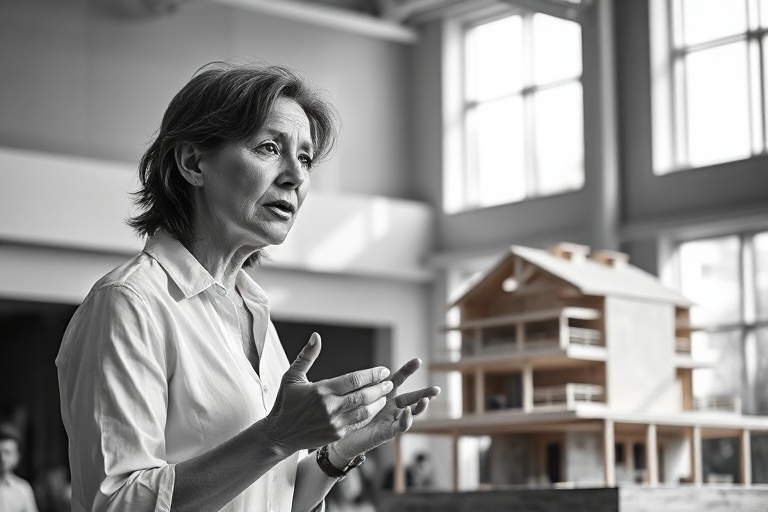
Dian Forrester: How Minimalist Design Transforms Modern Living
Dian Forrester’s influence in the design world extends far beyond the sleek lines of her projects or the muted tones of her color palettes. Over the past decade, she has quietly redefined how we perceive functionality in architecture, proving that beauty and utility need not exist in separate dimensions. Her work challenges the conventional wisdom that form must surrender to function—or vice versa—by weaving both into a seamless narrative that feels intuitive rather than imposed.
Forrester’s approach is rooted in a deep understanding of human behavior, a principle that often goes unnoticed in the glossy pages of design magazines. She doesn’t just design spaces; she curates experiences, ensuring that every element serves a purpose while contributing to the overall harmony of the environment. This philosophy has earned her a dedicated following among architects, interior designers, and even urban planners who see her as a pioneer in sustainable yet striking design.
The Philosophy Behind Forrester’s Designs
At the core of Forrester’s work is a commitment to what she terms “active simplicity”—a design ethos that prioritizes clarity without sacrificing depth. This isn’t minimalism for the sake of minimalism, but rather a deliberate stripping away of the superfluous to reveal the essential. Her projects often feature clean surfaces, uncluttered layouts, and materials left in their natural state, yet the results feel anything but austere. Instead, they exude a quiet confidence, as if the spaces themselves are inviting you to slow down and observe.
Forrester’s background in both fine arts and structural engineering provides a unique lens through which she views design. This dual perspective allows her to navigate the often-contentious divide between aesthetics and pragmatism. She has spoken in interviews about the importance of “listening to the space” before imposing a design, a concept that underscores her collaborative approach with clients and communities alike.
Key Tenets of Forrester’s Design Philosophy
- Contextual Sensitivity: Forrester’s designs are deeply rooted in their surroundings, whether urban, rural, or coastal. She avoids the one-size-fits-all mentality, instead tailoring each project to its environment and the people who will use it.
- Material Integrity: She champions the use of raw, sustainable materials—think reclaimed wood, untreated stone, and recycled metals—arguing that these elements carry their own stories and reduce the environmental footprint of construction.
- Human-Centered Functionality: Every design decision, from the height of a countertop to the placement of a window, is made with the end-user in mind. Forrester’s spaces are designed to be lived in, not just admired.
- Timelessness Over Trends: She avoids fleeting design fads, opting instead for solutions that will remain relevant and functional for decades. This long-term thinking aligns with her belief in design as a public service rather than a commercial endeavor.
Notable Projects and Their Impact
Forrester’s portfolio spans private residences, public institutions, and even temporary installations, each project serving as a case study in her evolving methodology. One of her most celebrated works is the Ridgeview Community Center in upstate New York, a project that reimagined the traditional community hub as a fluid, multi-purpose space. The building’s design incorporates passive solar heating, rainwater harvesting, and modular interiors that can adapt to the needs of the community over time.
The project received widespread acclaim for its ability to balance sustainability with social impact. Unlike many eco-conscious designs that prioritize green technology over user experience, Ridgeview felt immediately livable. Its open-air corridors, flooded with natural light, encouraged interaction among visitors, while its low-impact materials ensured minimal environmental disruption. The success of Ridgeview has since influenced a wave of community-focused architecture, proving that sustainable design can be both pragmatic and poetic.
Another standout is Forrester’s restoration of the historic Lakeshore Pavilion, a mid-century structure in danger of being demolished due to structural neglect. Rather than opting for a full rebuild, Forrester chose to preserve the original bones of the building while introducing subtle modern interventions. The result was a hybrid of old and new that retained the Pavilion’s original charm while making it accessible and functional for contemporary use. The project became a blueprint for adaptive reuse, demonstrating how heritage conservation can coexist with modern design imperatives.
The Broader Implications of Forrester’s Work
Forrester’s influence extends beyond the blueprints and construction sites. Her ideas have seeped into broader conversations about the role of design in society, particularly in an era of rapid urbanization and environmental degradation. She argues that design is not a luxury but a necessity—a tool for addressing some of the most pressing challenges of our time, from housing shortages to climate change.
Her emphasis on human-centered design has also sparked a reevaluation of how we measure the success of architectural projects. Traditionally, metrics like cost efficiency, square footage, and aesthetic appeal have dominated the conversation. Forrester, however, introduces a new criterion: emotional resonance. How does the space make people feel? Does it foster connection, creativity, or peace? These questions are increasingly being adopted by designers and developers who recognize that the most enduring spaces are those that leave a lasting impression on the human psyche.
Moreover, Forrester’s advocacy for sustainable materials and passive design strategies has placed her at the forefront of the green building movement. As governments and corporations scramble to meet carbon-neutrality targets, her work serves as a reminder that sustainability doesn’t require sacrificing beauty or functionality. In fact, her projects suggest that the most sustainable designs are often the most elegant, proving that less can indeed be more.
A Legacy Still Unfolding
At 54, Forrester shows no signs of slowing down. She continues to take on ambitious projects, from a net-zero energy school in Scandinavia to a series of micro-housing units in dense urban centers. Her recent foray into digital design tools—specifically, the use of AI to simulate human movement within a space—has also begun to turn heads. While some purists balk at the idea of machines influencing design, Forrester sees it as another tool to deepen her understanding of human behavior, much like the sketches and models she’s relied on for decades.
Yet, despite her growing reputation, Forrester remains grounded. She frequently cites her mentors—anonymous craftspeople, her grandmother’s thrifty upcycling, and the anonymous hands that built the structures she now admires—as her true teachers. This humility is perhaps her most enduring design principle: the belief that great design is a collective effort, not the product of a single visionary.
As we move further into an era defined by complexity and uncertainty, the clarity and purpose of Forrester’s work feel more relevant than ever. She doesn’t offer easy solutions or quick fixes, but she does provide a roadmap for creating spaces that are not only functional and beautiful but also deeply human. In a world that often feels fragmented, her designs serve as quiet anchors, reminding us of the power of intention and the beauty of simplicity.
For those looking to understand the future of design, Dian Forrester’s body of work is a good place to start. It’s a testament to the idea that the most impactful designs are not those that shout for attention, but those that listen first.