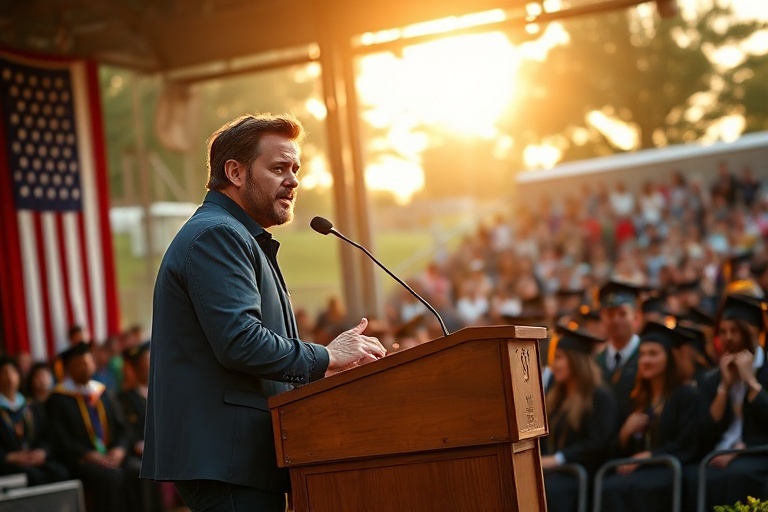
Eric Church’s recent commencement address at his alma mater, the University of North Carolina at Charlotte, was more than a routine speech. It was a moment where a genre-defining artist stripped away the glamour of superstardom to speak directly to the next generation about authenticity, resilience, and the value of staying true to oneself. Church, known for his unfiltered persona both on and off stage, delivered a message that resonated far beyond the usual platitudes of commencement rhetoric.
What made this speech stand out was its raw honesty. Church didn’t sugarcoat the challenges ahead for graduates. Instead, he framed them as necessary steps toward growth. His words carried weight because they came from someone who had climbed the ladder of success while repeatedly rejecting the trappings that often come with it. For a generation accustomed to curated social media personas, Church’s refusal to conform to expectations struck a chord.
The Core Messages of Church’s Speech
Church’s commencement address was structured around three central themes: self-belief, perseverance, and the importance of forging your own path. These themes weren’t just abstract ideals; they were rooted in his personal journey, making them relatable to the audience of recent graduates.
He opened with a reflection on his own college years, describing the uncertainty he felt as a young student unsure of his future. That uncertainty, he argued, was not a sign of failure but a natural part of the process. His advice to the graduates was simple: trust the journey, even when the destination is unclear. This message was particularly timely in an era where young people often feel pressured to have their lives mapped out by graduation day.
Church also emphasized the importance of surrounding yourself with the right people. He credited much of his success to the mentors, friends, and family who supported him during his most vulnerable moments. For graduates entering an unpredictable job market, this reminder about the value of community was both timely and practical.
Key Takeaways from Eric Church’s Commencement Speech
- Authenticity over conformity: Church urged graduates to embrace their individuality rather than conforming to external expectations. He shared stories of turning down opportunities that didn’t align with his values, even when they seemed lucrative.
- Resilience in the face of rejection: He recounted early rejections in his career, including being dropped by a record label, and how those setbacks shaped his resolve. His message was clear: failure is not the opposite of success but a part of it.
- The power of self-belief: Church stressed that confidence isn’t about arrogance but about trusting your instincts. He encouraged graduates to back their own judgment, even when others doubted them.
- Community as a foundation: He highlighted the role of relationships in achieving long-term success, urging graduates to cultivate meaningful connections rather than superficial networks.
Why Church’s Message Resonated Beyond Graduation Halls
While commencement speeches are often seen as ceremonial, Church’s address had broader implications for how we view success in modern America. His critique of the traditional metrics of achievement—wealth, fame, and status—offered a counter-narrative to the relentless pursuit of external validation that dominates social media and corporate culture.
Church’s speech also tapped into a growing cultural shift. Younger generations, particularly Millennials and Gen Z, are increasingly prioritizing purpose over paychecks. They seek careers that align with their values and reject the idea that success is measured solely by financial gain. Church’s emphasis on staying true to oneself struck a nerve in a society where authenticity is often commodified but rarely practiced.
Moreover, his speech challenged the narrative that success is a linear path. In an era where career trajectories are often non-traditional—marked by gig work, freelance hustles, and entrepreneurial pivots—Church’s acknowledgment of detours and dead ends felt refreshingly honest. His words validated the experiences of those who don’t fit into the conventional 9-to-5 mold.
The Broader Cultural Impact of Church’s Words
Church’s commencement speech wasn’t just a feel-good moment for graduates; it was a cultural touchstone. In an age where public figures often shy away from vulnerability, his willingness to share his struggles resonated deeply. His message aligned with a broader movement toward mental health awareness and the destigmatization of failure.
His speech also intersected with ongoing conversations about the role of artistry in modern society. Church, who has spent his career pushing back against industry norms, embodies a form of creative rebellion. His refusal to conform to the expectations of country music—whether in his sound, image, or business dealings—has made him a symbol of artistic integrity. For a generation that values self-expression, his career serves as both inspiration and proof that staying true to yourself can lead to success on your own terms.
Church’s address also highlighted the importance of regional identity in shaping success. Hailing from a small town in North Carolina, he never lost touch with his roots, even as he achieved national fame. This connection to place and community is something many young people today are rediscovering, whether through remote work, local activism, or a renewed interest in small-town living. Church’s speech subtly validated that connection, framing it as a strength rather than a limitation.
A Call to Action for Graduates and Beyond
Church’s commencement speech wasn’t just a collection of uplifting quotes; it was a call to action. He challenged graduates to redefine success on their own terms, to embrace uncertainty, and to prioritize relationships over transactions. These are not just lofty ideals but practical guidelines for navigating a world that often feels chaotic and unpredictable.
For those entering the workforce, his message was particularly pertinent. The job market is increasingly competitive, and the traditional pathways to success are no longer guaranteed. Church’s advice to trust the process and stay resilient offers a roadmap for those who feel overwhelmed by the pressure to have it all figured out immediately.
His speech also serves as a reminder that success is not a one-size-fits-all concept. Whether you’re a musician, an entrepreneur, or a recent graduate, the path to achievement looks different for everyone. What matters most is the willingness to keep moving forward, even when the destination is unclear.
Church’s words are a testament to the power of authenticity in a world that often rewards conformity. His refusal to play by the rules—whether in music, business, or life—has made him a standout figure in country music and a voice of reason for a generation seeking meaning in a material world.
As graduates take their first steps into the world, Church’s speech offers more than just inspiration. It provides a framework for building a life that is both successful and fulfilling, on your own terms.
For those interested in exploring more about how authenticity shapes success in creative fields, check out our Culture section, where we dive into the stories behind artists who’ve bucked trends and stayed true to themselves. You can also explore our Education category for more insights on navigating career paths and personal growth.