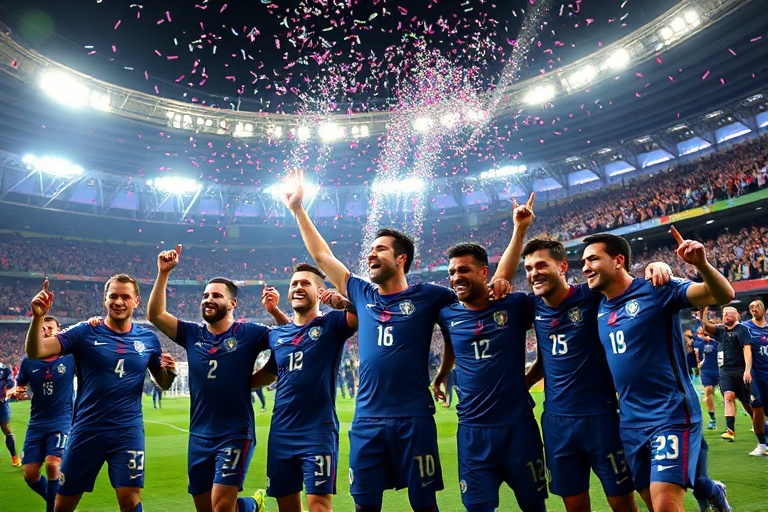
The French national football team has long stood as a symbol of excellence on the global stage, blending raw talent with tactical sophistication. As the squad prepares for the next World Cup cycle, anticipation builds around a generation of players who carry both the weight of history and the promise of innovation. France’s approach to squad construction reflects a broader cultural narrative—one where diversity, technical skill, and relentless competition converge to create a formidable force.
This year’s selection process has been closely watched, not just for individual performances but for how the team’s identity continues to evolve. With stars from Ligue 1, the Premier League, and domestic leagues across Europe, France’s squad embodies a cosmopolitan footballing philosophy. The French Football Federation (FFF) has carefully curated a roster that balances youthful exuberance with seasoned leadership, ensuring both depth and dynamism.
The cultural significance of this squad extends beyond the pitch. France, a country with a rich immigrant heritage, has often found its national identity reflected in its football teams. The current squad is no exception, featuring players of diverse backgrounds who represent the multicultural fabric of modern France. This diversity is not merely symbolic; it translates into a tactical versatility that opponents struggle to counter.
The Core of the Squad: A Star-Studded Midfield
At the heart of France’s ambitions lies a midfield that has redefined creativity in modern football. Players like Aurélien Tchouaméni and Eduardo Camavinga bring a blend of defensive solidity and progressive passing, while the return of Paul Pogba—if fit—adds an extra dimension of flair and experience. This midfield trio, when fully operational, forms a nucleus that can control games with both precision and power.
But the midfield’s depth doesn’t end there. Warren Zaïre-Emery, the teenage sensation from Paris Saint-Germain, has already demonstrated a maturity beyond his years. His ability to read the game and dictate tempo is reminiscent of France’s golden generation that won the 2018 World Cup. The squad’s midfield options reflect a strategic foresight, ensuring continuity even when key players are unavailable due to injury or suspension.
Key Midfielders in France’s World Cup Squad
- Aurélien Tchouaméni (Real Madrid) – The anchor, known for his ball-winning and distribution.
- Eduardo Camavinga (Real Madrid) – The all-rounder with elite vision and athleticism.
- Paul Pogba (Free Agent) – The creative force with a knack for game-changing moments.
- Warren Zaïre-Emery (Paris Saint-Germain) – The young prodigy with a mature footballing brain.
The cohesion of this midfield unit will be pivotal in France’s campaign. Their ability to transition from defense to attack seamlessly will determine how effectively France can impose its style on opponents. The technical staff has emphasized the importance of fluid movement and positional interchange, a hallmark of some of the world’s best teams.
Defensive Resilience: The Backbone of France’s Success
France’s defensive structure has often been the bedrock of its success, and the current squad is no different. With defenders like William Saliba and Jules Koundé marshaling the backline, France boasts a combination of physicality and technical ability that few teams can match. Saliba, in particular, has emerged as a leader, his composure under pressure and ability to play out from the back making him indispensable.
Complementing Saliba and Koundé are full-backs who offer both defensive security and attacking impetus. Theo Hernández and Benjamin Pavard provide width and creativity, while Ferland Mendy offers reliability and tactical discipline. The depth in defense is further bolstered by the likes of Ibrahima Konaté, whose presence alongside Saliba forms a partnership that has already shown its potential at both club and international level.
The defensive unit’s strength lies not just in individual quality but in the collective understanding of the system. Under Didier Deschamps, France has perfected a low-block approach that frustrates opponents while allowing for quick transitions. This tactical flexibility has been a defining feature of France’s World Cup-winning side, and it remains a cornerstone of their strategy.
The Attacking Arsenal: Balancing Experience and Youth
France’s attacking options are as diverse as they are dangerous. Kylian Mbappé, the team’s talisman, leads a forward line that blends raw speed with clinical finishing. Mbappé’s partnership with players like Antoine Griezmann and Ousmane Dembélé creates a dynamic that few teams can contain. The addition of young talents like Bradley Barcola and Randal Kolo Muani adds a fresh dimension, ensuring that France’s attack remains unpredictable.
However, the challenge for Deschamps will be managing the egos and ambitions of such a star-studded lineup. The French squad is stacked with attacking talent, but not all can play simultaneously. The coaching staff must find a way to integrate all these players while maintaining a cohesive system. This is where the depth of France’s squad becomes both an advantage and a challenge.
Mbappé’s role will be crucial. As the focal point of the attack, his ability to score and create will be vital. But the squad’s success will also depend on the contributions of players who operate in less glamorous roles—pressuring defenders, tracking back, and linking play. This collective effort is what has defined France’s best performances in major tournaments.
The Cultural Impact: More Than Just Football
France’s World Cup squad is more than a collection of talented individuals; it is a reflection of the country’s evolving identity. The team’s diversity is a testament to France’s multicultural society, where players of African, Caribbean, and European descent come together to represent a unified nation. This diversity is not just a political statement; it is a tactical asset that allows France to adapt to different opponents and situations.
The squad’s multicultural makeup also resonates globally, particularly in regions with strong ties to France. For many young players around the world, seeing their peers succeed in the French team serves as an inspiration. This cultural reach extends France’s influence beyond the football pitch, reinforcing its role as a global leader in both sport and society.
Moreover, the team’s style of play—characterized by technical skill, tactical intelligence, and physicality—has influenced football trends worldwide. France’s approach to squad building and player development is closely studied by other nations, making it a benchmark for footballing excellence.
Conclusion: The Path Ahead
As France prepares for the next World Cup, the squad stands at a crossroads. The blend of experience and youth, diversity and unity, offers a compelling narrative for both fans and analysts. The challenge ahead is to harness this potential and translate it into success on the biggest stage.
Didier Deschamps, the team’s manager, has emphasized the importance of humility and hard work. “We have a great squad, but talent alone is not enough,” he has said. “We must be united, disciplined, and ready to fight for each other.” This ethos has defined France’s previous successes, and it will be crucial in the tournaments to come.
For fans of sports and football enthusiasts worldwide, the France World Cup squad represents more than just a team—it is a symbol of what can be achieved through talent, diversity, and collective effort. As the campaign unfolds, the world will be watching, ready to witness another chapter in France’s storied footballing legacy.