What is the Video Assistant Referee (VAR)?
The Video Assistant Referee, commonly known as VAR, represents one of the most significant technological advancements in modern football. Introduced to reduce human error and enhance fairness, VAR allows match officials to review decisions using video footage and a headset for communication. The system operates under strict protocols, focusing on four key match-changing situations: goals, penalties, direct red cards, and mistaken identity.
VAR was first trialed in 2016 and implemented in top leagues by 2018, including the English Premier League, La Liga, and the UEFA Champions League. Its adoption followed public pressure after high-profile refereeing errors, such as Frank Lampard’s disallowed goal in the 2010 World Cup or the infamous “Hand of God” in 1986. The technology aims to uphold the integrity of the game by ensuring that critical decisions are accurate, even if it means interrupting the flow of play.
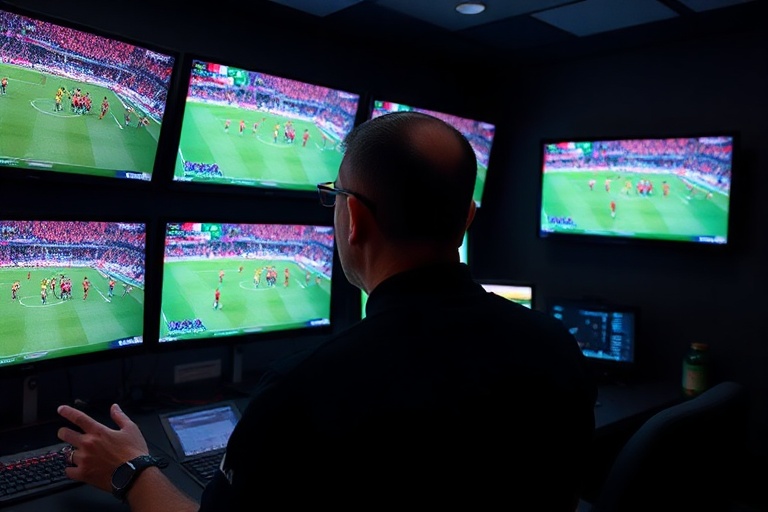
The process begins when a “clear and obvious error” is suspected. A VAR team, consisting of a lead video assistant referee and assistant referees, reviews the incident in real time. They communicate their findings to the on-field referee, who can choose to change the decision, conduct an on-pitch review, or maintain the original call. This system has sparked both praise and criticism, with debates over its impact on the spontaneity and emotion of football.
The Technology Behind VAR: Tools and Limitations
VAR relies on a combination of high-definition cameras, slow-motion replays, and specialized software. Most professional matches use between eight to sixteen broadcast cameras, some of which are equipped with ultra-motion capabilities to capture up to 500 frames per second. This level of detail is crucial for determining offside calls, handball decisions, and contact fouls.
The VAR hub is typically located in a central facility, such as the one at Stockley Park in England, where the Video Assistant Referee team operates. They have access to all camera angles, including those not broadcast to the public. The system is designed to be as objective as possible, but interpretation still plays a role—especially in subjective calls like foul intensity or intent.
Despite its sophistication, VAR is not without limitations. One major challenge is the “clear and obvious error” threshold. What constitutes a clear error can vary among referees, leading to inconsistencies. Another issue is the time taken for reviews, which sometimes disrupts the natural rhythm of the game. For example, in the 2022 World Cup, the average VAR review lasted 67 seconds, raising concerns about prolonged stoppages.
Additionally, VAR’s effectiveness depends heavily on the quality of camera angles. In lower-tier leagues or amateur matches, the absence of multiple high-definition cameras can render VAR ineffective. This disparity highlights the financial and logistical barriers to widespread implementation.
Controversies and Public Reception
VAR has become one of the most polarizing innovations in football history. Supporters argue that it has corrected egregious errors and restored faith in refereeing. For instance, in the 2019 Champions League semi-final between Tottenham and Ajax, a crucial offside decision was overturned, allowing Spurs to advance. Without VAR, the outcome might have been dramatically different.
Critics, however, contend that VAR has made the game less enjoyable by removing spontaneity and introducing excessive delays. A 2023 study by FIFA found that fans at stadiums often disapproved of VAR interventions due to the lack of immediate clarity. The frustration is palpable when a goal is disallowed for a marginal offside or a penalty is awarded for minimal contact.
Another contentious issue is the subjective nature of certain calls. Handball decisions, for example, have been widely debated. FIFA’s ever-changing interpretations of what constitutes a handball—culminating in the 2020-21 rule change—have left players and managers confused. Even Pep Guardiola, a vocal critic, admitted that VAR has “killed the joy” of scoring goals in some instances.
The emotional toll on players is also notable. Stars like Cristiano Ronaldo and Mohamed Salah have expressed frustration over decisions that went against them, while others like Lionel Messi have benefited from VAR overturns. The inconsistency in application has led to calls for a more standardized approach, though achieving uniformity remains a challenge.
Fan Reactions: A Divided Stance
- Supporters of VAR: Argue that it brings fairness and reduces referee bias. They point to high-profile cases where clear injustices were corrected.
- Detractors of VAR: Believe it disrupts the flow of the game and diminishes the human element. Many fans prefer to accept referee decisions as part of football’s charm.
- Neutral Observers: Suggest that VAR is a necessary evil in an era of high-stakes football, but improvements in transparency and speed are essential.
The Future of VAR: Innovations and Challenges
The evolution of VAR is already underway, with several key developments on the horizon. One promising innovation is the introduction of semi-automated offside technology, trialed in the 2022 World Cup. This system uses limb-tracking sensors and artificial intelligence to determine offside positions in real time, reducing the margin for error.
Another area of focus is improving communication between referees and fans. The use of on-screen graphics and live explanations could enhance transparency, allowing spectators to understand why a decision was made. The Premier League has experimented with pitch-side monitors, where referees review incidents themselves, though this has been met with mixed reactions.
However, challenges persist. The cost of implementing VAR remains prohibitive for many leagues, particularly in developing football nations. There are also concerns about over-reliance on technology, which could further erode the authority of on-field referees. FIFA and IFAB (International Football Association Board) continue to refine the rules, but finding the right balance between accuracy and game flow will take time.
Looking ahead, VAR’s role may expand beyond football. Sports like rugby, basketball, and tennis have shown interest in adopting similar systems, though each poses unique challenges. For football, the goal remains clear: to harness technology without losing the soul of the game.
Conclusion: Balancing Technology and Tradition
VAR has undeniably transformed football, offering a lifeline to fairness in an era where every decision is scrutinized. While it has corrected monumental errors and reduced referee controversies, it has also introduced new frustrations, from prolonged reviews to inconsistent interpretations. The technology’s future hinges on addressing these issues through innovation and collaboration.
Football will always be a sport of passion, and VAR, for all its flaws, is here to stay. The challenge now is to refine it—to make it faster, clearer, and more universally accepted. Until then, debates will rage on, but one thing is certain: the game will continue to evolve, with technology playing an ever-growing role.
For fans eager to stay updated on VAR’s latest developments, Dave’s Locker Sports provides in-depth analysis and breaking news. Whether you’re a supporter or a skeptic, the conversation around VAR is far from over.