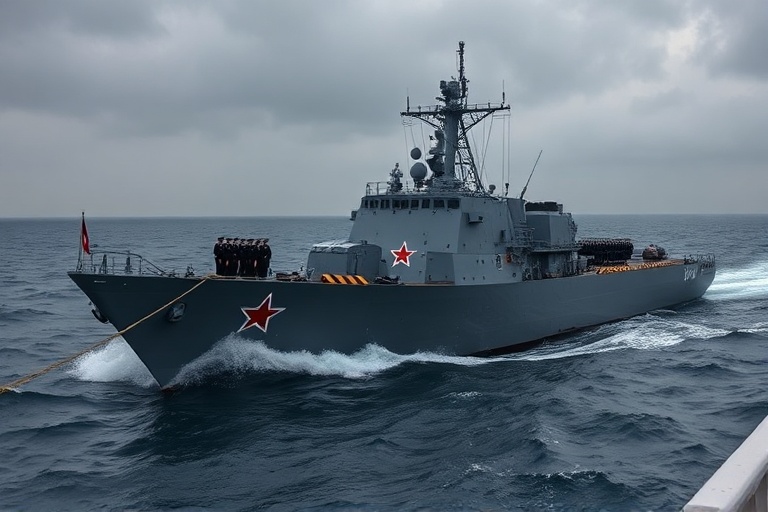
North Korea has long been shrouded in secrecy, particularly when it comes to its military capabilities. Yet, the unveiling of the Choe Hyon destroyer has sent ripples beyond the Korean Peninsula. Commissioned in 2021, this vessel represents more than just a new addition to Pyongyang’s fleet—it signals a deliberate shift in naval strategy, one that demands closer examination.
The Choe Hyon, named after a revered North Korean revolutionary figure, is the country’s most advanced surface combatant to date. With a displacement of around 3,000 tons, it dwarfs previous North Korean warships, showcasing capabilities that include anti-ship missiles, surface-to-air defense systems, and modern radar technology. While state media hailed it as a “symbol of self-reliance,” analysts see it as a calculated move to project power beyond coastal waters.
Technical Specifications: What Makes the Choe Hyon Stand Out
Understanding the Choe Hyon requires looking beyond its imposing silhouette. The destroyer’s design incorporates elements reminiscent of Soviet-era naval architecture, but with distinct modifications tailored to North Korea’s needs. Below are the key technical features that set it apart:
- Displacement and Size: Estimated at 3,000 tons, the Choe Hyon is nearly three times larger than North Korea’s previous flagship, the Najin-class frigate. Its length of approximately 120 meters allows for expanded operational range.
- Armament: The vessel is equipped with multiple anti-ship missiles, including what appear to be extended-range variants of the Kumsong-3 (a North Korean copy of the Russian Kh-35). It also features a 100mm main gun and close-in weapon systems.
- Radar and Sensors: Reports suggest the use of a 3D air-search radar, likely derived from Chinese or Russian models, enabling detection of airborne threats at greater distances.
- Propulsion: The Choe Hyon is powered by diesel engines, a practical choice for North Korea given fuel constraints. However, the exact configuration remains classified.
- Stealth Features: While not a true stealth design, the destroyer incorporates angular surfaces and reduced radar cross-section elements, possibly to evade detection.
These features collectively suggest that the Choe Hyon is intended for blue-water operations, a significant departure from North Korea’s traditional coastal defense doctrine. The vessel’s endurance and firepower indicate a focus on power projection, particularly in scenarios involving blockade-running or interdiction missions.
Strategic Implications: Why This Destroyer Matters
The introduction of the Choe Hyon is not merely an engineering achievement—it is a geopolitical statement. North Korea’s navy has long been dismissed as a relic of the Cold War, consisting of aging submarines and small missile boats. The Choe Hyon challenges that perception, forcing regional actors to reassess Pyongyang’s naval ambitions.
For South Korea, the destroyer represents a direct threat to its maritime dominance. The Choe Hyon’s range could allow it to operate near critical shipping lanes, including those used by U.S. and allied forces. This complicates naval exercises like the joint drills between South Korea and the U.S., which often aim to deter North Korean aggression.
For Japan, the destroyer’s presence in the Sea of Japan (East Sea) raises concerns about potential disruptions to commercial shipping or even provocative actions near disputed territories, such as the Dokdo/Takeshima islands. Tokyo has already accelerated its own naval modernization in response, highlighting the cascading effects of Pyongyang’s military advances.
Beyond Northeast Asia, the Choe Hyon’s emergence aligns with North Korea’s broader strategy of leveraging asymmetric capabilities to counter conventional military superiority. By fielding a modern destroyer, Pyongyang is signaling that it can project force asymmetrically, even if its overall naval strength remains inferior to regional powers.
Domestic and International Reactions
North Korea’s state media has framed the Choe Hyon as a triumph of Juche ideology, emphasizing self-sufficiency and technological prowess. Images of the destroyer’s commissioning ceremony were broadcast domestically, with Kim Jong Un personally inspecting the vessel. This propaganda effort serves to bolster the regime’s legitimacy, particularly at a time when economic sanctions and international isolation weigh heavily on the country.
Internationally, the reaction has been mixed. The United States and its allies view the Choe Hyon as a provocation, further complicating efforts to engage North Korea diplomatically. The U.N. Security Council has yet to issue a formal response, but diplomatic sources suggest that discussions are underway to address what some see as a violation of existing arms control resolutions.
China, North Korea’s primary ally, has adopted a cautious stance. While Beijing has not publicly criticized Pyongyang’s naval expansion, it has also not endorsed the move. This reflects China’s delicate balancing act—maintaining strategic ties with North Korea while avoiding actions that could escalate tensions in the region.
Broader Context: North Korea’s Naval Ambitions in the 21st Century
The Choe Hyon is not an isolated development. It is the latest in a series of steps North Korea has taken to modernize its navy, albeit incrementally. Over the past decade, Pyongyang has introduced new submarines, missile boats, and coastal defense systems, all aimed at overcoming its qualitative inferiority to regional navies.
This modernization reflects a broader shift in North Korea’s military strategy. Traditionally, the Korean People’s Army (KPA) Navy focused on coastal defense, with an emphasis on swarming tactics using small, fast vessels. However, the Choe Hyon suggests a move toward a more balanced fleet, capable of operating in deeper waters. This could enable North Korea to challenge maritime blockades, disrupt shipping, or even conduct limited power projection in the Yellow Sea or East Sea.
Yet, significant challenges remain. North Korea’s industrial base is constrained by sanctions, limiting its ability to produce advanced naval platforms at scale. The Choe Hyon itself may have required extensive foreign assistance or reverse-engineering of existing designs. Additionally, the country’s chronic fuel shortages could hinder sustained operations, even with a modern destroyer.
Despite these limitations, the Choe Hyon’s introduction underscores North Korea’s determination to remain a relevant military power, regardless of its economic struggles. It also highlights the limitations of sanctions, which have failed to curb Pyongyang’s military advancements. As regional powers recalibrate their strategies, the Choe Hyon serves as a reminder that North Korea’s naval ambitions are evolving—and that complacency is not an option.
What’s Next for North Korea’s Navy?
The commissioning of the Choe Hyon raises several questions about North Korea’s future naval plans. Will Pyongyang build more destroyers of this class, or was the Choe Hyon a one-off experiment? Could we see a larger fleet of such vessels in the coming years? And how will regional powers respond to this growing threat?
The answers to these questions will depend on a mix of technical, economic, and political factors. North Korea’s ability to sustain naval modernization will hinge on its access to foreign technology and components, despite sanctions. Meanwhile, the international community will need to decide whether to escalate diplomatic pressure or explore new avenues for dialogue.
One thing is certain: the Choe Hyon has rewritten the script for North Korea’s naval narrative. Whether this script leads to conflict or cooperation remains to be seen—but there is no denying that Pyongyang has made its intentions clear.
For now, the Choe Hyon stands as a silent sentinel, a symbol of North Korea’s resilience and ambition. How the world chooses to interpret its presence will shape the balance of power in Northeast Asia for years to come.