Portland vs Montréal: How Two Cities Shape Urban Futures
By [Your Name]
Published:
The Urban Philosophies Behind Portland and Montréal
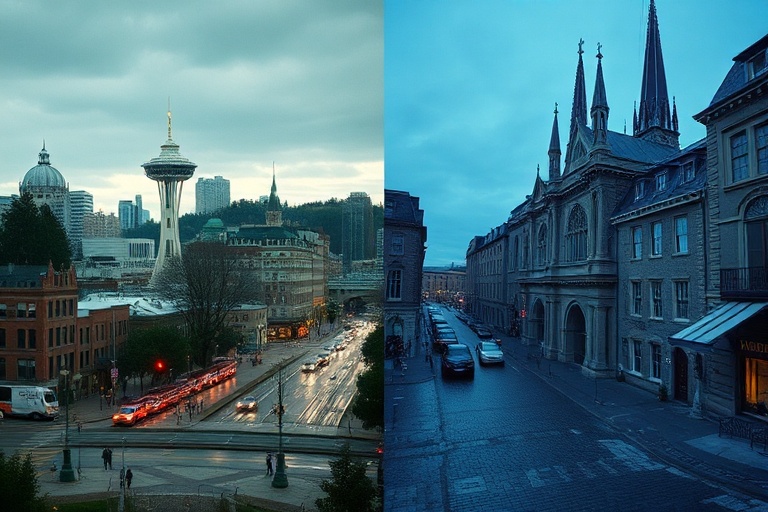
Portland and Montréal may both be known for their vibrant cultures, but their urban philosophies couldn’t be more different. Portland, Oregon, embraces an ethos of minimalism and sustainability, where bike lanes outnumber highways and local businesses thrive under strict zoning laws. The city’s 2035 Growth Concept plan prioritizes density over sprawl, ensuring that neighborhoods remain walkable and green spaces plentiful.
Montréal, on the other hand, thrives on controlled chaos. The city’s urban fabric blends historic European charm with modern multiculturalism, where narrow streets twist into hidden courtyards and vibrant murals cover every other alleyway. Montréal’s urban planning is less about restrictive zoning and more about adaptive reuse—abandoned factories become condos, and century-old churches transform into tech hubs. This flexibility has allowed the city to evolve organically, fostering a dynamic where the past and future coexist seamlessly.
These contrasting approaches reveal two distinct visions of urban life: one where order and intention guide growth, and another where spontaneity and reinvention dictate the city’s rhythm.
Cultural Economy: How Each City Supports Its Creative Class
The way each city nurtures its creative class speaks volumes about its priorities. Portland’s economy runs on small-scale craftsmanship. The city’s famous food carts, indie breweries, and artisan coffee roasters operate under a business-friendly but tightly regulated environment. The city’s Food scene, for example, is dominated by hyper-local purveyors who benefit from Portland’s lack of sales tax and strong support for local agriculture.
Montréal’s creative economy, meanwhile, thrives on institutional support and international collaboration. The city invests heavily in arts and culture, funding festivals like the Just for Laughs comedy festival and subsidizing film production through provincial tax credits. This has turned Montréal into a global hub for gaming, animation, and music, attracting international talent while maintaining affordability in key artistic neighborhoods like Mile End.
Where Portland’s creative economy feels like a cottage industry—organic, grassroots, and slightly insular—Montréal’s feels like a well-oiled machine, leveraging global connections without sacrificing its local identity.
A Tale of Two Transit Systems
Public transit reveals another layer of their differences. Portland’s MAX Light Rail and streetcar system are efficient but limited in scope, serving a metro area of just 2.5 million people. The city’s transit-oriented development policies have successfully concentrated growth along transit corridors, but outside these lines, car dependency remains a stubborn reality for many residents.
Montréal’s metro, by contrast, is a marvel of mid-century engineering and public artistry. Opened in 1966, the system’s 68 stations are adorned with mosaics, sculptures, and stained glass, turning daily commutes into cultural experiences. With four lines intersecting at key hubs like Berri-UQAM, the metro handles over 1.3 million daily riders, making it one of the busiest systems in North America per capita. The city’s integrated bus and bike-sharing networks further reduce car reliance, creating a transit ecosystem that feels both ambitious and user-friendly.
These transit systems reflect broader philosophies: Portland’s is pragmatic and incremental, while Montréal’s is bold and aspirational.
Key Differences in Transit
- Coverage: Portland’s system is streamlined but limited; Montréal’s is extensive and interconnected.
- Design: Portland favors functionality; Montréal prioritizes aesthetics and public art.
- Integration: Portland’s bike lanes complement transit; Montréal’s metro integrates seamlessly with buses and BIXI bikes.
- User Experience: Portland’s system is easy to navigate but feels utilitarian; Montréal’s is a destination in itself.
Broader Implications: What These Cities Teach Us About Urban Futures
The choices made by Portland and Montréal offer valuable lessons for cities worldwide. Portland’s model demonstrates how intentional planning and sustainability can create livable spaces, even as it grapples with housing affordability and homelessness. Its approach appeals to cities seeking to balance growth with environmental stewardship, proving that density doesn’t have to come at the cost of quality of life.
Montréal’s adaptability, meanwhile, shows how cities can reinvent themselves without losing their soul. By embracing change while preserving heritage, Montréal has become a magnet for young professionals and artists, all while maintaining a cost of living far below that of other major North American cities. Its success suggests that flexibility and cultural investment may be just as crucial as physical infrastructure in shaping the cities of tomorrow.
Both cities also highlight the role of governance in urban development. Portland’s strict zoning laws and growth boundaries are the result of decades of advocacy by environmental and neighborhood groups. Montréal’s more permissive approach reflects a history of civic engagement and a willingness to experiment with public-private partnerships. These governance models reveal that there’s no one-size-fits-all solution—each city’s path is shaped by its unique political and social context.
As climate change and housing crises force cities to rethink their futures, Portland and Montréal serve as contrasting case studies. One offers a blueprint for sustainable restraint; the other, a masterclass in reinvention. The question isn’t which model is superior, but how cities can borrow from both to create environments that are livable, dynamic, and equitable.
Final Thoughts
Portland and Montréal may be separated by thousands of miles and distinct cultures, but their urban experiments offer universal insights. Whether through Portland’s disciplined sustainability or Montréal’s fluid adaptability, each city provides a lens into the possibilities—and challenges—of modern urban life. For planners, policymakers, and residents alike, the takeaway is clear: the best cities aren’t those that rigidly adhere to a single philosophy, but those that evolve by learning from both order and spontaneity.
As debates over urban futures intensify, these two cities remind us that there’s more than one way to build a better city—just as long as the people who live in them remain at the heart of the process.