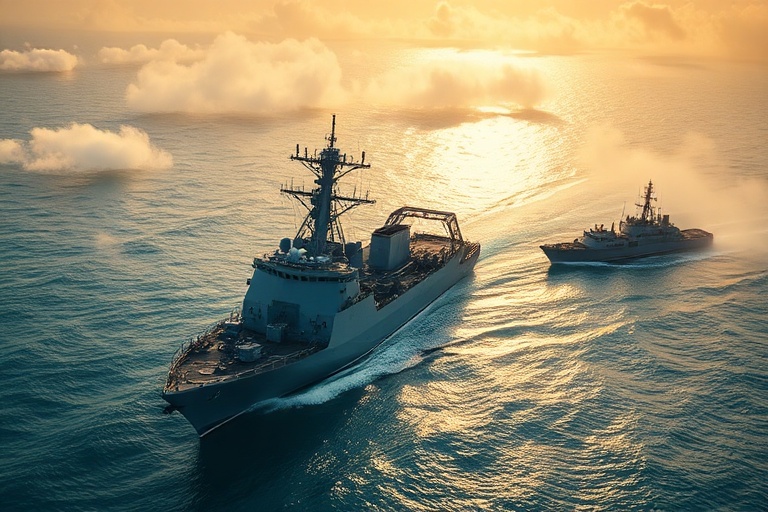
South China Sea Conflict: Why U.S.-China Tensions Are Escalating
Analyzing the escalating geopolitical rivalry that could reshape global maritime security
The South China Sea: A High-Stakes Geopolitical Chessboard
The South China Sea has emerged as one of the most volatile flashpoints in U.S.-China relations, where competing territorial claims, military posturing, and economic interests collide. Stretching over 3.5 million square kilometers, this maritime region is crisscrossed by critical shipping lanes that carry $3.4 trillion in annual trade—roughly one-third of global maritime commerce. The sea also sits atop vast oil and natural gas reserves, estimated at 190 trillion cubic feet of natural gas and 11 billion barrels of oil.
China’s sweeping “nine-dash line” claim, which encompasses about 90% of the South China Sea, has drawn objections from Brunei, Malaysia, the Philippines, Taiwan, and Vietnam. The Permanent Court of Arbitration in The Hague ruled in 2016 that China’s claims had no legal basis, a decision Beijing has consistently ignored. Meanwhile, the United States maintains that it takes no position on territorial disputes but insists on freedom of navigation and overflight—principles it enforces through regular naval patrols known as Freedom of Navigation Operations (FONOPs).
Key Features of the Dispute
- Strategic Islands: China has reclaimed and militarized several reefs and atolls, including Mischief Reef, Subi Reef, and Fiery Cross Reef, constructing runways, radar facilities, and missile systems.
- Militarization: Beijing has deployed surface-to-air missiles, anti-ship cruise missiles, and electronic jamming equipment on its artificial islands.
- Gray Zone Tactics: Chinese vessels use maritime militia, coast guard ships, and fishing boats to harass rival claimants without triggering full-scale conflict.
- U.S. Alliance Network: Washington has strengthened defense ties with the Philippines, Vietnam, and Malaysia through joint exercises and access agreements.
Why the U.S. and China Are Locked in a Maritime Rivalry
The South China Sea dispute is not merely about rocks and reefs—it is a proxy for a broader struggle for influence in the Indo-Pacific. For China, control over these waters is essential to projecting naval power into the Pacific, securing resource access, and enforcing its maritime borders. The People’s Liberation Army Navy (PLAN) has rapidly expanded, becoming the world’s largest fleet by number of ships, and the South China Sea serves as its forward operating base.
For the United States, the region is the cornerstone of its Indo-Pacific strategy, designed to counterbalance China’s rise. Since 2012, the U.S. has conducted more than 100 FONOPs, challenging excessive maritime claims by China and others. These operations are not just symbolic; they are backed by a network of alliances and partnerships that include Australia, Japan, and India. The U.S. also conducts bilateral and multilateral exercises such as the Rim of the Pacific (RIMPAC) and the Malabar series with India.
“The South China Sea is where the rubber meets the road in U.S.-China strategic competition. It’s not just about who controls the waves—it’s about who sets the rules of the road for the 21st century.” — Dr. Mira Rapp-Hooper, Senior Fellow at the Yale Law School Center for Global Legal Challenges
The stakes are clear: dominance in the South China Sea would allow China to dictate maritime norms, restrict access to rival powers, and potentially choke off trade routes in a crisis. Conversely, a U.S.-led coalition could contain Chinese expansion, preserve open sea lanes, and uphold the rules-based international order.
The Human and Economic Cost of Escalation
Beyond geopolitics, the South China Sea dispute has real-world consequences for millions of people. Over 6 million fishermen operate in these waters, and territorial tensions have led to violent confrontations, vessel seizures, and loss of life. In 2019, a Vietnamese fishing boat was sunk by a Chinese coast guard vessel near the Paracel Islands, sparking protests in Vietnam. Similarly, the Philippines has reported multiple incidents of Chinese vessels blocking its resupply missions to the Second Thomas Shoal, where a small contingent of marines is stationed on a grounded warship.
Economically, the region’s instability threatens global supply chains. Any disruption—whether from conflict, piracy, or coercive diplomacy—could trigger price spikes in energy, electronics, and consumer goods. Shipping insurance premiums in high-risk zones have already risen, and multinational corporations are factoring geopolitical risk into their logistics planning.
Economic and Environmental Risks
- Disrupted Trade: Over 12,000 ships pass through the South China Sea annually, including 80% of China’s crude oil imports.
- Fisheries Decline: Overfishing and habitat destruction from island-building have reduced fish stocks by an estimated 70-95% in some areas.
- Environmental Damage: Coral reefs, critical to marine biodiversity, have been destroyed by dredging and construction.
- Energy Security: Vietnam and the Philippines have canceled oil exploration deals under Chinese pressure, limiting regional energy development.
What’s Next? Scenarios and Diplomatic Pathways
The trajectory of U.S.-China tensions in the South China Sea will be shaped by three possible scenarios: escalation, stabilization, or managed competition. Each carries distinct risks and opportunities for global stability.
Possible Futures
- Escalation: A miscalculation—such as a collision during a FONOP or a clash between coast guards—could trigger a crisis. China might declare an Air Defense Identification Zone (ADIZ), while the U.S. could impose sanctions or increase military presence.
- Stabilization: Diplomatic breakthroughs, such as a Code of Conduct (CoC) between China and ASEAN, could reduce tensions. However, progress has been slow due to China’s insistence on bilateral negotiations and its refusal to include enforcement mechanisms.
- Managed Competition: Both sides may settle into a long-term rivalry, where competition is contained through confidence-building measures, hotlines, and crisis communication protocols.
One glimmer of hope lies in Track II diplomacy, where retired officials, academics, and NGOs facilitate dialogue. The Dave’s Locker Analysis section has covered similar efforts in other flashpoints, highlighting how unofficial channels can pave the way for de-escalation.
Another factor is public opinion. In Southeast Asia, surveys show growing unease over China’s assertiveness, particularly in the Philippines and Vietnam. This could push governments to seek stronger security guarantees from the U.S., further entrenching the U.S.-China divide.
“The South China Sea is a litmus test for whether the international community can uphold the rule of law in the face of revisionist powers. If we fail here, the precedent will echo across oceans and industries for decades.” — Rear Admiral (Ret.) James Goldrick, Australian naval strategist
Conclusion: A Watershed Moment for Global Order
The South China Sea is more than a regional dispute—it is a litmus test for the future of international law, military deterrence, and economic interdependence. The U.S. and China are engaged in a high-stakes game of brinkmanship, where the costs of miscalculation are catastrophic, but the rewards of dominance are transformative.
For smaller claimants like the Philippines and Vietnam, the challenge is to balance economic dependence on China with security partnerships with the U.S. For the global community, the imperative is to prevent this rivalry from spiraling into conflict that could disrupt trade, destabilize alliances, and redefine power structures for generations.
As diplomats grapple with solutions, one thing is certain: the South China Sea will remain a defining issue of the 21st century. Whether it becomes a flashpoint for war or a model for peaceful coexistence may well determine the shape of the world order in the decades ahead.
To stay informed on evolving developments in global security and maritime issues, follow updates in the Trending and Politics sections of Dave’s Locker.