The Metropolitan Line stands as a testament to London’s enduring commitment to public transportation. Opened in 1863, it was the world’s first underground railway, revolutionizing urban mobility. Today, it remains a vital artery in London’s transport network, connecting key destinations from the city’s core to its leafy northwestern suburbs.
Its legacy extends beyond mere functionality. The line’s architecture, engineering feats, and cultural impact have left an indelible mark on London’s identity. From its early steam-powered days to its modern electric operations, the Metropolitan Line has continually adapted while preserving its historic character.
A Brief History of the Metropolitan Line
The Metropolitan Railway’s inception was driven by necessity. By the mid-19th century, London’s streets were choked with horse-drawn carriages and pedestrians, making travel between the City of London and affluent suburbs like Paddington an ordeal. The solution? A subterranean railway.
Construction began in 1860 under the direction of civil engineer John Fowler. The line’s first section, from Paddington to Farringdon, opened on January 10, 1863, using steam locomotives. This inaugural stretch covered just 3.75 miles but sparked a transportation revolution. Within months, daily ridership exceeded 26,000 passengers—a clear sign that Londoners embraced the innovation.
The line expanded rapidly. By 1880, it reached Harrow, and in 1904, it extended to Uxbridge. The introduction of electric trains in 1905 marked another milestone, eliminating the need for steam and improving air quality in the tunnels. The Metropolitan Railway’s legacy endures in its name, which survives today in the modern London Underground network.
Key Milestones in the Line’s Evolution
- 1863: Opening of the world’s first underground railway (Paddington to Farringdon).
- 1880: Extension to Harrow, serving growing suburban communities.
- 1905: Transition to electric trains, improving efficiency and passenger comfort.
- 1933: Integration into the London Passenger Transport Board, becoming part of the unified Tube network.
- 2010s: Introduction of new rolling stock (S8 and S7 stock) to modernize the fleet.
Route and Key Destinations
The Metropolitan Line’s route is a study in contrasts. It begins in the heart of London at Aldgate, weaving through the financial district before venturing northwest into residential and commercial hubs. The line’s 34 stations span a distance of 42 miles, making it one of the longest in the London Underground system.
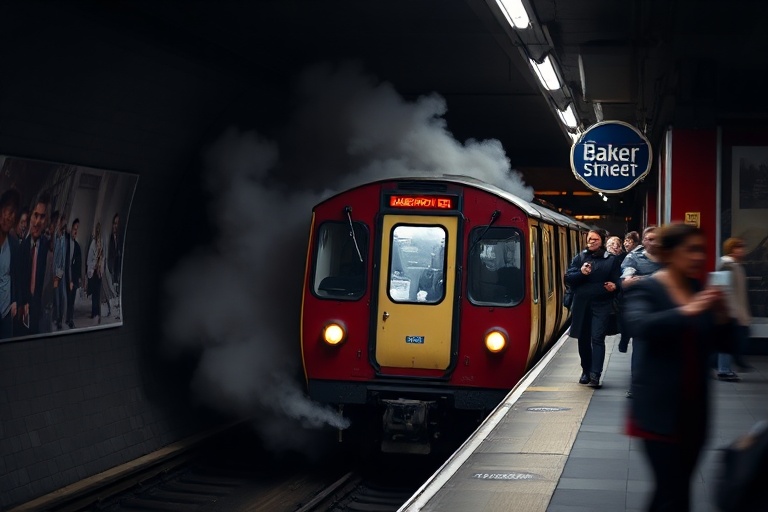
Its path includes some of London’s most iconic locations. At Baker Street, passengers can transfer to the Circle, Hammersmith & City, and Jubilee lines, as well as visit the Sherlock Holmes Museum. The line also serves Wembley Park, home to the iconic Wembley Stadium, and Moor Park, a gateway to the Chiltern Hills.
One of the line’s most distinctive features is its separation into two distinct services. The main line runs from Aldgate to Uxbridge, while the “Metropolitan line” branch serves stations like Watford, Amersham, and Chesham. This split reflects the line’s dual role as both a commuter service and a connector to outer suburban areas.
Notable Stations and Their Stories
- Aldgate: The line’s eastern terminus, located near the historic boundary of the City of London. The station’s name derives from a former medieval gate in the city wall.
- Baker Street: Famous for its connection to Sherlock Holmes, this station also serves as a major interchange hub.
- Harrow-on-the-Hill: A key junction where the Metropolitan Line splits into its two branches, serving as a gateway to northwest London’s suburbs.
- Amersham: The line’s most westerly station, serving the Chiltern Hills and providing access to rural landscapes.
Engineering and Operational Challenges
The Metropolitan Line’s construction was a feat of 19th-century engineering. Workers dug deep trenches and constructed brick-lined tunnels, a method that required meticulous planning and labor. The line’s original tunnels, some of which still operate today, were built to accommodate steam trains, a challenge that required innovative ventilation systems.
Modern challenges include maintaining the aging infrastructure while meeting the demands of a growing city. The introduction of new rolling stock, such as the S8 trains, has improved reliability and passenger comfort. However, the line still faces congestion during peak hours, particularly on its core sections between Baker Street and Harrow.
Another challenge is the line’s mixed service pattern. The split between the main line and the branch services can lead to uneven passenger distribution. Stations like Moor Park and Rickmansworth often experience lower ridership compared to central sections, raising questions about the efficiency of the current service model.
Innovations and Future Upgrades
- Automatic Train Operation: Trials are underway to introduce driverless trains on the Metropolitan Line, which could improve service frequency and reliability.
- Station Modernization: Projects like the upgrade of Wembley Park station aim to enhance passenger experience with better accessibility and amenities.
- Demand Management: Proposals to adjust service patterns could address uneven ridership and reduce overcrowding on key sections.
The Metropolitan Line in Popular Culture
The Metropolitan Line’s influence extends beyond transportation. It has inspired artists, writers, and filmmakers, becoming a symbol of London’s gritty, industrial past and its dynamic present. In literature, the line appears in works by Charles Dickens, who often referenced the chaos of London’s streets and railways. More recently, it has been featured in films like Sliding Doors and The World’s End, where its stations serve as backdrops for dramatic and comedic moments.
Music has also embraced the line. The 1970s progressive rock band Gentle Giant named one of their albums In a Glass House, inspired by the claustrophobic atmosphere of the Metropolitan Line’s tunnels. Meanwhile, contemporary musicians like Damon Albarn have referenced the line in their lyrics, capturing its role as a lifeline for Londoners.
Even in gaming, the Metropolitan Line has made appearances. Titles like London Underground: The Quiz Game challenge players to navigate the network, while strategy games like Railway Empire feature the line as a key route in their simulations of 19th-century rail travel.
Cultural References to the Metropolitan Line
- Film: The 2013 sci-fi film About Time features a pivotal scene set on the Metropolitan Line, where the protagonist uses his time-traveling abilities to alter his daily commute.
- Literature: In Zadie Smith’s novel White Teeth, the line serves as a metaphor for the multicultural fabric of London, with characters navigating its tunnels as they navigate their identities.
- Music: The song Metropolitan Line by the band The Long Blondes captures the line’s gritty, urban charm, with lyrics that evoke the hustle and bustle of its stations.
- Art: The Turner Prize-winning artist Mark Wallinger created a series of works inspired by the Metropolitan Line, including his installation Metro, which reimagined the line’s map as a work of abstract art.
Why the Metropolitan Line Still Matters
In an era dominated by high-speed rail and autonomous vehicles, the Metropolitan Line remains a vital part of London’s identity. It is more than just a mode of transport; it is a living museum of engineering and urban history. Its continued operation reflects London’s commitment to preserving its past while embracing the future.
The line also plays a crucial role in the city’s economy. By connecting business hubs like the City of London with residential areas, it supports commuter patterns that underpin the capital’s productivity. Additionally, its role in serving major events—such as football matches at Wembley Stadium—highlights its importance in facilitating large-scale gatherings.
For residents and visitors alike, the Metropolitan Line offers a glimpse into London’s soul. Whether it’s the grandeur of Baker Street station, the quiet charm of a rural terminus like Chesham, or the bustling energy of Aldgate, the line encapsulates the diversity and dynamism of one of the world’s greatest cities.
As London continues to grow and evolve, the Metropolitan Line stands ready to meet the challenges of the future. With ongoing upgrades and innovations, it will remain a cornerstone of the city’s transport network for generations to come.
For those looking to explore London’s history and culture, the Metropolitan Line is an essential journey. Board a train at any station, and you’ll find yourself not just traveling through space, but through time as well.
To learn more about London’s transport heritage, visit our Transport category on Dave’s Locker. For deeper insights into the city’s urban development, check out our Culture section.