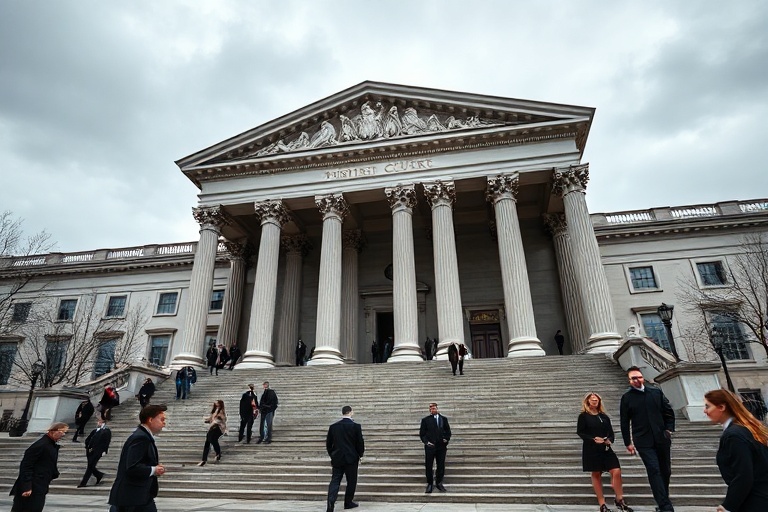
The Virginia Supreme Court stands as the highest judicial authority in the Commonwealth, shaping legal interpretations that ripple through state governance, civil liberties, and public policy. Established in 1776, it is one of the oldest appellate courts in the United States, with a legacy that reflects both historical continuity and evolving judicial philosophy. Unlike federal courts, which interpret the U.S. Constitution, the Virginia Supreme Court primarily interprets the Virginia Constitution and state statutes—making its decisions uniquely influential within the state’s legal framework.
Its role extends beyond mere adjudication. The court serves as a guardian of constitutional principles, a check on legislative and executive power, and a final arbiter in disputes that define the boundaries of individual rights and government authority. In an era marked by polarization and rapid social change, the Virginia Supreme Court often finds itself at the intersection of tradition and transformation, balancing deference to precedent with the demands of contemporary justice.
The Court’s Structure and Jurisdiction
The Virginia Supreme Court operates under a unique structure within the American judicial system. Comprising seven justices—including a chief justice—the court hears appeals primarily from the Court of Appeals of Virginia and, in rare instances, from the circuit courts. Unlike the U.S. Supreme Court, which selects its docket through discretionary review, the Virginia Supreme Court is largely bound by statute to hear most appeals, particularly in cases involving the death penalty, attorney discipline, or constitutional questions.
Its jurisdiction is divided into several key areas:
- Appellate Review: The court reviews decisions from lower courts, focusing on legal errors rather than factual disputes. This includes civil cases, criminal appeals, and matters involving administrative agencies.
- Original Jurisdiction: In limited instances, the court may hear cases directly, such as disputes between local governments or matters involving the removal of public officials.
- Disciplinary Actions: The court oversees the Virginia State Bar and handles attorney disbarment or suspension proceedings.
- Writs and Declaratory Judgments: It may issue writs such as habeas corpus or declaratory judgments to clarify legal rights without waiting for a full trial.
This structure ensures that the court remains accessible to litigants while maintaining a high standard of legal reasoning. However, it also places significant responsibility on the justices to interpret the law in ways that serve justice without overreaching into legislative or executive domains.
Notable Cases and Legal Precedents
The Virginia Supreme Court has issued rulings that have had far-reaching consequences, not only in Virginia but across the United States. One of its most consequential decisions came in Atkins v. Virginia (2002), where the court ruled that executing intellectually disabled individuals violated the Eighth Amendment’s prohibition against cruel and unusual punishment. This decision mirrored the U.S. Supreme Court’s ruling in the same case, reinforcing the state’s commitment to humane justice.
Another landmark case, Loving v. Virginia (1967), originated from a Virginia trial court before reaching the U.S. Supreme Court, which struck down state bans on interracial marriage. While the Virginia Supreme Court did not issue the final ruling, its earlier decisions in the case highlighted the state’s fraught history with racial equality—a legacy that continues to influence its jurisprudence.
The court has also played a pivotal role in shaping environmental law. In Virginia Uranium, Inc. v. Warren (2019), the court upheld a state ban on uranium mining, deferring to legislative authority while acknowledging the risks of nuclear contamination. This decision reflected a growing global trend toward prioritizing environmental protection over industrial expansion.
Recent Controversies and Social Impact
In recent years, the Virginia Supreme Court has faced scrutiny over its handling of cases involving civil rights, policing, and reproductive freedoms. One such case, Hill v. Commonwealth (2020), centered on the use of facial recognition technology by law enforcement. The court ruled that warrantless searches using such technology violated the state’s constitutional protections against unreasonable searches. This decision aligned Virginia with a growing number of states pushing back against unchecked surveillance.
Another contentious issue involved the court’s interpretation of the Virginia Constitution’s right to privacy. In Planned Parenthood v. Herring (2021), the court declined to recognize a constitutional right to abortion, leaving the regulation of reproductive rights to the legislature. This ruling occurred against the backdrop of national debates over abortion access, highlighting the court’s role as both a legal and political actor.
These cases underscore the court’s influence in shaping Virginia’s social landscape. While some applaud its restraint in deferring to elected officials, others argue that the court has missed opportunities to affirm fundamental rights. The tension between judicial restraint and active interpretation remains a defining feature of the court’s evolving identity.
The Court’s Global Influence and Comparative Perspectives
From a global perspective, the Virginia Supreme Court exemplifies the challenges faced by state-level judiciaries in balancing local autonomy with universal human rights principles. Unlike national supreme courts, such as those in Germany or India, which often grapple with federalism and constitutional supremacy, the Virginia Supreme Court operates within a unitary system where state law holds supremacy unless it conflicts with federal law.
Its decisions frequently draw comparisons to other common law systems, particularly in the United Kingdom and Canada, where courts similarly interpret constitutional texts while navigating social change. For example, the UK Supreme Court’s ruling in R (Miller) v. Prime Minister (2019), which limited the executive’s power to suspend Parliament, resonates with Virginia’s tradition of judicial checks on governmental authority.
Culturally, the court reflects Virginia’s complex history—from its colonial roots to its role in the Civil Rights Movement. Statues of Confederate generals once adorned its grounds, and its early rulings enforced segregationist laws. Today, the court grapples with modernizing its image while preserving its historical significance. In 2020, the court removed a portrait of a former justice who had authored racially discriminatory rulings, signaling a commitment to reckoning with its past.
The Future of the Virginia Supreme Court
Looking ahead, the Virginia Supreme Court faces several critical challenges. First is the issue of judicial diversity. Historically, the court has been dominated by white men, a reflection of Virginia’s political and legal elite. While recent appointments have included more women and people of color, advocates argue that systemic barriers persist in the selection process.
Second is the court’s relationship with the legislature. Virginia’s legislature, often controlled by a single party, has occasionally clashed with the court over issues such as redistricting and voting rights. The court’s role in policing gerrymandering—most notably in the Virginia House of Delegates v. Bethune-Hill (2019) case—has thrust it into the center of political debates about electoral fairness.
Finally, the court must navigate the broader erosion of public trust in institutions. Gallup polls consistently show declining confidence in the judiciary nationwide, and Virginia is no exception. To counter this, the court has increased transparency, livestreaming oral arguments and expanding public outreach. These efforts aim to demystify its work while reinforcing its legitimacy.
As Virginia continues to evolve, so too will the Virginia Supreme Court. Its decisions will shape not only the state’s legal landscape but also its cultural and political identity. In an era of rapid change, the court’s ability to uphold justice while adapting to new realities will determine its enduring relevance.
Conclusion
The Virginia Supreme Court is more than a legal institution—it is a reflection of Virginia’s past, present, and future. From its colonial origins to its modern-day rulings, the court has played a pivotal role in defining the boundaries of justice, equality, and governance. Its decisions echo beyond the state’s borders, offering lessons for legal systems worldwide.
Yet the court’s greatest challenge may be its own legacy. Can it reconcile its historical injustices with a commitment to progress? Can it balance deference to democratic processes with the protection of fundamental rights? These questions will define its next chapter. For now, the Virginia Supreme Court remains a vital force in American jurisprudence—a court that must constantly weigh the scales of justice in an ever-changing world.
For more analysis on legal trends in Virginia, visit our News section. To explore how state courts shape national policy, check out our Politics category.