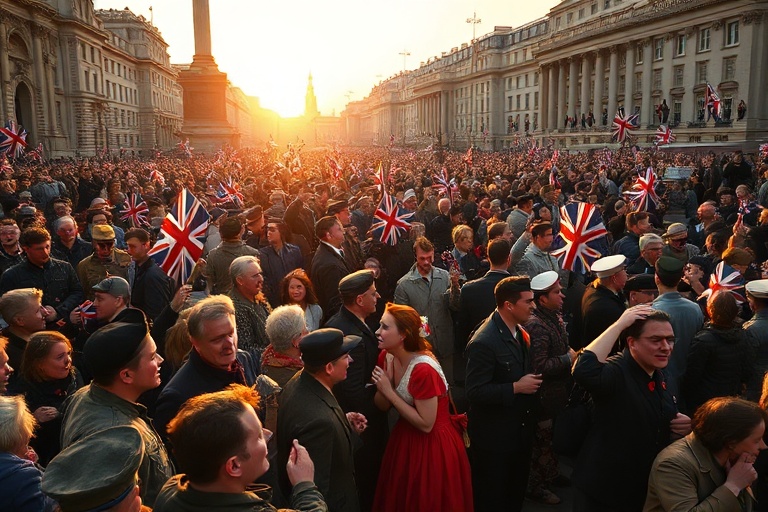
On May 8, 1945, the world exhaled. After nearly six years of global conflict, Nazi Germany had surrendered unconditionally, bringing World War II in Europe to a decisive end. The day became known as Victory in Europe Day—or VE Day—a moment of jubilation that echoed across continents. Cities from London to Los Angeles erupted in celebration, marking not just the defeat of fascism but the beginning of a new geopolitical order.
VE Day was more than a military triumph; it was a cultural and psychological turning point. The war had reshaped economies, displaced millions, and redefined national identities. The Allied victory on May 8 signaled the dawn of a new era, one where the United Nations would rise, empires would crumble, and the Cold War would soon cast its shadow. Decades later, VE Day remains a touchstone for understanding 20th-century history and its lasting consequences.
The Road to May 8, 1945: A War Unlike Any Other
World War II was a conflict of unprecedented scale and brutality. It began in 1939 with Germany’s invasion of Poland, followed by the rapid expansion of Nazi control across Europe. By 1941, the war had engulfed the Soviet Union, North Africa, and the Pacific, drawing in nations from every continent. The human cost was staggering: an estimated 70–85 million fatalities, including the systematic genocide of six million Jews in the Holocaust.
The Allied forces—led by the United States, the Soviet Union, the United Kingdom, and France—fought on multiple fronts, from the beaches of Normandy to the frozen steppes of Stalingrad. The Soviet Union bore the brunt of the war’s devastation, suffering over 20 million military and civilian deaths. Meanwhile, the Western Allies faced the brutal realities of total war, from the Blitz in London to the island-hopping campaigns in the Pacific.
By early 1945, Germany’s defeat was inevitable. The Soviet Red Army had pushed westward, liberating concentration camps and encircling Berlin. In the west, Allied forces had crossed the Rhine and advanced toward the heart of Nazi territory. Adolf Hitler committed suicide on April 30, and by May 7, his successor, Admiral Karl Dönitz, signed the unconditional surrender in Reims, France. The war in Europe was over.
May 8, 1945: A Day of Unbridled Joy and Lasting Consequences
The announcement of Germany’s surrender on May 8 sent shockwaves of relief and euphoria across the globe. In London, crowds gathered outside Buckingham Palace, singing and waving Union Jacks as King George VI and Prime Minister Winston Churchill appeared on the balcony. Churchill’s radio address that evening declared, “Our dear friends, the cause of freedom is safe.” In New York, Times Square filled with revelers, while in Moscow, Joseph Stalin’s speech emphasized the Soviet Union’s pivotal role in the victory.
Yet VE Day was not a moment of pure celebration. For many, the war’s end brought grief as much as joy. Families mourned lost loved ones. Prisoners of war and survivors of concentration camps faced the daunting task of rebuilding their lives. The psychological toll of the war lingered, shaping post-war trauma and the rise of existentialist philosophy in Europe.
The geopolitical implications of VE Day were profound. The wartime alliance between the Western Allies and the Soviet Union frayed rapidly, setting the stage for the Cold War. The Yalta Conference of February 1945 had already foreshadowed the division of Europe, and by 1947, the Truman Doctrine and Marshall Plan would formalize the split. Germany itself was carved into occupation zones, a division that would last until 1990.
- Emergence of Superpowers: The United States and the Soviet Union emerged as the two dominant global forces, replacing the weakened European empires.
- United Nations Founded: VE Day accelerated the push for a new international organization to prevent future conflicts, leading to the UN’s establishment in October 1945.
- Decolonization: The war weakened European colonial powers like Britain and France, fueling independence movements in Asia and Africa.
- Economic Transformation: The war had devastated Europe’s infrastructure and economies, paving the way for the Marshall Plan and the eventual European Economic Community.
VE Day in Memory: How a Single Day Shaped Modern Commemoration
VE Day’s legacy is preserved through annual commemorations, historical reenactments, and cultural reflections. In the United Kingdom, the day is marked with ceremonies at the Cenotaph in London and services in towns and cities across the country. Veterans’ organizations play a crucial role in these events, ensuring that the sacrifices of those who served are not forgotten.
In Germany, VE Day is observed with a more somber tone. Known as Tag der Befreiung (Day of Liberation), it acknowledges the end of Nazi rule but also confronts the nation’s responsibility for the war’s atrocities. Educational programs and memorials emphasize the importance of remembering history to prevent its repetition.
For younger generations, VE Day offers a window into a past that feels both distant and immediate. The dwindling number of surviving veterans makes these commemorations increasingly poignant. Oral histories, documentaries, and digital archives ensure that their stories endure. Platforms like Dave’s Locker Culture and History sections provide accessible resources for those seeking to learn more about WWII and its aftermath.
The Lessons of VE Day: Why It Still Matters Today
VE Day’s significance extends beyond its historical context. It serves as a reminder of the cost of unchecked authoritarianism and the fragility of peace. The post-war order, built on cooperation and collective security, has faced challenges in recent decades, from rising nationalism to global conflicts. The lessons of VE Day—about unity, resilience, and the dangers of division—remain relevant.
Moreover, VE Day highlights the importance of remembrance. In an age where misinformation spreads rapidly and historical literacy wanes, commemorations like VE Day provide opportunities to reflect on the past with clarity. They challenge us to ask how societies can prevent the mistakes of history while fostering a future built on justice and cooperation.
The war’s end also marked the beginning of a new era of technological and scientific advancement. The Manhattan Project, spurred by fears of Nazi Germany developing atomic weapons, culminated in the bombings of Hiroshima and Nagasaki just months after VE Day. This dual legacy—of liberation and destruction—underscores the complexity of progress and the need for ethical stewardship of innovation.
As we look back on VE Day, we are reminded that history is not a series of isolated events but a continuum of cause and effect. The choices made in 1945 shaped the world we live in today, from the global order to the technologies we rely on. By studying VE Day, we gain not only a deeper understanding of the past but also insights into the challenges and opportunities of the present.
The celebrations of May 8, 1945, were a fleeting moment of unity, but their echoes reverberate through the decades. They challenge us to honor the sacrifices of the past while striving for a future where peace and justice prevail. In remembering VE Day, we do more than commemorate history—we affirm our commitment to building a world worthy of the sacrifices that made it possible.