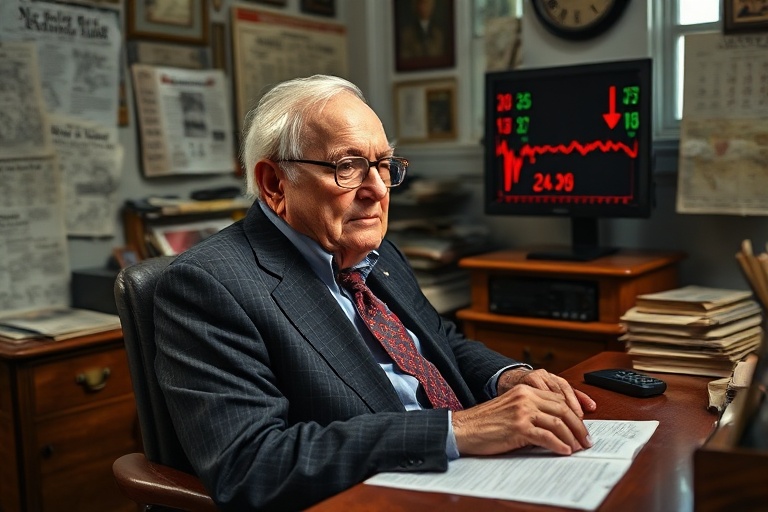
Warren Buffett Issues Stark Warning About Stock Market Risks
Warren Buffett’s Stock Market Warning: A Global Perspective
Warren Buffett, one of the most respected investors of all time, has issued a rare warning about the stock market. His concerns are not just about short-term volatility but about structural risks that could reshape global investing for years. Buffett’s warnings often carry weight because of his long-term track record, but this time, his message feels particularly urgent.
The Oracle of Omaha has repeatedly emphasized the importance of patience and discipline in investing. Yet, his recent remarks suggest a deeper unease about the current environment. While he hasn’t called for a market collapse, he has highlighted risks that could affect portfolios worldwide. Understanding Buffett’s perspective requires looking beyond the headlines and examining the broader economic and cultural forces at play.
What Warren Buffett Is Warning About
Buffett’s concerns center on two key issues: valuation and liquidity. He has pointed out that many stocks, particularly in the tech and growth sectors, are trading at historically high valuations. This is not just a U.S. phenomenon but a global trend. In Europe, Asia, and emerging markets, similar patterns are emerging as investors chase returns in a low-interest-rate environment.
Another critical issue is liquidity. Buffett has warned that markets could face liquidity crises if central banks tighten monetary policy too quickly. This is a concern because liquidity—the ease with which assets can be bought and sold—has been a driving force behind the market’s recent stability. If liquidity dries up, even fundamentally strong companies could see sharp price declines.
Buffett’s warnings also reflect broader cultural shifts in investing. Over the past decade, retail investing has exploded, with platforms like Robinhood and apps like WeChat in China democratizing access to markets. While this has brought new participants into the market, it has also introduced risks. Retail investors often chase trends, leading to speculative bubbles that can burst suddenly.
The Global Ripple Effect of Buffett’s Warning
Buffett’s influence extends far beyond the U.S. His warnings resonate globally because his investment philosophy is widely studied and emulated. In Europe, where markets are already grappling with energy crises and political uncertainty, Buffett’s caution adds another layer of complexity. Investors in countries like Germany and France are watching closely, as any shift in U.S. market sentiment could trigger capital outflows.
In Asia, Buffett’s warning has sparked debates about the sustainability of growth in markets like India and Southeast Asia. These regions have seen a surge in retail investing, with platforms like Zerodha in India and local brokers in Vietnam attracting millions of new investors. However, the lack of financial literacy in some of these markets could amplify the risks Buffett has highlighted.
Even in emerging markets, where Buffett’s direct influence is limited, his warnings serve as a reminder of the interconnected nature of global finance. A liquidity crisis in the U.S. could lead to capital flight from emerging markets, destabilizing currencies and economies. This is a risk that policymakers in countries like Brazil and South Africa are closely monitoring.
Buffett’s warning also underscores the cultural shift toward passive investing. Over the past decade, index funds and ETFs have grown at an unprecedented pace, leading to a concentration of ownership in a handful of large companies. This trend has reduced market diversity and increased systemic risk. If a major index fund faces liquidity issues, the ripple effects could be severe.
How Investors Are Responding to Buffett’s Warning
Investors are reacting to Buffett’s warning in different ways. Some are taking a defensive approach, increasing their cash allocations or shifting into defensive sectors like healthcare and utilities. Others are doubling down on growth stocks, betting that central banks will continue to support markets. The divide reflects broader cultural attitudes toward risk and uncertainty.
In the U.S., where Buffett’s influence is strongest, some investors are revisiting his core principles. Buffett has long advocated for investing in companies with durable competitive advantages and strong cash flows. This approach has fallen out of favor in recent years, as investors have chased high-growth but speculative stocks. Buffett’s warning may prompt a return to fundamentals.
Globally, investors are also looking for alternative assets. Gold, cryptocurrencies, and real estate are all seeing increased interest as hedges against market volatility. However, these assets come with their own risks. For example, the cryptocurrency market is notoriously volatile, while real estate is illiquid and sensitive to interest rate changes.
For those looking to navigate this uncertain environment, Buffett’s advice remains timeless. He often emphasizes the importance of staying within one’s circle of competence and avoiding investments that are poorly understood. This is particularly relevant today, as new financial products and platforms make it easier than ever to take on excessive risk.
Lessons from Buffett’s Long-Term Perspective
Buffett’s warnings are not just about the current market environment but about the long-term health of the financial system. His approach to investing is rooted in patience, discipline, and a deep understanding of businesses. These principles are more important than ever in a world where short-term thinking often dominates.
One of Buffett’s most valuable lessons is the importance of margin of safety. This principle, borrowed from Benjamin Graham, emphasizes buying assets at prices far below their intrinsic value. In today’s market, where valuations are stretched, this lesson is particularly relevant. Investors who focus on margin of safety are better positioned to weather market downturns.
Buffett’s warning also highlights the need for diversification. While it’s tempting to chase high returns in a single sector or asset class, diversification remains one of the best ways to manage risk. This is a lesson that global investors would do well to remember, especially in an environment where correlations between asset classes are rising.
Finally, Buffett’s warning serves as a reminder of the role of culture in investing. Markets are not just driven by economics but by human behavior. Fear and greed, optimism and pessimism—these emotions shape market cycles. Understanding these cultural forces is essential for any investor looking to navigate the current environment.
Conclusion: Preparing for an Uncertain Future
Warren Buffett’s warning about the stock market is a wake-up call for investors worldwide. While his concerns are not new, their urgency feels heightened in today’s environment. From valuation risks to liquidity challenges, the challenges facing investors are complex and interconnected. Yet, Buffett’s long-term perspective offers a roadmap for navigating these challenges.
For investors, the key takeaway is to stay disciplined. Whether it’s sticking to fundamentals, maintaining a margin of safety, or diversifying across asset classes, Buffett’s principles remain as relevant as ever. In a world where markets are increasingly driven by speculation, these principles are a counterbalance to the prevailing winds.
As global markets continue to evolve, Buffett’s warning is a reminder that investing is not just about chasing returns but about building resilience. For those willing to listen, his message offers a path forward in an uncertain world.
For more insights on investing and market trends, explore our Finance and Analysis sections. Stay informed, stay disciplined, and remember: the best investments are often the ones you don’t make in the heat of the moment.