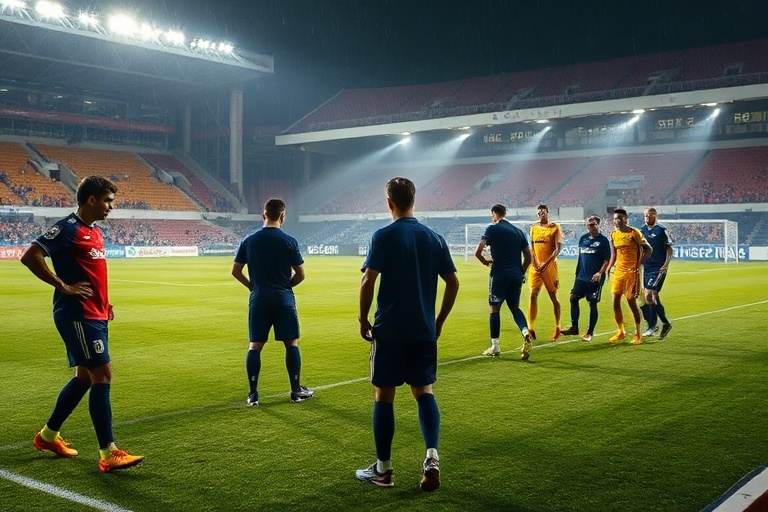
Football rivalries in Romania often carry layers of history, regional pride, and cultural identity. Among these, the clash between Argeș Pitești and Rapid București stands out as a fixture that transcends mere competition. These two clubs, separated by geography and tradition, have carved their narratives into Romanian football history, offering a compelling study of how sport reflects broader societal dynamics.
The rivalry between Argeș Pitești and Rapid București isn’t just about points on the table or league positions. It’s about two cities with distinct personalities—Argeș Pitești in the heart of Wallachia, known for its industrial heritage and academic institutions, and Rapid București in the capital, a city that pulses with energy, political significance, and a football culture deeply intertwined with urban identity. This matchup is a collision of narratives: one rooted in pragmatism and local pride, the other in cosmopolitan ambition and historical prestige.
A Brief History of Two Clubs
Argeș Pitești was founded in 1961 through the merger of two local teams, CS Pitești and Dinamo Pitești. The club quickly rose through the ranks, reaching the top division by 1968 and enjoying its golden era in the late 1970s. Under the guidance of coach Florin Halagian, Argeș Pitești won its only league title in 1979, a moment still celebrated in the city as a symbol of local achievement against bigger clubs from Bucharest.
Rapid București, on the other hand, traces its roots to 1923 and has long been associated with the railway workers’ community, which shaped its identity. The club’s crest—a stylized train—reflects this heritage. Rapid won its first league title in 1937 and has since become one of Romania’s most decorated clubs, though its recent history has been marked by financial instability and relocations. Despite this, Rapid remains a symbol of resistance and continuity in Romanian football.
The two clubs first met in the 1960s, and their encounters have often been tense, reflecting not only sporting ambition but also the broader socio-economic tensions between capital and periphery. Matches between them have been known to feature high intensity, with physicality and tactical discipline playing key roles.
The Cultural Significance of the Rivalry
Football in Romania is rarely just a sport. It’s a mirror of regional identity, class, and even politics. Argeș Pitești represents the industrial heartland—workers, engineers, and students who see the club as a point of local pride. Pitești itself, once known for its communist-era factories, has evolved into a university city, giving the club a younger, more educated fanbase.
Rapid București, meanwhile, is deeply embedded in the capital’s urban fabric. Its fanbase is diverse, spanning generations, and includes many who commute daily on the city’s public transport system—echoing the club’s railway origins. Rapid’s supporter groups are known for their vocal presence, and their chants often carry political undertones, reflecting Bucharest’s role as the nation’s center of power.
This rivalry is also a study in contrasts. Argeș Pitești’s supporters are often seen as more reserved, loyal, and community-oriented, while Rapid’s fanbase is larger and more vocal, with a reputation for creating an electric atmosphere in the stands. The contrast extends to the clubs’ playing styles—Argeș Pitești has historically favored structured, defensive football, while Rapid is known for attacking flair and improvisation.
Key Moments in the Rivalry
- 1979: The Title Decider – Argeș Pitești secured the league title with a draw against Rapid in Bucharest, a result that still resonates in Pitești as a David vs. Goliath moment.
- 2002: Rapid’s Dominance – Rapid won 4-0 at home, a result that highlighted their resurgence during that period and Argeș Pitești’s struggles with relegation.
- 2016: Cup Final Drama – Both clubs met in the Romanian Cup final, with Rapid winning on penalties, sparking celebrations among Bucharest fans and frustration in Pitești.
- 2022: A Narrow Escape – Argeș Pitești avoided relegation in a dramatic 2-1 win in Bucharest, a result that kept them in the top flight and dashed Rapid’s hopes of promotion.
The Global Context: Football Rivalries in Transition
While Argeș Pitești vs. Rapid București may not have the global recognition of clashes like Barcelona vs. Real Madrid or Celtic vs. Rangers, it fits into a broader pattern of football rivalries shaped by urbanization, migration, and economic change. These rivalries often reflect the tensions between tradition and modernity, between provincial identity and cosmopolitan ambition.
In many ways, this rivalry mirrors what’s happening across Europe. Clubs from smaller cities—like Argeș Pitești—often struggle to compete financially with those from major urban centers like Bucharest. The financial disparities have led to a growing gap in resources, talent, and infrastructure. This imbalance raises questions about the sustainability of local football cultures in an era of globalization and commercialization.
Yet, the Argeș Pitești vs. Rapid București rivalry endures because it’s about more than trophies. It’s about community. It’s about identity. It’s about the stories fans tell their children and the pride they feel when their club stands tall, even if just for 90 minutes.
What the Future Holds
The future of this rivalry depends on both clubs’ ability to navigate the challenges of modern football. For Argeș Pitești, the focus remains on stability—avoiding relegation, developing youth talent, and maintaining fan engagement. The club’s survival in the top flight is a testament to its resilience and the loyalty of its supporters.
For Rapid București, the challenge is more complex. After years of financial turmoil and relocations, the club has begun to rebuild, focusing on youth development and community engagement. A return to its former glory will require more than just sporting success—it will demand a reconnection with its roots and a renewed sense of purpose.
As both clubs look ahead, the rivalry itself remains a constant. Whether in the top flight or lower divisions, when these two teams meet, the intensity is always palpable. The fans arrive with expectations shaped by history, and the players step onto the pitch knowing they’re part of something bigger than themselves.
In an era where football is increasingly dominated by money and media spectacle, the Argeș Pitești vs. Rapid București rivalry is a reminder of what makes the sport truly special. It’s not about global brands or million-dollar signings. It’s about passion, pride, and the communities that keep the game alive.