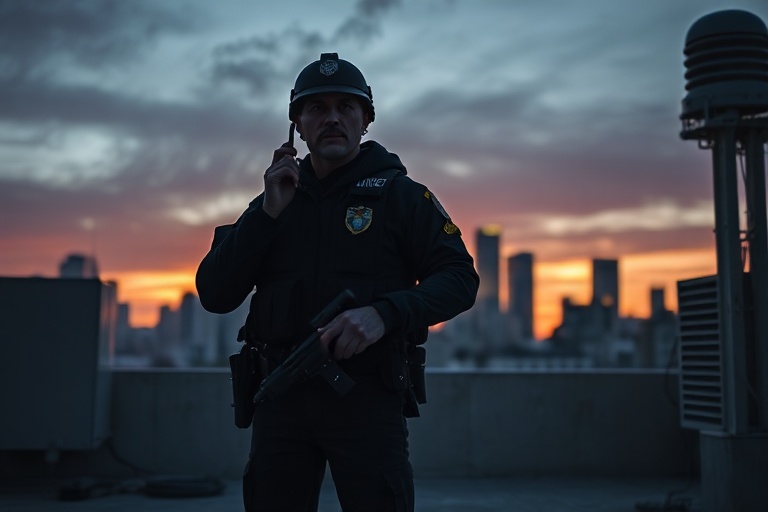
The image of a police officer standing alone on a rooftop, rifle in hand, scanning a city skyline, has become one of the most enduring symbols of modern urban policing. It evokes a sense of vigilance, authority, and the constant tension between protection and surveillance. This scene, which first gained prominence during the 1960s and 1970s in American cities, wasn’t just a tactical choice—it was a visual statement about the role of law enforcement in an era of rapid social change.
The Origins of the “Cop on a Rooftop” Trope
The practice of stationing officers on rooftops emerged as a direct response to the urban unrest and crime surges of mid-20th century America. Cities like New York, Chicago, and Los Angeles faced rising crime rates, civil rights protests, and a growing sense of disorder. Police departments, often under pressure to restore order, adopted high-visibility tactics, including elevated observation posts.
This strategy was formalized during the 1960s, particularly in New York City under Police Commissioner William H. McManus and later under Mayor John Lindsay’s administration. Officers were assigned to rooftops in high-crime precincts, armed with rifles and binoculars, to monitor streets, rooftops, and alleyways. The goal was both practical—improving response times and situational awareness—and psychological: projecting a sense of omnipresence to deter crime.
By the early 1970s, this tactic had become so common that it was immortalized in media. Films like Dirty Harry (1971) and TV shows such as Kojak and Hawaii Five-O frequently featured scenes of lone officers surveying cityscapes from above. The image was powerful—it suggested that safety could be surveilled, and that danger lurked just out of sight, below.
Why Rooftops Became Prime Real Estate for Policing
There were several tactical and symbolic reasons rooftops became key surveillance points:
- Height Advantage: Rooftops provided unobstructed views of multiple streets, intersections, and escape routes, making it easier to track suspects or spot disturbances.
- Tactical Isolation: Elevated positions reduced the risk of ambushes from ground-level threats, offering officers a safer vantage point during high-risk operations.
- Psychological Deterrence: The presence of an armed officer on a rooftop sent a clear message to potential offenders: the police were watching, and they were everywhere.
- Media and Public Perception: In an era before widespread surveillance cameras, the visible presence of officers on rooftops reinforced the idea of a vigilant, proactive police force.
Yet, this approach also reflected a broader shift in policing philosophy—one that prioritized visibility and deterrence over community engagement. While the tactic may have reduced certain types of crime in targeted areas, it also contributed to a growing perception of police as an occupying force rather than protectors.
The Broader Implications: Safety vs. Surveillance
The image of a cop on a rooftop is not just a relic of 20th-century policing—it’s a precursor to modern debates about surveillance, privacy, and the militarization of law enforcement. The rooftop officer, though armed only with a rifle and binoculars, embodied the idea that safety could be achieved through observation and control.
This model laid the groundwork for today’s extensive use of surveillance cameras, drones, and facial recognition technology. While these tools offer undeniable benefits in crime prevention and investigation, they also raise serious concerns about civil liberties, racial profiling, and the erosion of public trust in law enforcement.
Moreover, the rooftop cop symbolizes a top-down approach to policing—one that assumes authority and compliance rather than partnership with the community. Studies have shown that community-oriented policing, which emphasizes trust-building and collaboration, is far more effective in reducing crime and improving public safety than tactics that rely solely on surveillance and intimidation.
Legacy and Lessons: What the Rooftop Cop Teaches Us Today
Today, the sight of a police officer on a rooftop is far less common than it was in the 1970s and 1980s. The rise of mobile patrols, body cameras, and real-time communication systems has rendered the rooftop post somewhat obsolete as a primary tactic. Yet, the legacy of this approach lives on in the broader conversation about how we balance security with freedom.
As cities continue to grapple with issues of crime, inequality, and police reform, the image of the cop on a rooftop serves as a reminder of the unintended consequences of heavy-handed tactics. It challenges us to ask: What does true safety look like? Is it achieved through omnipresent surveillance, or through meaningful engagement with the communities we serve?
Perhaps the most important lesson is this: tactics that prioritize control over connection may provide short-term gains, but they often come at a long-term cost. The rooftop cop, for all his vigilance, could never truly see the city below—not in the way that mattered most.
For more on the evolution of urban policing and its cultural impact, explore our Trending and Analysis sections, where we examine how law enforcement strategies shape—and are shaped by—society.