Trump Leads National Prayer Event at Lincoln Memorial Drawing Millions
An Unprecedented Gathering in the Heart of Washington
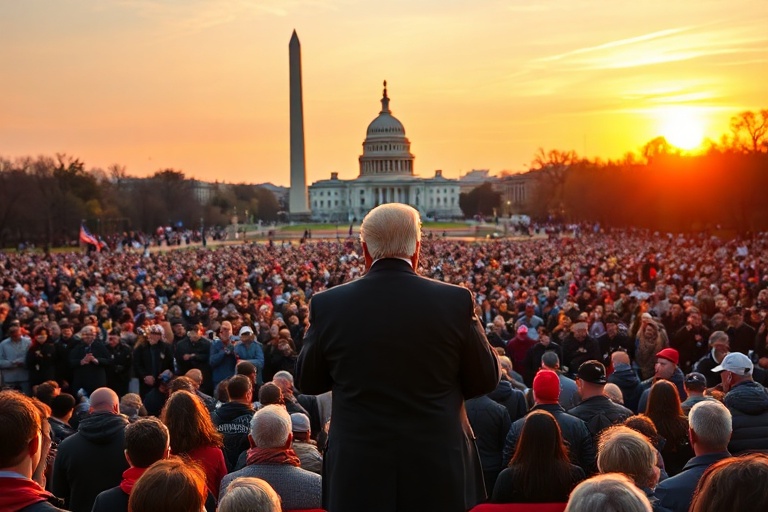
The National Mall in Washington, D.C., witnessed an extraordinary convergence of faith, politics, and public expression on Saturday, as former President Donald Trump hosted a prayer event that drew an estimated 1.5 to 2 million attendees. The event, titled the “God Bless the USA National Day of Prayer and Repentance,” unfolded against the backdrop of the Lincoln Memorial, a site steeped in American history and symbolism. Organizers framed the gathering as a call for national spiritual renewal, while critics viewed it through a lens of political spectacle.
The scale of the event was difficult to overstate. Aerial footage broadcast by major networks captured a sea of American flags waving in unison, punctuated by banners emblazoned with religious and patriotic messages. Security measures were extensive, reflecting the sensitivity of the moment and the presence of high-profile speakers. Unlike typical political rallies, this event positioned itself explicitly within the domain of faith, drawing comparisons to historic revival meetings and civil religious observances that have punctuated American public life for centuries.
The choice of location was deliberate. The Lincoln Memorial, with its towering statue of the 16th president—often invoked in national discourse on unity and moral purpose—served as a powerful visual anchor. Speakers positioned the event as a moment of reckoning for the nation, invoking themes of repentance, healing, and divine intervention in public affairs. These themes resonated not only with the American audience but also sparked international commentary on the intersection of religion and governance.
Speakers and Messages: A Fusion of Faith and Politics
The lineup of speakers reflected a deliberate blending of religious and political voices, underscoring the hybrid nature of the event. Among the most prominent was Franklin Graham, the evangelical leader and longtime Trump ally, who delivered a fiery sermon emphasizing the need for national repentance. His message drew on biblical imagery, framing America’s challenges as spiritual in nature and calling for collective moral renewal.
Other speakers included pastors, military veterans, and family members of victims from high-profile tragedies, all of whom framed their remarks within a narrative of national crisis and redemption. The rhetoric consistently wove together themes of patriotism, divine favor, and political renewal. One speaker invoked the phrase “awakening,” a term widely used in evangelical circles to describe a spiritual revival that transforms both hearts and societies.
While the event was not officially a campaign event, its timing and messaging intersected closely with the 2024 election cycle. Trump’s closing remarks were met with sustained applause, reinforcing his role as a central figure in this cultural moment. Analysts noted that the event could be seen as both a spiritual mobilization and a political rally, reflecting the growing entanglement of religion and partisan identity in American public life.
Global Reactions: A Mirror of Diverse Perspectives
The event did not exist in a vacuum. International observers and media outlets responded with a mix of fascination, skepticism, and concern. European outlets such as The Guardian and Le Monde framed the gathering as a symptom of deepening political polarization in the United States, highlighting the risks of conflating religious identity with national identity. Commentators in countries with state religions, like the United Kingdom or Italy, noted the contrast with their own traditions, where public expressions of faith are often more constrained by constitutional separation of church and state.
In contrast, conservative media in Latin America and parts of Africa praised the event as a bold assertion of faith in the public square. Some evangelical leaders in these regions drew parallels to their own struggles for religious freedom, seeing in the event a model of courageous witness. In Asia, where governments often regulate religious expression, the event was reported with caution, focusing on its scale and potential implications for U.S. foreign policy rather than its spiritual content.
Across the Middle East, reactions were particularly nuanced. While some Muslim-majority countries viewed the event with suspicion—especially given Trump’s past rhetoric about Islam—others acknowledged its domestic significance without endorsing its theological claims. The global conversation underscored a broader truth: the American experiment in civil religion, where faith and nation intertwine, continues to fascinate and unsettle observers around the world.
Cultural and Historical Context: Where Faith Meets the Republic
To understand the significance of this event, it is helpful to place it within a longer arc of American history. The United States has long been described as a nation with a “civil religion”—a set of shared symbols, rituals, and narratives that bind people together under a common moral framework. From the Thanksgiving proclamations of George Washington to the sermons of Martin Luther King Jr., public expressions of faith have often served as a glue for national identity.
Yet this tradition is not without controversy. Critics argue that the blending of faith and nationalism risks idolizing the state or excluding those who do not share the dominant religious vision. The National Mall, in particular, has been the site of both sacred and secular pilgrimage—from Marian processions to the 1963 March on Washington. The 2024 prayer event sits at this intersection, raising questions about the future of pluralism in America.
Some scholars compare the event to earlier revivals, such as the Great Awakenings of the 18th and 19th centuries, which reshaped American society through mass religious gatherings. Others draw parallels to civil rights-era church meetings, where faith was explicitly linked to social transformation. What makes this moment distinct, however, is the role of media and political messaging in amplifying its reach across digital platforms, transforming a local gathering into a globally trending topic.
Key Takeaways from the Event
- Scale and Symbolism: The event’s location at the Lincoln Memorial and its estimated attendance of 1.5–2 million people made it one of the largest public gatherings in recent U.S. history.
- Faith-Politics Fusion: Speakers deliberately wove religious themes into political narratives, blurring the lines between spiritual renewal and national revival.
- Global Attention: International media responded with a mix of curiosity, critique, and concern, highlighting the event’s resonance beyond U.S. borders.
- Historical Precedents: The gathering reflects a long tradition of civil religion in America, though its modern form is amplified by digital media and partisan identity.
A Moment of Reflection or a Political Stage?
As the sun set over the National Mall on Saturday evening, the event concluded with a benediction and a rendition of “God Bless the USA.” For supporters, it was a moment of hope and spiritual clarity. For critics, it was a carefully orchestrated display of power, cloaked in the language of faith. The truth, as often, lies somewhere in between.
The prayer event highlighted the enduring role of religion in American public life—not as a relic of the past, but as a living force that continues to shape identity, politics, and collective memory. Whether viewed as a genuine call to repentance or a strategic mobilization for a political base, the event revealed the complex ways in which faith and nation continue to co-evolve in the 21st century.
One thing is clear: the images of that day—the flags, the speakers, the crowd—will be analyzed, debated, and remembered. They will appear in documentaries, political ads, and sermons for years to come. And they will continue to provoke questions about what it means to be American in a time of deep division and rapid change.
As the nation moves forward, the legacy of the National Mall prayer event will depend not only on its immediate impact, but on how its themes of faith, repentance, and renewal are interpreted—and who gets to define their meaning.