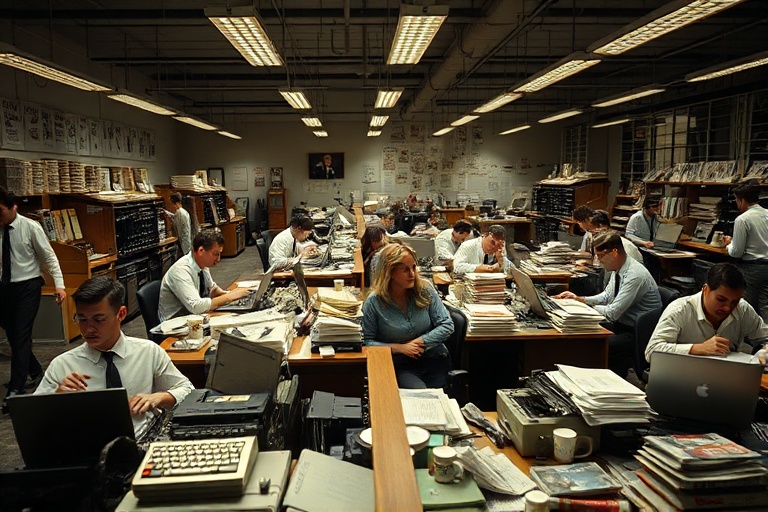
How Newsweek Adapted from Print to Digital Over 90 Years
Newsweek’s Evolution: From Print Pioneer to Digital Dynamo
Founded in 1933 by Thomas J.C. Martyn, Newsweek emerged during an era when weekly news magazines dominated global information consumption. The publication carved its niche by blending investigative journalism with accessible analysis, a formula that sustained it through the 20th century. By the 1960s, it had become a cultural institution, with circulation peaking at over 3 million in the 1990s—a testament to its role in shaping public discourse.
Yet the same forces that propelled Newsweek to prominence later threatened its survival. The rise of cable news and the internet eroded the dominance of weekly print publications. By 2010, the magazine faced a crisis when it transitioned from print to digital-only, a move that reflected broader industry shifts. Today, Newsweek operates as a hybrid entity: part legacy brand, part modern media outlet, navigating the complexities of a fragmented information landscape.
The Global Reach of Newsweek: Covering the World from New York to Nairobi
Newsweek has long positioned itself as a bridge between American perspectives and global events. Its international editions, once printed in multiple languages, demonstrated an early commitment to cross-cultural reporting. Even after discontinuing most print editions, the magazine maintained bureaus in key cities including London, Jerusalem, and Tokyo, ensuring coverage of geopolitical events from multiple vantage points.
This global approach has shaped its coverage of pivotal moments. During the Cold War, Newsweek provided in-depth analysis of nuclear diplomacy and proxy conflicts. In the 21st century, it has documented the rise of China, the Arab Spring, and the ongoing war in Ukraine with a blend of on-the-ground reporting and expert commentary. The magazine’s ability to contextualize local events within broader historical and cultural frameworks remains one of its defining strengths.
- Bureau Locations (as of 2024): New York (HQ), London, Jerusalem, Tokyo, Nairobi
- Key International Coverage Areas: Geopolitics, Human Rights, Economic Trends, Cultural Shifts
- Language Editions (Historical): Arabic, Spanish, Polish, Japanese, Korean, and Russian
Cultural Impact: Newsweek’s Role in Shaping Public Thought
Newsweek has never been just a news outlet—it has been a participant in cultural conversations. In the 1960s, it amplified voices from the civil rights movement, publishing essays by James Baldwin and interviews with activists. During the AIDS crisis of the 1980s and 1990s, it provided some of the most comprehensive reporting on the epidemic, challenging stigma and misinformation.
The magazine’s annual lists—such as “The 100 Most Influential People”—have become cultural touchstones, sparking debates about power, legacy, and representation. These lists reflect not just who wields influence but how society defines it. In recent years, Newsweek has also embraced digital storytelling, launching podcasts and documentary series that explore complex issues like climate change and artificial intelligence.
Its coverage of technology has been particularly influential, chronicling the rise of Silicon Valley while questioning its ethical implications. From early warnings about social media’s impact on democracy to deep dives into cryptocurrency’s volatility, Newsweek has positioned itself as a critical voice in tech discourse.
The Digital Transformation: Challenges and Opportunities
The shift from print to digital has been neither smooth nor painless. In 2018, Newsweek was acquired by IBT Media, a transaction that later sparked controversy over ownership and editorial independence. The magazine faced criticism for sensationalism and retracted several stories, a period that underscored the risks of prioritizing speed over accuracy in the digital age.
Yet this turbulence also catalyzed reinvention. Under new leadership, Newsweek has focused on rebuilding trust through rigorous fact-checking and transparent sourcing. Its digital platform now features multimedia content, including interactive data visualizations and live blogs covering breaking news. The magazine has also leveraged social media, with a robust presence on X (formerly Twitter) and Instagram, where it engages younger audiences with concise, shareable content.
Despite these strides, Newsweek faces persistent challenges. The decline of ad-supported media has forced a reliance on subscriptions and sponsored content, raising questions about journalistic integrity. Meanwhile, the rise of partisan outlets and misinformation has diluted the authority of traditional news brands. In this climate, Newsweek’s longevity hinges on its ability to balance speed with substance, accessibility with depth.
What’s Next for Newsweek?
As Newsweek approaches its centenary, its future will likely be defined by two competing imperatives: preservation and innovation. The magazine must honor its legacy as a bastion of investigative journalism while adapting to the demands of a mobile-first audience. This means investing in long-form reporting that social media cannot replicate, as well as experimenting with formats like newsletters and audio journalism.
Globalization will also shape its trajectory. With audiences in over 190 countries, Newsweek has the potential to serve as a connective tissue between disparate regions. Covering climate policy from the perspective of both Washington and Warsaw, or analyzing migration through the lens of both Berlin and Lagos, could reaffirm its role as a truly international publication.
The magazine’s archives—spanning nearly a century of global events—offer another avenue for growth. Digitizing this trove could create new revenue streams through licensing and educational partnerships, while also providing readers with historical context for contemporary issues. Imagine a feature that juxtaposes a 1963 Newsweek article on the March on Washington with a 2023 retrospective—such storytelling could underscore the magazine’s enduring relevance.
A Legacy of Influence, a Future of Uncertainty
Newsweek’s story is one of adaptation. From its founding during the Great Depression to its survival in the digital age, the magazine has repeatedly reinvented itself to stay relevant. Yet its greatest asset remains its commitment to journalism that informs, challenges, and provokes thought.
In an era where news is often reduced to headlines and hot takes, Newsweek offers something increasingly rare: perspective. Whether through a 5,000-word investigation or a tightly argued analysis, it reminds readers that understanding the world requires both breadth and depth. As media consumption habits continue to evolve, the magazine’s ability to deliver this will determine whether it thrives or merely survives into its second century.
The challenges ahead are formidable, but Newsweek has weathered storms before. Its next chapter may not replicate its past glories, but if it can merge tradition with innovation, it could carve out a new role in the 21st century’s media ecosystem.