Iran War Hormuz: How a Strait Controls Global Oil and Power
“`html
Iran War Hormuz: Mapping the Strait’s Strategic Stakes
The Strait of Hormuz isn’t just a maritime chokepoint—it’s a global pressure valve. When tensions rise between Iran and its neighbors, the world watches not only for political signals but for the shadow cast over 20% of the world’s oil supply. The region’s volatility isn’t new, but recent escalations have sharpened focus on how a conflict could disrupt energy markets, military logistics, and diplomatic alliances within weeks.
Understanding the stakes requires more than headlines. It demands a look at geography, military capabilities, and the fragile balance of power that has kept shipping lanes open for decades. From Iran’s asymmetric naval tactics to the presence of U.S. and allied fleets, the Strait of Hormuz remains one of the most militarized waterways on Earth.
The Strait as a Geopolitical Pressure Point
The Strait of Hormuz connects the Persian Gulf to the Gulf of Oman and, ultimately, the Indian Ocean. Just 21 miles wide at its narrowest point, it’s flanked by Iran to the north and Oman to the south. Despite its size, it carries about 20–30% of the world’s seaborne oil daily—roughly 17 million barrels—according to the U.S. Energy Information Administration.
This narrow corridor isn’t just an energy artery; it’s a geopolitical fault line. Iran has long viewed control of regional waters as essential to its security doctrine. In 2019, attacks on oil tankers near the strait, attributed to Iran by the U.S. and allies, demonstrated how quickly shipping can be disrupted. Such incidents aren’t isolated—they’re part of a broader strategy Iran uses to project influence and deter aggression.
International law governs transit through the strait, but enforcement is inconsistent. UN Convention on the Law of the Sea (UNCLOS) guarantees “transit passage” rights, yet regional conflicts and unilateral actions by coastal states often override these norms in practice.
Key Players and Their Interests
- Iran: Uses naval forces, proxies, and missile threats to deter external intervention and maintain influence in Iraq, Syria, Lebanon, and Yemen.
- Saudi Arabia & UAE: Depend on Hormuz for oil exports; increasingly diversify routes via pipelines to bypass the strait.
- U.S. & Allies: Maintain a naval presence (e.g., U.S. Fifth Fleet) to ensure freedom of navigation and counter Iran’s asymmetric threats.
- China: Increasingly reliant on Middle Eastern oil; views stability in Hormuz as critical to its energy security and Belt and Road Initiative.
- Russia: Supports Iran diplomatically and militarily, seeing it as a counterbalance to Western influence in the region.
Military Postures and Escalation Risks
Iran’s military strategy in the strait relies on speed, surprise, and deniability. Its Islamic Revolutionary Guard Corps (IRGC) operates a fleet of fast attack boats, mines, and anti-ship missiles. These assets are designed not for sustained combat but for disrupting commercial traffic and drawing adversaries into costly defensive operations.
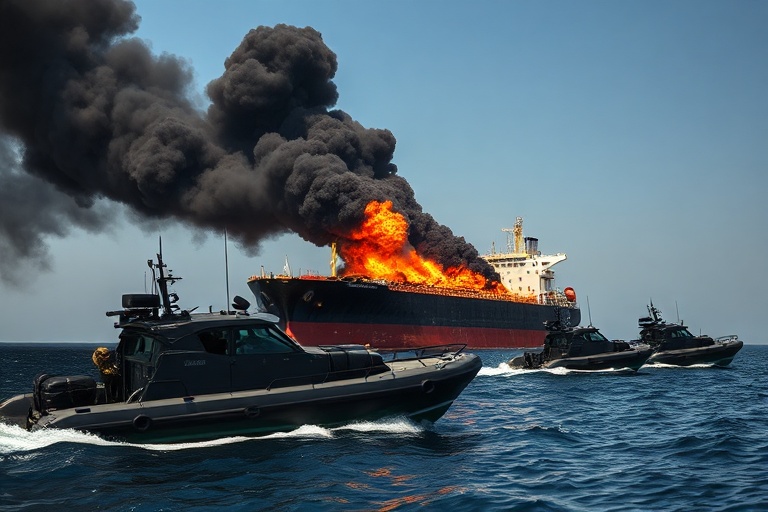
In response, the U.S. Fifth Fleet, based in Bahrain, conducts regular patrols and exercises with allies like the UK, France, and regional partners. These operations aim to deter aggression and maintain open shipping lanes. Yet, incidents still occur—from drone strikes to alleged sabotage—each raising the risk of miscalculation.
One of the most dangerous scenarios involves a blockade. Iran has threatened to close the strait in past crises, though experts debate whether it could enforce such a move without triggering a major military response. A full closure would halt nearly all Gulf oil exports, sending global prices soaring and triggering shortages in Asia and Europe.
Recent Flashpoints
- 2019 Tanker Attacks: Four vessels were damaged in attacks near Fujairah and the Strait of Hormuz, blamed on Iran by the U.S.
- 2021 Israeli Strikes: Alleged Israeli attacks on Iranian ships in the Red Sea and Gulf of Oman raised tensions and prompted retaliatory threats.
- 2023 Drone Interception: U.S. forces shot down several Iranian drones near the strait after they flew too close to American ships.
- 2024 Houthi Attacks: Yemeni rebels, backed by Iran, targeted commercial vessels in the Red Sea, forcing rerouting and raising concerns over spillover into Hormuz.
Economic and Global Implications
The economic ripple effects of a Hormuz conflict would be immediate and far-reaching. Oil prices could spike by 50% or more within days, disrupting supply chains and inflation forecasts. Industries from aviation to manufacturing would face higher fuel costs, while governments scramble to secure alternative energy sources.
The impact on global trade would be equally severe. Over 90% of traded goods travel by sea. A prolonged disruption in the Strait of Hormuz would force costly rerouting around the Cape of Good Hope, adding weeks to transit times and increasing insurance premiums for shippers.
Financial markets would react swiftly. Energy stocks could surge, while aviation and shipping sectors might plummet. Currency markets, especially in oil-dependent nations, would experience volatility. Central banks would face pressure to stabilize prices, potentially altering monetary policy in unexpected ways.
Beyond economics, a conflict could reshape alliances. Gulf states might accelerate defense cooperation with Israel or strengthen ties with China and Russia as alternatives to U.S. security guarantees. This shift could erode Western influence in the region over the long term.
Can Diplomacy Prevent the Next Crisis?
Despite the volatility, diplomatic channels remain open. Oman has historically mediated between Iran and the West. Qatar, too, plays a quiet but crucial role in backchannel negotiations. The 2015 nuclear deal (JCPOA) offered a glimmer of hope, but its collapse in 2018 removed a key confidence-building framework.
New talks have emerged in recent years, often focused on maritime security and nuclear constraints. Yet progress is fragile. Iran demands sanctions relief and regional recognition; the U.S. insists on verifiable commitments. With neither side willing to compromise fully, the risk of miscalculation grows.
International organizations like the International Maritime Organization (IMO) have called for de-escalation, but enforcement is limited. The best hope may lie in confidence-building measures—such as joint naval patrols or early-warning systems—to reduce the chance of accidental conflict.
What Needs to Happen Next
- Revive Dialogue: Resume structured talks between Iran, Gulf states, and Western powers focused on maritime security and nuclear constraints.
- Enhance Maritime Surveillance: Expand real-time monitoring and information-sharing among allied navies to detect threats early.
- Diversify Energy Routes: Accelerate pipeline projects and alternative shipping corridors to reduce reliance on Hormuz.
- Public Diplomacy: Encourage regional media and civil society to promote narratives of cooperation over confrontation.
The Strait of Hormuz remains a tinderbox wrapped in a choke point. It’s not just about oil—it’s about stability, sovereignty, and the future of global trade. The question isn’t whether a conflict could happen, but how devastating its consequences would be. The time to act is before the next crisis, not during it.
For now, the world holds its breath. But geography doesn’t take sides. And in the end, the strait decides who controls the flow—not just of oil, but of power itself.