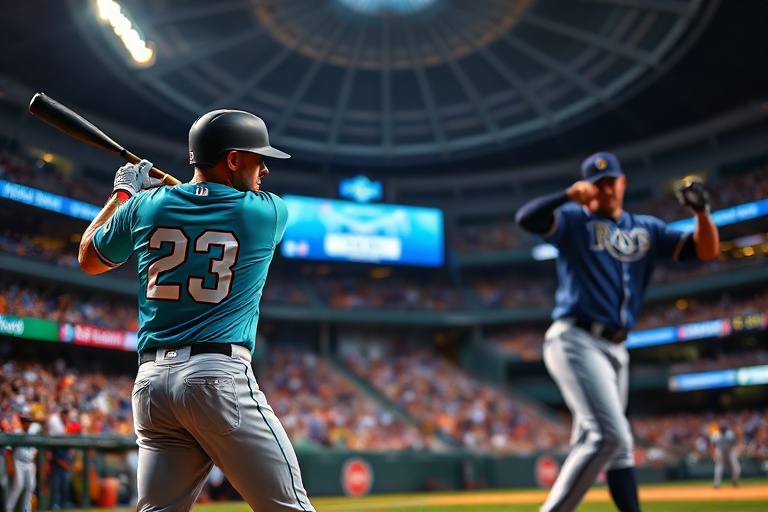
Rivalry Renewed: Miami Marlins and Tampa Bay Rays Face Off in a Battle of Florida
The Miami Marlins and Tampa Bay Rays have spent years locked in a regional rivalry that extends beyond the diamond. While both teams compete in Major League Baseball’s National League East, their matchups carry distinct cultural and economic weight across Florida. The Marlins, representing Miami’s vibrant Latino community and global tourism hub, face off against the Rays, whose identity is tied to Tampa Bay’s diverse, fast-growing urban landscape.
This rivalry isn’t just about wins and losses. It reflects broader themes of geography, identity, and competition in one of America’s most dynamic states. Miami and Tampa Bay, separated by 270 miles, have long been seen as Florida’s two cultural capitals—one pulsating with Latin flair, the other evolving into a tech-driven, diversified economy. When the Marlins and Rays meet, they bring that broader story onto the field.
The Historical Roots of a Florida Showdown
The Marlins, established in 1993 as the Florida Marlins, quickly became a symbol of Miami’s resurgence after decades of economic and social transformation. The team’s 1997 and 2003 World Series titles cemented its place in the city’s identity, especially within the Cuban-American community. Meanwhile, the Rays—originally the Devil Rays—emerged in 1998 as Tampa Bay’s first major league team, giving a region hungry for sports representation a team to call its own.
Over the years, the rivalry has been marked by competitive imbalance. The Marlins, despite their World Series wins, have struggled with attendance and financial consistency. The Rays, meanwhile, have built a reputation as a model franchise under innovative leadership, making deep playoff runs despite being in the shadow of the New York Yankees and Boston Red Sox. Their 2020 American League Championship appearance underscored their rise as a legitimate contender.
Yet, it’s not just about records. The Marlins and Rays represent two different visions of Florida’s future. The Marlins embody the state’s global gateway status, drawing players and fans from across Latin America and the Caribbean. The Rays reflect Tampa Bay’s transformation into a hub for healthcare, finance, and tech, with a fanbase that reflects the region’s growing diversity.
Cultural Impact: More Than Just Baseball
In Miami, baseball is woven into the city’s cultural fabric. The Marlins’ stadium in Little Havana is more than a ballpark—it’s a social hub where families gather, salsa music fills the air, and conversations flow in Spanish, English, and Spanglish. The team’s branding, from its orange and black colors to its mascot, Billy the Marlin, resonates deeply with the city’s Latino majority.
The Rays, on the other hand, have cultivated a fanbase that mirrors Tampa Bay’s demographic evolution. The team’s 2021 rebranding, dropping the “Devil” from their name, signaled a shift toward inclusivity and modernity. Today, Tropicana Field in St. Petersburg is a gathering place for a diverse audience, reflecting the region’s growing Hispanic, Black, and immigrant populations. The Rays’ embrace of analytics and innovation has also made them a model for younger, tech-savvy fans.
This cultural divide extends beyond the stands. In Miami, baseball is entertainment with a global flair—think Latin music nights and player appearances by stars from the Dominican Republic or Venezuela. In Tampa Bay, the experience is more rooted in family and community, with a focus on affordability and accessibility. These differences shape not just how fans engage with the game, but how the teams themselves are perceived across Florida and beyond.
Economic and Geographic Factors Behind the Rivalry
The Marlins and Rays don’t just compete on the field—they compete for attention, investment, and civic pride. Miami’s tourism-driven economy relies heavily on its international image, and the Marlins play a key role in that branding. The team’s success, or lack thereof, can influence perceptions of the city as a global destination.
For Tampa Bay, the Rays represent an opportunity to solidify the region’s identity as more than just a retirement community. The team’s push for a new stadium in downtown St. Petersburg highlights the broader effort to redefine the area as a vibrant, urban center. The Rays’ success is tied to Tampa Bay’s ambition to attract young professionals and families who want a dynamic lifestyle.
Geography also plays a role. The two cities are separated by water, culture, and history. Miami has long been Florida’s international gateway, while Tampa Bay has emerged as a logistics and innovation hub. When the Marlins and Rays face off, it’s not just a baseball game—it’s a symbolic clash between two visions of Florida’s future.
Fan Perspectives: Two Cities, Two Experiences
Fans of the Marlins and Rays often describe their support in deeply personal terms. For Miami supporters, the Marlins are a point of pride in a city that has fought for its place on the global stage. The team’s struggles have only deepened the emotional connection for many fans, who see their loyalty as an act of defiance against the odds.
Rays fans, meanwhile, often describe their support as a reflection of Tampa Bay’s underdog spirit. The team’s ability to compete with larger markets has fostered a sense of community pride. Fans point to the Rays’ analytics-driven approach and affordable ticket prices as reasons for their loyalty, even in years when the team falls short.
These perspectives are reflected in the way fans engage with the rivalry. Marlins supporters often travel to Tampa Bay in large numbers, bringing the energy of Little Havana with them. Rays fans, in turn, make the trip to Miami with a sense of determination, eager to prove that their team belongs in the conversation alongside Florida’s more established franchises.
Looking Ahead: What’s Next for the Rivalry?
The future of the Marlins-Rays rivalry is as much about off-field developments as it is about baseball. For the Marlins, the challenge is to rebuild a winning culture while maintaining their connection to Miami’s diverse communities. The team’s recent investments in player development and community outreach suggest a commitment to long-term growth.
The Rays, meanwhile, are focused on securing a new stadium and solidifying their place as Tampa Bay’s premier sports franchise. Their innovative approach to the game, both on and off the field, has set a new standard for how teams can compete in today’s MLB. As the Rays continue to push the boundaries of analytics and fan engagement, the Marlins will need to adapt to keep pace.
For fans, the rivalry offers a chance to celebrate what makes Florida unique. Whether it’s the Marlins’ global flair or the Rays’ community-driven ethos, each team represents something vital about the state. As long as both teams continue to compete at a high level, the rivalry will remain a defining feature of Florida’s sports landscape.
One thing is certain: when the Marlins and Rays take the field, they’re not just playing for wins. They’re playing for the soul of Florida.
Key Takeaways
- The Marlins and Rays represent two distinct visions of Florida, one global and one local.
- Their rivalry extends beyond baseball, reflecting broader cultural and economic themes.
- Fan experiences in Miami and Tampa Bay highlight the diversity of Florida’s sports culture.
- The future of the rivalry will be shaped by each team’s ability to innovate and connect with their communities.
As Florida continues to grow and evolve, so too will the story of its baseball rivalry. For now, the Marlins and Rays remain locked in a battle that transcends the game itself.