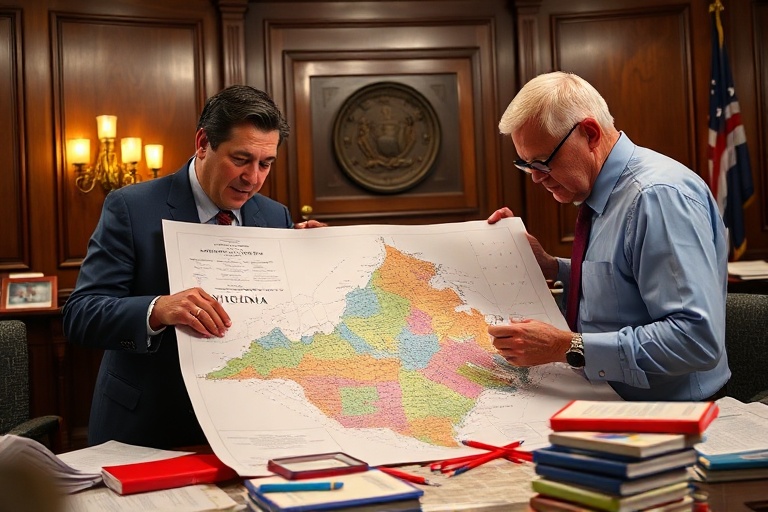
redistricting in virginia
Every decade, political landscapes across the United States undergo a quiet but seismic shift through redistricting—a process that redefines electoral power. Virginia, with its complex political history and growing diversity, finds itself at the center of this often-contentious practice. As the state prepares for its 2025 redistricting cycle, the stakes are higher than ever, reflecting broader global trends in electoral manipulation, demographic change, and civic engagement.
Unlike many nations where independent commissions draw district lines, Virginia entrusts this responsibility to its legislature—a system critics argue invites partisanship. The process has drawn comparisons to redistricting battles in countries like India, where gerrymandering has been used to dilute minority voting power, and South Africa, where post-apartheid reforms aimed to create more equitable representation. Virginia’s experience offers a microcosm of these global challenges, where geography, race, and power intersect in some of the most heated political debates of our time.
The Mechanics of Redistricting: How Lines Are Drawn
At its core, redistricting is about ensuring equal representation by adjusting electoral district boundaries to reflect population changes captured in the U.S. Census. Virginia, with 11 seats in the U.S. House of Representatives and 140 seats in the General Assembly, must redraw these lines every ten years to account for shifts in population density and demographic composition.
The process begins with data collection. The U.S. Census Bureau releases detailed population counts, which Virginia’s legislature then uses to redraw district maps. However, the methodology varies widely. Some states employ independent commissions to reduce bias, while others, like Virginia, leave the task to elected officials—a system that often leads to partisan gerrymandering, where incumbents manipulate district shapes to secure re-election or suppress opposition voting blocs.
In 2011, Virginia’s Republican-led legislature drew maps that critics argued were designed to maximize GOP control. The resulting districts were so contorted that one, affectionately nicknamed the “dragon district,” snaked through multiple counties to connect disparate communities. This kind of manipulation isn’t unique to Virginia; it echoes tactics seen in political systems worldwide, from Brazil’s “rotten boroughs” to Hungary’s electoral engineering under Viktor Orbán.
For Virginia, the legal framework adds another layer of complexity. The state constitution requires districts to be compact, contiguous, and respectful of local boundaries. Yet, these guidelines are often ignored in practice, leading to frequent court challenges. In 2018, Virginia’s congressional map was struck down by a federal court for racial gerrymandering, forcing a redraw that shifted power dynamics in the state.
Key Players in the Redistricting Process
Redistricting in Virginia isn’t just about lines on a map—it’s about the people who draw them. The process involves a mix of legislators, lobbyists, and advocacy groups, each with their own agendas. Here’s a breakdown of the key players:
- Virginia General Assembly: The state legislature, composed of 40 senators and 100 delegates, has primary responsibility for redrawing district lines. Party control dictates the outcome, with the majority party often prioritizing its own electoral advantage.
- Governor: The governor can veto redistricting plans, though overrides are possible with a two-thirds majority in the legislature. This veto power adds a layer of political strategy to the process.
- Courts: When disputes arise, Virginia’s courts step in to resolve conflicts, as seen in the 2018 case that invalidated the state’s congressional map. Legal challenges often hinge on constitutional violations, such as racial discrimination or unequal population distribution.
- Advocacy Groups: Organizations like the Democracy Forward and the Common Cause Virginia push for fairer maps, advocating for transparency and public input in the redistricting process.
- Citizens: Public hearings and community forums provide opportunities for residents to voice concerns. However, participation is often limited by awareness and access, disproportionately affecting marginalized communities.
The interplay between these groups creates a high-stakes environment where the rules of the game are constantly renegotiated. In Virginia, as in many democracies, redistricting isn’t just a technical exercise—it’s a reflection of who holds power and who gets left behind.
The Cultural and Global Context of Redistricting
Redistricting isn’t just a domestic issue; it’s a global phenomenon with deep cultural and historical roots. The practice has been used to either empower or disenfranchise communities, depending on the political climate. In the United States, gerrymandering has been a tool of racial suppression, particularly in the South, where district lines were drawn to dilute the voting power of African Americans. Virginia, with its history of segregation and civil rights struggles, has been no stranger to this legacy.
Internationally, redistricting takes different forms but serves similar purposes. In Canada, independent boundary commissions draw electoral maps to ensure fairness, while in Kenya, ethnic politics often dictate district boundaries, leading to tensions and violence. In Germany, the process is designed to balance representation between states, reflecting the country’s federal structure. These variations highlight how electoral systems adapt—or fail to adapt—to the unique challenges of their societies.
Virginia’s redistricting battles also mirror broader trends in democratic backsliding. Around the world, leaders have used electoral engineering to entrench their power, from Turkey’s redistricting in the 2010s to Poland’s controversial judicial reforms. In Virginia, the specter of partisan gerrymandering raises questions about the health of the state’s democracy. When elected officials choose their voters rather than voters choosing their representatives, the very foundation of representative government is undermined.
Culturally, redistricting reflects deeper societal divides. In Virginia, debates over district lines often intersect with conversations about race, class, and geography. Urban areas, with their dense populations, frequently find themselves packed into fewer districts, diluting their influence. Meanwhile, rural communities, though spread across vast areas, may see their voices amplified through strategic line-drawing. These tensions aren’t unique to Virginia; they’re echoed in debates from Brexit-era Britain to South Africa’s post-apartheid struggles.
Public Perception and the Fight for Transparency
Public awareness of redistricting remains low, despite its profound impact on political outcomes. A 2020 Pew Research Center study found that only 34% of Americans understand what redistricting is, let alone its implications. In Virginia, efforts to increase transparency have gained traction, with advocacy groups pushing for open hearings and digital tools that allow residents to visualize district changes.
Grassroots movements have also emerged, such as the Virginia Redistricting Coalition, which includes organizations like the League of Women Voters and the NAACP. These groups argue that the current system lacks accountability, with maps often finalized behind closed doors. Their solution? Independent redistricting commissions, similar to those in California and Arizona, where nonpartisan experts draw district lines.
Public participation is critical, but it’s often stymied by a lack of accessible information. In 2021, Virginia launched a redistricting website where residents could submit feedback on proposed maps. While a step in the right direction, critics argue that the process remains too opaque, with technical jargon and complex data alienating many participants.
What’s Next for Virginia’s Redistricting Battle
As Virginia gears up for its 2025 redistricting cycle, the stakes couldn’t be higher. The state’s political landscape has shifted dramatically in recent years, with Democrats gaining control of the legislature in 2019 and expanding their majority in 2023. This new balance of power could lead to a reversal of the GOP’s 2011 gerrymander, though the process remains fraught with legal and political risks.
One potential outcome is the adoption of a hybrid system, where legislators and independent experts collaborate on map-drawing. This approach has been used in Michigan, where a citizen-led commission redrew the state’s districts in 2021, resulting in more competitive elections. Virginia could follow suit, though such reforms require constitutional amendments—an uphill battle in a state where partisan interests are deeply entrenched.
Another factor is the role of technology. Advanced mapping software and data analytics have made gerrymandering more precise than ever, allowing parties to target individual voters with surgical precision. However, these same tools can also be used to detect and counteract unfair practices. Organizations like Azavea have developed open-source platforms that allow the public to analyze district maps for bias, empowering citizens to hold their leaders accountable.
The 2025 cycle will also test Virginia’s commitment to racial equity. The Voting Rights Act prohibits districts that dilute minority voting power, but enforcement remains inconsistent. Advocacy groups are pushing for maps that reflect the state’s growing diversity, particularly in Northern Virginia, where Asian American and Latino populations have surged. Failure to address these concerns could reignite legal battles and further erode public trust.
Ultimately, Virginia’s redistricting saga is about more than just political maps—it’s about the future of democracy itself. As the state grapples with its past and charts a path forward, the lessons it learns will resonate far beyond its borders. In a world where electoral integrity is increasingly under threat, Virginia’s struggle offers a glimpse into the challenges—and opportunities—of ensuring fair representation for all.