street fighter movie
Few video game adaptations have left as complicated a mark as the 1994 Street Fighter film. Directed by Steven E. de Souza and starring Jean-Claude Van Damme and Raúl Juliá, it arrived during a transitional era when Hollywood was still figuring out how to translate pixelated heroes into live-action spectacle. More than three decades later, the movie remains a nostalgic curiosity—part cult classic, part cautionary tale—while its legacy continues to shape expectations for future gaming adaptations.
The Making of a High-Stakes Action Spectacle
Development began in the late 1980s when Capcom’s arcade beat ’em up became a global phenomenon. Studio executives saw potential in its blend of martial arts and sci-fi storytelling, but translating the game’s fast-paced combat into a coherent film proved difficult. The script underwent multiple revisions, with early drafts leaning into darker, more political themes before settling on a bombastic, cartoonish tone.
The casting choices reflected the film’s dual identity. Van Damme, then at the height of his action-star fame, played Guile, the stoic U.S. military officer. Juliá’s charismatic portrayal of M. Bison, the flamboyant dictator, became the film’s defining element. Behind the camera, de Souza—a veteran of Die Hard and 48 Hrs.—brought a kinetic energy to the shoot, though budget constraints forced creative workarounds, including the use of miniatures for some of the film’s explosive set pieces.
The production faced significant challenges, including delays and cost overruns. Filming took place in the Philippines, chosen for its lower costs and tropical backdrops. The location’s limitations, however, sometimes clashed with the film’s grand ambitions. Despite these hurdles, the final product delivered a visual style that balanced gritty realism with exaggerated action—a tone that would later become a hallmark of 1990s blockbuster filmmaking.
From Game to Screen: How Faithful Was the Adaptation?
The original Street Fighter arcade game was a straightforward fighting game with simple mechanics: players chose a character and battled opponents in one-on-one duels. The film attempted to expand this into a full narrative, introducing a global conflict between Bison’s Shadaloo organization and an international coalition led by Guile. Characters like Chun-Li, Ken, and Ryu were integrated into the plot, though their roles were often reduced to archetypes rather than fully fleshed-out personalities.
One of the film’s most ambitious choices was its world-building. Instead of confining the story to a single location, the screenplay spread the action across multiple continents, from Bangkok’s bustling streets to Bison’s hidden fortress. This approach mirrored the game’s progression but diluted the focus, making it harder for audiences to connect with the characters. The film’s pacing suffered as a result, with long stretches of exposition interrupting the action.
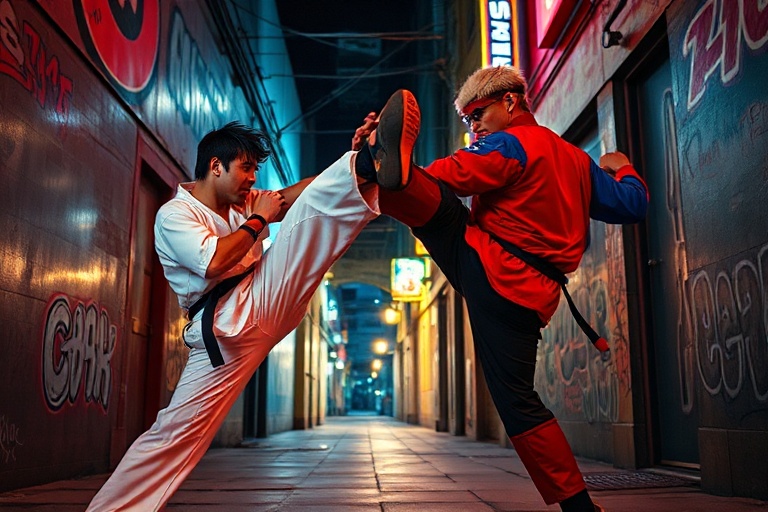
Visually, the movie embraced its arcade roots in some ways. The fight choreography drew from classic martial arts cinema, particularly the work of Bruce Lee, whose influence can be seen in both Guile’s military-style combat and Ryu’s more fluid, traditional techniques. However, the film’s reliance on practical effects—like slow-motion punches and exaggerated sound design—sometimes clashed with the more grounded tone of the performances.
For longtime fans of the game, the film’s deviations were inevitable. While it captured the spirit of Street Fighter’s high-energy battles, it struggled to translate the game’s simplicity into a compelling narrative. This tension between fidelity and innovation would become a recurring theme in video game adaptations, influencing later projects like Mortal Kombat and Uncharted.
The Cast That Defined a Generation
Raúl Juliá’s performance as M. Bison remains the film’s most enduring legacy. His portrayal was equal parts campy and sinister, blending theatrical flair with moments of genuine menace. Juliá’s untimely death in 1994, just months before the film’s release, added a layer of poignancy to his performance, cementing Bison as one of cinema’s most memorable villains.
Jean-Claude Van Damme brought his trademark intensity to Guile, though the role required him to dial back his usual charisma in favor of a more stoic, disciplined presence. The dynamic between Guile and Bison—two alpha males locked in a battle of wills—became the emotional core of the film. Their final confrontation, set against the backdrop of a collapsing Shadaloo base, remains one of the movie’s most iconic moments.
The supporting cast included Wesley Snipes as Blade, a morally ambiguous mercenary, and Byron Mann as Ryu, the game’s iconic martial artist. While Snipes’ performance was widely praised, Mann’s portrayal of Ryu leaned heavily into the character’s stoic, almost robotic demeanor, which some fans found lacking compared to the game’s more expressive design.
The film also introduced Kylie Minogue as Cammy, a British special forces operative with a mysterious past. Her role was expanded from the game, where she was a playable character, into a more central narrative figure. Though her screen time was limited, her presence added a layer of diversity to the cast in an era when such representation was rare in action films.
Behind the scenes, the cast’s camaraderie was a highlight of the production. Interviews from the time reveal a group of actors who genuinely enjoyed working together, despite the film’s challenges. This chemistry translated to the screen, giving the movie a warmth that its script sometimes lacked.
Legacy and Influence on Gaming and Film
The Street Fighter movie arrived at a pivotal moment in the history of video game adaptations. While earlier efforts like Super Mario Bros. (1993) had stumbled, Street Fighter demonstrated that with the right combination of star power and action choreography, a game-based film could find an audience. Its modest box office success—earning over $99 million worldwide against a $35 million budget—proved that there was demand for this kind of entertainment, even if the critical reception was mixed.
Critics at the time were divided. Some praised the film’s energy and visual style, while others criticized its convoluted plot and uneven performances. Roger Ebert, in his review, called it “a loud, dumb movie” but acknowledged its entertainment value. Over time, however, the film’s reputation has shifted. It’s now often cited as a nostalgic artifact of the 1990s, a time when Hollywood was still experimenting with how to bring video games to life.
The movie’s influence can be seen in later adaptations. The gaming industry has since embraced more faithful and cinematic approaches, as evidenced by the success of films like Detective Pikachu (2019) and the Sonic the Hedgehog reboot (2020). Yet the Street Fighter film remains a touchstone, a reminder of the early struggles and occasional triumphs of this genre.
In the years since its release, the movie has gained a dedicated fanbase. Merchandise, including action figures and comic book adaptations, has kept its legacy alive. The film’s soundtrack, composed by Graeme Revell, has also been celebrated for its synth-heavy, industrial score, which perfectly complements the movie’s high-octane atmosphere.
For modern audiences, the Street Fighter movie is less a blueprint and more a historical curiosity—a snapshot of a time when Hollywood was still figuring out how to bridge the gap between pixels and film. Its flaws are part of its charm, and its ambitions, however flawed, paved the way for future adaptations to aim higher.
Where Does the Street Fighter Movie Stand Today?
Decades after its release, the Street Fighter movie occupies a unique space in pop culture. It’s neither a critical darling nor a complete flop, but rather a film that has transcended its initial reception to become something else entirely—a nostalgic relic that fans revisit for its sheer audacity. Its place in gaming history is secure, even if its cinematic legacy remains debated.
The film’s most lasting contribution may be its impact on the careers of those involved. For Jean-Claude Van Damme, it was a high-profile role that solidified his status as an action star. Raúl Juliá’s performance as Bison remains one of his most memorable, a testament to his talent and charisma. Even Kylie Minogue’s brief but impactful role has been reappraised in recent years, with some calling for a modern reboot that expands her character’s story.
Looking ahead, the gaming industry continues to explore adaptations, with varying degrees of success. The upcoming Street Fighter animated series from Netflix, announced in 2023, promises a more faithful and character-driven approach. While it’s unlikely to directly retell the 1994 film’s story, it may finally give the franchise the narrative depth it deserves.
For longtime fans, the original movie is a reminder of a time when video games and cinema were still figuring each other out. It’s a flawed but fascinating artifact, one that captures the spirit of its era in a way that few other adaptations can. Whether it’s celebrated as a cult classic or critiqued as a missed opportunity, its place in history is assured.
Ultimately, the Street Fighter movie is a product of its time—a high-stakes, high-energy spectacle that pushed boundaries while stumbling over its own ambitions. It may never be considered a masterpiece, but it remains an essential chapter in the story of gaming’s journey to the big screen.
Final Thoughts
The Street Fighter movie is a reminder that adaptation is a tricky art. It demands respect for the source material while also carving out its own identity. The 1994 film may not have achieved perfection, but it captured the spirit of its time in a way that few other gaming adaptations have. As the industry continues to evolve, its legacy serves as both an inspiration and a