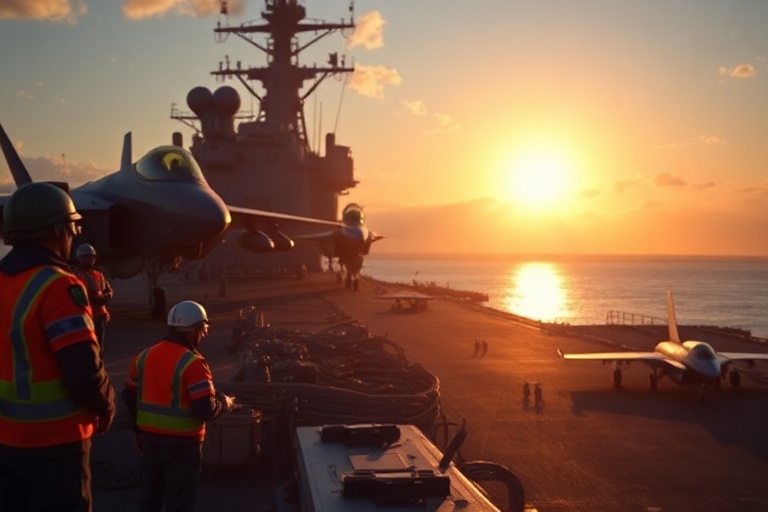
USS Gerald R. Ford Returns: A New Era in Naval Power
USS Gerald R. Ford Returns to Norfolk After Historic Deployment
The USS Gerald R. Ford, the United States Navy’s most advanced aircraft carrier, has returned to its homeport in Norfolk, Virginia, following a six-month deployment that underscored the vessel’s operational readiness and global strategic importance. The carrier’s return marks a significant milestone for the Navy, validating years of investment in next-generation technology and crew training. As one of the most complex engineering feats in modern naval history, the Ford-class carrier represents a leap forward in power projection and maritime dominance.
The deployment tested the carrier’s systems in real-world conditions, from high-traffic sea lanes to contested operational environments. Crew members, many of whom are still adapting to the Ford’s advanced automation and digital interfaces, reported a steep but rewarding learning curve. The return to Norfolk is not just a logistical achievement; it is a cultural moment for the Navy, signaling a new era in carrier aviation.
The Ford’s Technological Leap: What Makes It Different
The USS Gerald R. Ford is the lead ship of its class and the first new U.S. aircraft carrier designed in over 40 years. Unlike its Nimitz-class predecessors, the Ford incorporates electromagnetic aircraft launch systems (EMALS), advanced radar, and a redesigned island superstructure to improve efficiency and reduce crew requirements. These upgrades are not merely incremental—they redefine what an aircraft carrier can do.
- EMALS: Replaces traditional steam catapults with electromagnetic technology, enabling faster launch cycles and reduced maintenance.
- Advanced Arresting Gear: Improves recovery rates for aircraft, particularly critical for drones and heavier jets.
- Increased Power Generation: The Ford produces three times the electrical power of the Nimitz class, supporting future directed-energy weapons and lasers.
- Reduced Crew Requirements: Automation allows for a smaller crew while maintaining operational tempo.
During its deployment, the Ford demonstrated its ability to integrate with allied navies, including exercises with NATO partners in the Mediterranean and North Atlantic. These drills highlighted the carrier’s role not just as a warship, but as a diplomatic tool, projecting stability in regions where tensions are rising. The Ford’s arrival in Norfolk was met with a water salute from other naval vessels, a tradition reserved for ships returning from significant missions.
Global Reactions: How the World Views America’s New Carrier
The USS Gerald R. Ford’s deployment did not go unnoticed by America’s rivals. Chinese state media criticized the carrier as a symbol of U.S. military overreach, while Russian analysts emphasized the challenges of countering such advanced platforms. Meanwhile, allied nations, particularly in Europe and the Indo-Pacific, welcomed the Ford’s presence as a stabilizing force.
In Japan, defense officials praised the Ford’s deployment as a sign of America’s commitment to regional security. The carrier’s participation in joint exercises with the Japan Maritime Self-Defense Force underscored the growing importance of U.S.-Japan defense cooperation. Similarly, NATO allies in Europe viewed the Ford’s operations in the Mediterranean as a reinforcement of collective defense principles.
Public perception of the Ford varies widely. In the United States, the carrier is often framed as a symbol of national pride and technological prowess. However, critics argue that the $13 billion price tag could have been better spent on other defense priorities. Globally, the Ford is seen as both an asset and a provocation—an unmistakable reminder of America’s unrivaled naval power.
What’s Next for the USS Gerald R. Ford?
The carrier’s return to Norfolk is not the end of its journey, but the beginning of a new phase. The Navy plans to conduct extensive post-deployment assessments to evaluate the Ford’s performance, particularly its advanced systems. Some adjustments may be necessary before the carrier embarks on its next deployment, which is expected in 2025.
The Ford-class program remains a cornerstone of the Navy’s future fleet. The second ship in the class, the USS John F. Kennedy, is already under construction, with plans for additional carriers to follow. These vessels will ensure that the U.S. maintains its dominance in carrier aviation for decades to come.
For the crew of the USS Gerald R. Ford, the return home is a moment of reflection. Many have spent years preparing for this deployment, and their experiences will shape the next generation of naval aviation. The carrier’s technological innovations and operational successes will influence not just the Navy, but the broader defense industry.
As the Ford undergoes maintenance and upgrades, its legacy is already being written. It is more than a ship—it is a statement of intent, a testament to American engineering, and a key piece of the global security architecture. The world is watching, and the next chapter of the Ford’s story is just beginning.