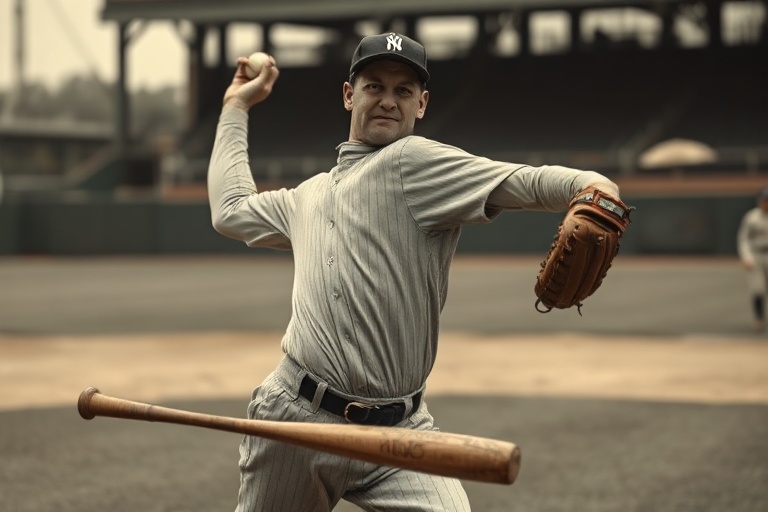
Few names resonate as powerfully in baseball history as Cy Young. Over a 22-year career spanning from 1890 to 1911, Young established records that would stand for generations. His dominance on the mound wasn’t just about statistics—it was about sheer consistency and longevity that modern pitchers rarely approach.
The pitcher we now memorialize with baseball’s most prestigious award wasn’t always a household name. Denton True Young began his professional career in 1890 with the Cleveland Spiders, a franchise that would later become infamous for its role in the 1899 “syndicate” scandal. Young’s early years showed flashes of brilliance, but it was his move to the Boston Americans (later the Red Sox) in 1901 that cemented his legendary status.
The Pitching Dominance That Defined an Era
Young’s approach to pitching was revolutionary for his time. Unlike modern pitchers who rely on specialized pitch types, Young mastered a straightforward repertoire: a blazing fastball, an effective changeup, and pinpoint control. His ability to work deep into games became his trademark. In 1904, he pitched a perfect game against the Philadelphia Athletics—a feat so rare that only 24 have been thrown in MLB history since.
His most staggering achievement came in 1904 when he pitched three no-hitters in a single season, including a streak of 25.1 consecutive hitless innings. While modern pitchers have surpassed some of his statistical records, Young’s endurance remains unmatched. Consider these milestones from his career:
- 511 career wins (a record that still stands over a century later)
- 749 complete games out of 815 starts
- 7,356 innings pitched (nearly 1,000 more than Walter Johnson, second all-time)
- 316 losses (another record that may never be broken)
Young’s approach wasn’t about flashy strikeouts—it was about efficiency and durability. He averaged over 300 innings per season during his prime years, a workload that would terrify modern pitching coaches. His longevity was equally remarkable. He won 20 or more games in 15 different seasons, including 30-win seasons at ages 39 and 41.
The Man Behind the Legend
Born in 1867 in Gilmore, Ohio, Young grew up on a farm where he developed both his work ethic and his powerful right arm. He began playing semi-pro baseball while working as a farmhand, eventually signing with Canton in 1889. His nickname “Cy” reportedly came from his similarity to a fire-breathing character named Cyclone Young from local folklore.
Off the field, Young was known for his quiet demeanor and dedication to the game. He married his wife, Roba Miller, in 1892 and remained devoted to her until her death in 1933. The couple had no children, but Young remained close to his extended family throughout his life. After retiring from baseball in 1911, he returned to his Ohio farm where he lived quietly until his death in 1955 at age 88.
Young’s post-retirement years were marked by financial struggles that surprised many given his legendary status. Despite being one of baseball’s first millionaires, poor investments and the stock market crash left him financially vulnerable. The baseball community eventually rallied to support him, culminating in the creation of the Cy Young Award in 1956, which honors the best pitchers in each league.
Legacy and Impact on Modern Baseball
When evaluating Young’s impact, it’s essential to contextualize his achievements within baseball’s evolution. The dead-ball era in which he thrived featured smaller ballparks, softer baseballs, and pitching mounds that favored pitchers significantly. Young’s success wasn’t just about his talent but about his ability to adapt to changing conditions throughout his career.
His influence extends beyond statistics. Young’s longevity inspired generations of pitchers to prioritize durability alongside performance. While modern pitchers focus on pitch counts and pitch types, Young’s approach was fundamentally different. He relied on location and changing speeds rather than velocity, proving that finesse could be just as effective as power.
Today, the Cy Young Award remains the most prestigious honor a pitcher can receive. Since its inception, the award has been won by legends like Sandy Koufax, Greg Maddux, and Clayton Kershaw. Each winner receives a trophy featuring Young’s likeness, ensuring his legacy endures with every season.
Young’s career also provides valuable lessons about perspective in sports. His 316 losses, which would be unthinkable for modern pitchers, remind us that baseball is a team game where even the greatest pitchers face poor defensive support or offensive droughts. His ability to maintain excellence despite these challenges speaks to his character as much as his skill.
Why Cy Young Still Matters
In an era where baseball statistics are dissected with microscopic precision, Young’s achievements remain relevant because they represent something fundamental about the sport. His 511 wins weren’t achieved through specialization but through adaptability and work ethic. He pitched in an era before relief specialists, before pitch clocks, and before elaborate scouting reports.
Young’s career challenges modern notions of pitcher workload and development. While baseball has rightfully focused on pitcher safety in recent decades, Young’s career serves as a reminder that baseball was once a different game—one where pitchers were expected to be iron men. His records stand as both monuments to his greatness and warnings about the physical toll of the sport.
More than a century after his retirement, Young’s legacy continues to shape baseball’s understanding of pitching excellence. The Cy Young Award ensures that new generations learn his name alongside current superstars. His story reminds us that true greatness isn’t measured in highlight-reel moments but in sustained excellence over decades.
For fans seeking to understand baseball’s history, Young’s career offers a fascinating window into the sport’s past. His dominance wasn’t about breaking records—it was about defining what excellence looked like in his era. In that sense, Cy Young remains one of baseball’s most important figures, bridging the gap between the sport’s early days and the modern game.
As baseball continues to evolve, Young’s records may eventually fall. But his legacy as the winningest pitcher in history will endure, a testament to his unparalleled combination of skill, durability, and love for the game.
Explore more baseball history and sports legends on Dave’s Locker.