damien hirst
Damien Hirst remains one of the most polarizing and influential figures in contemporary art. Since bursting onto the scene in the late 1980s as part of the Young British Artists (YBAs) movement, Hirst has consistently challenged artistic conventions while maintaining a firm grip on the public imagination. His work spans sculpture, painting, installation, and conceptual pieces, often exploring themes of death, religion, and the human condition with unapologetic directness.
Early Life and the Rise of the YBAs
Born in Bristol, England, in 1965, Damien Steven Hirst grew up in Leeds before studying Fine Art at Goldsmiths College in London. It was there, in the late 1980s, that he began to crystallize his artistic vision—a blend of shock value, scientific inquiry, and existential reflection. Alongside peers like Tracey Emin and Sarah Lucas, Hirst became a central figure in the YBAs, a group that would redefine British art in the 1990s.
The YBAs were united by their embrace of unconventional materials and themes, often blurring the line between art and controversy. Hirst’s early work, particularly his “Natural History” series, set the tone. These pieces featured preserved animals—sharks, cows, sheep—suspended in formaldehyde-filled vitrines, forcing viewers to confront the visceral reality of death. His 1991 installation Mother and Child Divided, featuring a cow and calf cut in half and displayed in separate tanks, became an instant icon of shock art.
By the mid-1990s, Hirst’s reputation had skyrocketed. In 1995, he won the Turner Prize, a watershed moment that cemented his status as a cultural provocateur. His work was no longer just art; it was a statement, a provocation, and a business strategy all at once.
The Business of Art: Hirst as Entrepreneur
Hirst’s relationship with commerce has been as contentious as his art. He has often blurred the boundaries between artist, brand, and commodity, embracing the role of the entrepreneur long before terms like “artpreneur” entered the lexicon. His 2008 auction at Sotheby’s, “Beautiful Inside My Head Forever,” was a landmark event where he bypassed galleries entirely, selling over £110 million worth of work directly to collectors.
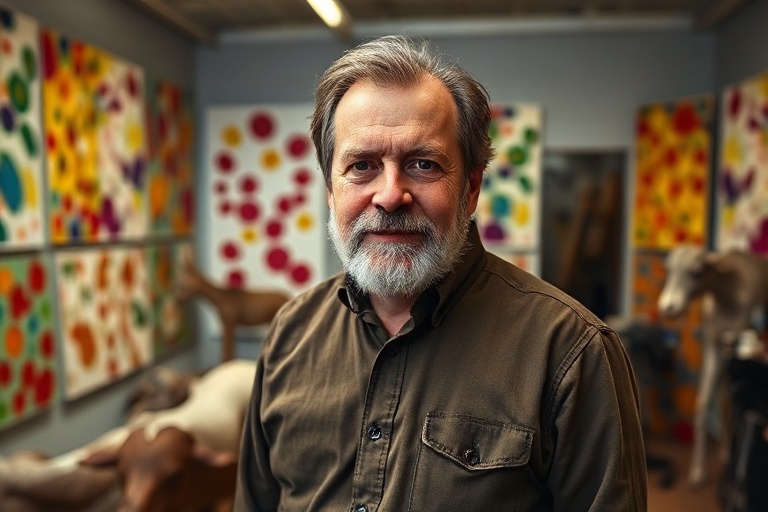
This approach was both revolutionary and controversial. Critics accused Hirst of prioritizing profit over artistic integrity, while supporters argued that he was simply acknowledging the market forces that have always shaped art. His spot paintings, for instance, became a formulaic yet endlessly adaptable product—uniform rows of colored dots that could be produced in any size or color scheme, appealing to corporate collectors and casual buyers alike.
Hirst’s business acumen extended beyond auctions. He launched his own publishing house, Other Criteria, and collaborated with brands like Alexander McQueen and Absolut Vodka. Even his exhibitions, such as Treasures from the Wreck of the Unbelievable (2017), were designed as immersive, marketable experiences, blending myth, history, and spectacle.
Controversies and Criticisms: The Price of Provocation
Hirst’s career has been marked by a relentless pursuit of controversy, often drawing ire from both the art world and the public. His 1999 exhibition In and Out of Love, featuring live butterflies emerging from pupae attached to canvas, was criticized for its perceived cruelty to the insects. Similarly, his use of real animals in formaldehyde has sparked ethical debates about the treatment of animals in art.
Some detractors argue that Hirst’s work lacks depth, reducing complex themes like mortality and religion to gimmicks designed for shock value. His 2007 sculpture For the Love of God, a diamond-encrusted skull, was lambasted by some as a crass display of wealth rather than a meditation on vanitas. Yet others saw it as a brilliant commentary on consumerism and the commodification of art itself.
Hirst has also faced scrutiny for his reliance on assistants to produce much of his work. While this practice is common among contemporary artists, Hirst’s scale and visibility have made it a focal point for criticism. He has defended the approach, arguing that the concept and execution are inseparable in his work, and that the physical labor is part of the creative process.
Key Controversies in Hirst’s Career
- 1999: In and Out of Love – Criticized for the use of live butterflies in an installation.
- 2007: For the Love of God – A diamond-encrusted skull that became a symbol of both artistic genius and excess.
- 2012: Spot Paintings – Accused of being formulaic and mass-produced, undermining their artistic value.
- 2017: Treasures from the Wreck of the Unbelievable – A sprawling exhibition criticized for its perceived lack of originality and reliance on spectacle.
Legacy and Influence: Shaping the Art World
Despite the controversies, Hirst’s impact on the art world is undeniable. He has redefined what it means to be an artist in the 21st century, merging conceptual rigor with commercial savvy. His work has inspired countless artists to explore the intersection of art and commerce, often blurring the lines between the two. The YBAs, in particular, owe much of their global recognition to Hirst’s early leadership and boundary-pushing ethos.
Hirst’s influence extends beyond the art world. His collaborations with fashion designers, musicians, and even pop culture figures have cemented his status as a cultural icon. His 2019 exhibition Cherry Blossoms, featuring vibrant paintings of cherry trees, marked a departure from his earlier themes, showcasing his versatility and willingness to evolve.
Yet, his legacy is not without its complexities. For some, Hirst represents the worst excesses of the art market—a symbol of how art can become a commodity divorced from meaning. For others, he is a necessary disruptor, challenging audiences to confront uncomfortable truths about life, death, and value. Whether admired or reviled, Hirst’s work demands attention, forcing us to grapple with the role of art in society.
Where to Experience Hirst’s Work Today
Hirst’s work can be found in museums and galleries around the world, from the Tate Modern in London to the Museum of Modern Art in New York. For those interested in diving deeper into his oeuvre, here are a few key destinations:
- The Broad, Los Angeles – Home to In and Out of Love, this contemporary art museum offers a close look at one of Hirst’s most controversial installations.
- Tate Modern, London – The permanent collection includes several of Hirst’s seminal works, including Mother and Child Divided and The Physical Impossibility of Death in the Mind of Someone Living.
- Leviathan, Venice – Hirst’s 2017 exhibition at the Venice Biennale featured a massive anatomical sculpture, blending art and science in a striking installation.
- Newport Street Gallery, London – A dedicated space for Hirst’s collection of his own work and pieces by other artists, offering a curated glimpse into his artistic vision.
For a broader exploration of contemporary art movements that Hirst influenced, visit our Culture and Entertainment sections on Dave’s Locker.
Conclusion: The Enduring Provocation of Damien Hirst
Damien Hirst’s career is a study in contradictions. He is both a genius and a charlatan, a visionary and a provocateur. His work challenges us to think critically about life, death, and the value we place on art. Whether through his shocking installations or his unapologetic embrace of the market, Hirst has ensured that his name—and his art—remain impossible to ignore.
Love him or hate him, Hirst’s influence on contemporary art is undeniable. He has redefined the boundaries of what art can be, and in doing so, has left an indelible mark on the cultural landscape. As the art world continues to evolve, Hirst’s legacy serves as a reminder that art is not just about beauty or technique—it is about provocation, conversation, and the relentless pursuit of meaning.