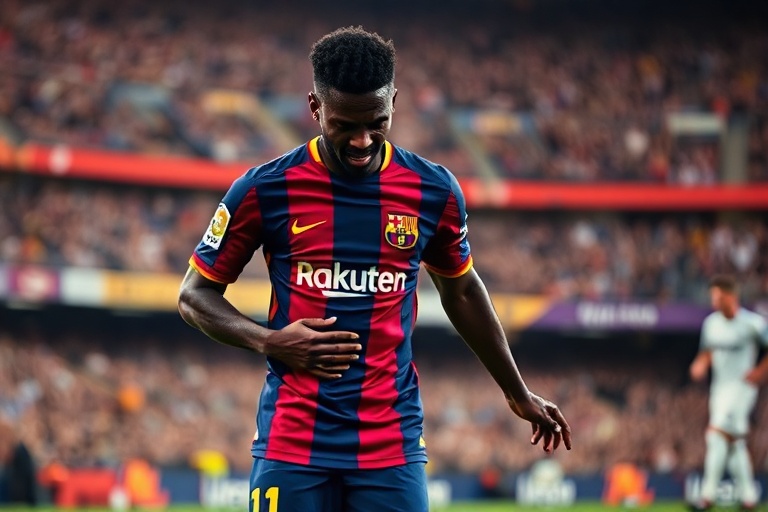
Ousmane Dembélé’s recurring injury issues have once again thrust Barcelona into the spotlight for all the wrong reasons. The French winger, whose flair and creativity have long been central to the team’s attacking identity, has become synonymous with fragility rather than brilliance. As the club grapples with its most turbulent season in decades, Dembélé’s latest setback—reported during a recent league match—has amplified concerns about both his future and the team’s ability to compete at the highest level.
Injuries are an inevitable part of professional football, but Dembélé’s case has taken on a different dimension. Unlike fleeting hamstring strains or minor knocks, his issues have lingered, raising questions about underlying physical imbalances, recovery protocols, or even psychological factors. Barcelona, a club accustomed to medical crises, now faces a dilemma that extends beyond the pitch: how to manage a player whose talent is undeniable but whose availability has become a recurring nightmare.
The Anatomy of Dembélé’s Struggles
Dembélé’s injury history is well-documented. Since joining Barcelona in 2017 for a reported €140 million, he has missed over 100 matches due to various ailments. His issues are not limited to one specific area; instead, they span a spectrum of concerns:
- Muscle strains: Primarily affecting his hamstrings and adductors, these injuries have sidelined him in critical moments, including Champions League fixtures.
- Recurrent ankle problems: A persistent issue that has required multiple interventions, including injections and rehabilitation.
- Psychological toll: The pressure to perform while constantly battling injuries has taken a visible toll on his confidence and consistency.
The latest injury, suffered during a La Liga clash with Real Sociedad, has reignited debates about whether Barcelona’s medical team is doing enough—or if the club’s grueling schedule is exacerbating the problem. European football’s relentless calendar, combined with the physical demands of playing in a high-intensity league, has made injury prevention a Herculean task for even the most well-resourced clubs.
Barcelona’s Broader Crisis: More Than Just Dembélé
Dembélé’s plight is emblematic of a larger crisis at Barcelona. The club, once the bastion of tiki-taka football and global dominance, is now a shadow of its former self. Financial mismanagement, poor recruitment, and a revolving door of managers have all contributed to a downward spiral. In this context, injuries to key players—whether Dembélé, Gavi, or Araújo—feel like the final straw.
Barcelona’s reliance on a small core of players has made them particularly vulnerable. When injuries strike, the depth of the squad is exposed, and the consequences are immediate. The club’s transfer ban in recent years has further limited their ability to rotate players or bring in reinforcements, forcing them to squeeze every drop of performance from an already fatigued group.
Globally, Barcelona’s struggles have resonated deeply with fans. The club’s identity is intertwined with its history of resilience, from the 2008 financial crisis to the 2010-11 treble. Yet, today’s challenges feel different—less about tactical missteps and more about structural failures. Dembélé, for all his talent, is a symptom of a system that has broken down.
Cultural Impact: The Globalization of Football’s Injury Epidemic
Dembélé’s story is not unique in the modern game. Across Europe, clubs are grappling with an epidemic of injuries, particularly to high-profile attacking players. The reasons are multifaceted:
- Increased physical demands: The modern game requires players to cover more ground, press higher, and execute quick transitions, all of which elevate the risk of muscle fatigue and injury.
- Shorter preseasons: The expansion of club competitions, including the FIFA Club World Cup and expanded Champions League, has reduced preparation time, leaving players ill-prepared for the rigors of the season.
- Data-driven training: While analytics have improved performance, they have also contributed to over-training and insufficient recovery periods, particularly for players with pre-existing conditions.
- Cultural differences in player management: European clubs often prioritize immediate performance over long-term health, a mindset that contrasts sharply with leagues like the MLS or J-League, where player longevity is more carefully managed.
Dembélé’s case has also sparked conversations about the role of agents and advisors in pushing players back to fitness prematurely. In an era where contracts are tied to performance bonuses, the incentives to return quickly—even if not fully recovered—are strong. This dynamic has led to a cycle of recurring injuries, where players never truly regain their peak form.
The Road Ahead: Can Barcelona Recover?
The path to recovery for both Dembélé and Barcelona is fraught with uncertainty. For the player, the focus must shift from short-term fixes to long-term solutions. This could involve:
- Working with specialists to address underlying biomechanical issues.
- Implementing a rigorous off-season conditioning program to build resilience.
- Exploring alternative recovery methods, such as cryotherapy or hyperbaric oxygen therapy, which have shown promise in recent years.
For Barcelona, the challenges are even steeper. The club’s financial constraints mean that immediate reinforcements are unlikely. Instead, they must rely on internal solutions: better squad management, tactical adjustments to reduce physical strain, and a renewed emphasis on youth development. The emergence of players like Lamine Yamal and Fermín López offers a glimmer of hope, but the transition will not be seamless.
Globally, the debate about player welfare is gaining traction. UEFA and FIFA have begun to address the issue, with proposals for reduced fixtures and mandatory rest periods. However, progress is slow, and the commercial interests of clubs often take precedence over the health of players.
Dembélé’s journey will be closely watched in the coming months. If he can return to form, it may signal a turning point for Barcelona. If not, it could be the final chapter in a story of wasted potential. Either way, his story serves as a cautionary tale about the fragility of modern football and the need for systemic change.
Conclusion: A Moment of Reckoning
Ousmane Dembélé’s injury is more than a setback for Barcelona—it is a reflection of deeper issues plaguing the sport. In a world where football is increasingly commodified, the human cost of the game is often overlooked. Clubs must strike a balance between ambition and pragmatism, prioritizing player health over short-term gains.
For fans, the hope is that this moment of crisis will lead to meaningful change. Whether through improved medical protocols, better scheduling, or a cultural shift in how we view player welfare, the lessons from Dembélé’s struggles must not be wasted. Football’s beauty lies in its unpredictability, but its future depends on its ability to protect those who make it possible.
For more insights into Barcelona’s season and player injuries, visit our Sports section.