From the lush green hills of the Emerald Isle to the rugged highlands of Caledonia, the relationship between Ireland and Scotland is one steeped in history, culture, and sport. While the world often focuses on their athletic competitions, the ties between these two nations run deeper than the scores on a scoreboard. This is a story of shared heritage, economic bonds, and the enduring spirit of competition that defines their interactions on the global stage.
The Historical Tapestry: Shared Roots and Divergent Paths
Centuries ago, Ireland and Scotland were not merely neighboring lands separated by the North Channel; they were part of a broader Celtic world. The Gaels, a people whose language and traditions once stretched across both regions, left an indelible mark on the cultural landscape. Place names, folklore, and even surnames in both countries reflect this ancient connection. For instance, the Scottish surname “MacDonald” and the Irish “MacDonnell” trace their origins to the same Gaelic roots, illustrating a shared ancestry that predates modern national boundaries.
Yet history also carved distinct paths for these nations. Ireland’s struggle for independence from Britain in the early 20th century set it apart from Scotland, which remained part of the United Kingdom. This divergence shaped their political and social trajectories, creating a dynamic where proximity did not always equate to alignment. The 1921 partition of Ireland, which left Northern Ireland under British rule, further complicated relations, as Scotland’s own identity within the UK evolved differently. Despite these differences, the cultural exchanges between the two nations persisted, influencing music, literature, and even culinary traditions.
Key Moments in Historical Exchange
- 1609: The Plantation of Ulster saw Scottish settlers move to Ireland, particularly in the northern province, leaving a lasting demographic and cultural imprint.
- 1707: The Acts of Union merged Scotland with England to form Great Britain, while Ireland remained under separate, though increasingly intertwined, governance.
- 19th Century: Mass emigration from Ireland to Scotland, particularly to cities like Glasgow and Edinburgh, strengthened cultural ties but also brought challenges, including sectarian tensions.
- 2014: Scotland’s independence referendum, though unsuccessful, sparked discussions in Ireland about its own constitutional future and the possibility of reunification.
Sporting Rivalries: More Than Just Games
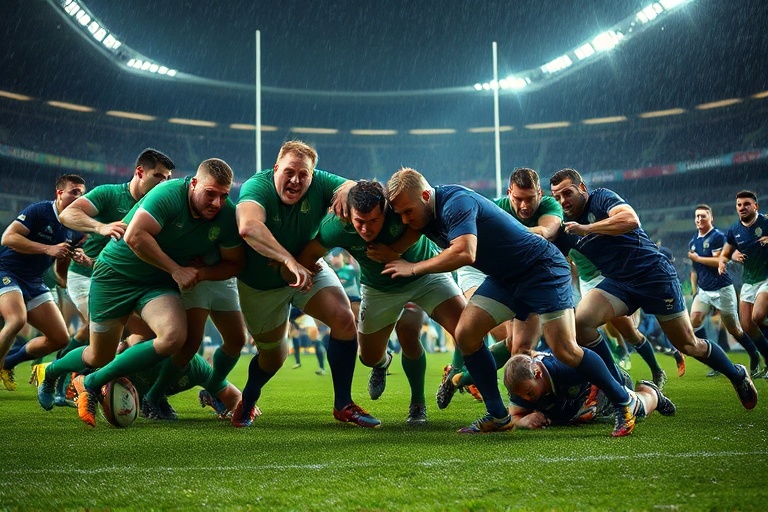
Sport has long served as a microcosm of the broader relationship between Ireland and Scotland. While rugby and football dominate the headlines, these competitions are more than just games; they are expressions of national pride, historical grievances, and cultural identity. The annual Six Nations rugby tournament, where Ireland and Scotland face off, is a prime example of how sport can amplify emotions that transcend the pitch.
In rugby, Ireland has enjoyed significant success in recent years, winning the Six Nations Grand Slam in 2018 and 2023. Their dominance has added a layer of intensity to matches against Scotland, who, despite their smaller population, have a proud rugby tradition. Matches between the two teams are often closely contested, reflecting a mutual respect and a desire to prove superiority. Football, too, has its moments, though the rivalry is less pronounced. The two nations have faced off in international competitions and club tournaments, but the passion is often overshadowed by club rivalries, such as those between Celtic and Rangers in Scotland and the Dublin-based clubs in Ireland.
Beyond the Pitch: Cultural and Economic Exchanges
The rivalry between Ireland and Scotland is not confined to sports arenas. Both nations have developed robust cultural and economic relationships that highlight their interdependence. Tourism is a prime example, with thousands of visitors crossing the Irish Sea each year to explore the other’s landscapes, historic sites, and vibrant cities. Dublin and Edinburgh, in particular, share a reputation as cultural hubs, attracting artists, musicians, and writers from around the world.
Economically, the ties are equally significant. Ireland and Scotland are major trading partners, with goods and services flowing freely between them. The technology sector, in particular, has seen growing collaboration, as companies in both nations benefit from shared expertise and resources. Meanwhile, the energy sector offers another point of connection, with Scotland’s expertise in renewable energy complementing Ireland’s push toward sustainability. These exchanges underscore a pragmatic relationship that prioritizes mutual growth over historical tensions.
The Modern Relationship: Cooperation and Competition
In the 21st century, Ireland and Scotland have found themselves navigating a complex global landscape where cooperation often trumps competition. Both nations are members of the European Union (until Brexit reshaped their relationship with Europe), the United Nations, and other international organizations. This shared membership has fostered collaboration on issues ranging from climate change to digital innovation. For instance, both countries have committed to ambitious carbon reduction targets, and their governments frequently consult on strategies to achieve these goals.
Yet competition remains a defining feature of their relationship, particularly in areas where they vie for global attention. Tourism boards in both nations actively market their unique attractions, from Ireland’s coastal cliffs to Scotland’s historic castles. Similarly, their education systems attract international students, with universities in Dublin, Cork, and Galway competing with those in Edinburgh, Glasgow, and Aberdeen for top talent. This healthy rivalry drives innovation and ensures that both nations continue to punch above their weight on the world stage.
Looking Ahead: What the Future Holds
The future of the Ireland-Scotland relationship will likely be shaped by three key factors: Brexit, the push for Irish reunification, and the evolving dynamics of the UK and EU. Brexit has already forced both nations to rethink their economic strategies, with Scotland’s desire to remain closely aligned with the EU clashing with the UK government’s stance. Meanwhile, the debate over Irish reunification, fueled by demographic shifts and political changes, could redefine the island’s relationship with its northern neighbor and, by extension, Scotland.
Regardless of these challenges, the cultural and historical bonds between Ireland and Scotland are unlikely to fray. The two nations share a love for music, with traditional Irish and Scottish folk traditions influencing each other for centuries. Literature, too, has seen cross-pollination, from the works of James Joyce and W.B. Yeats to those of Robert Burns and Irvine Welsh. These artistic connections serve as a reminder that, beyond politics and sport, Ireland and Scotland are bound by a shared creativity that transcends borders.
As the world becomes increasingly interconnected, the relationship between Ireland and Scotland offers a compelling case study in how nations can navigate shared histories while forging new paths forward. Whether on the rugby field, in the boardroom, or in the concert hall, their interactions are a testament to the power of rivalry and cooperation in shaping a shared future.
For more on the cultural and sporting connections between these nations, explore our Sports and Culture sections. The stories of Ireland and Scotland are far from over, and their next chapters promise to be as rich and complex as their past.