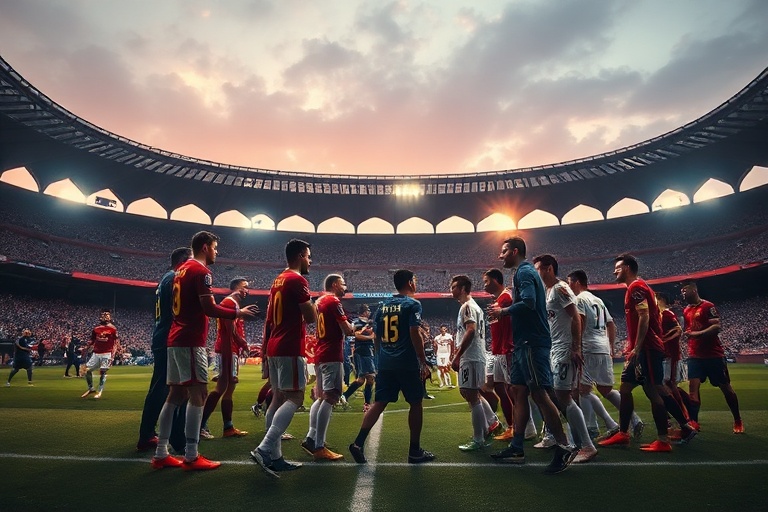
Football’s most dramatic narratives often unfold outside the bright lights of the season’s climax. Such was the case on December 17, 2023, when Sevilla FC hosted Real Madrid CF at the Ramón Sánchez-Pizjuán Stadium in a Spanish league match that carried more than just three points in the balance. This encounter, devoid of the official label of “Clásico,” still carried the weight of a rivalry that has simmered for generations.
Madrid arrived as the undisputed king of European football, fresh off a Champions League triumph and a league title. Sevilla, meanwhile, were in the midst of a rebuilding phase under coach Diego Alonso, a team still finding its identity after years of continental success. Yet this match would become a microcosm of football’s unpredictability—a reminder that no fortress is unassailable, no crown entirely secure.
The Rivalry Beyond the Headlines
While Real Madrid and Barcelona’s Clásico dominates global attention, the Madrid-Sevilla fixture carries its own cultural significance. Located just 530 kilometers apart, these cities share a deep historical connection rooted in Reconquista-era alliances, regional pride, and economic rivalry. Sevilla, the gateway to Andalusia, has long been a cultural powerhouse—home to flamenco, Moorish architecture, and a working-class identity that contrasts sharply with Madrid’s bureaucratic centralism.
Football has become another battleground for this identity. Sevilla, despite their smaller budget, have historically punched above their weight in Europe, winning the Europa League a record seven times. Real Madrid, meanwhile, represent the apex of global football—Galácticos, Ballon d’Or winners, and a club synonymous with excellence. The clash between ambition and tradition played out on the pitch in vivid colors.
A Tactical Chess Match in Andalusia
Alonso lined up Sevilla in a disciplined 4-2-3-1, prioritizing defensive solidity and quick transitions. Real Madrid, under Carlo Ancelotti, deployed a fluid 4-3-3 formation, with Jude Bellingham orchestrating play from midfield and Vinícius Júnior and Rodrygo stretching the pitch. Early pressure from Madrid saw them dominate possession, but Sevilla’s organization frustrated their creativity.
The turning point came in the 24th minute, when Sevilla’s Lucas Ocampos capitalized on a defensive error to score a clinical first goal. Madrid responded with wave after wave of attacks, but Sevilla’s goalkeeper, Marko Dmitrović, produced a string of crucial saves, including a point-blank stop from Karim Benzema just minutes before halftime.
In the second half, Madrid increased the tempo. Federico Valverde and Eduardo Camavinga surged forward, while Vinícius Júnior forced Dmitrović into another save. Yet Sevilla’s counterattacks remained dangerous—Ocampos nearly doubled the lead in the 68th minute, only for the goal to be ruled out for a marginal offside call.
As the final whistle approached, Madrid threw everything forward. A 90th-minute equalizer from Federico Valverde seemed inevitable—until it wasn’t. The rebound fell to Benzema, whose shot was brilliantly blocked by Sevilla’s central defender, Loïc Badé, in the 94th minute. The stadium erupted. Madrid’s players collapsed in exhaustion. Sevilla had earned a historic point.
Why This Match Resonated Beyond the Scoreboard
The result sent ripples across the football world. For Sevilla, it was validation—a sign that their patient rebuilding was bearing fruit. For Madrid, it was a rare setback in a season that saw them dominate domestically and in Europe. But beyond the standings, the match highlighted broader trends in modern football.
Madrid’s reliance on individual brilliance—Bellingham, Vinícius, Benzema—was momentarily disrupted by Sevilla’s collective resilience. The Andalusian side demonstrated that tactical discipline, team cohesion, and a never-say-die attitude can still overcome star power. In an era where clubs like Manchester City and Bayern Munich prioritize possession and high pressing, Sevilla’s pragmatic approach felt like a throwback to a different footballing philosophy.
This match also underscored the growing influence of Spanish football outside the traditional powerhouses. Sevilla’s Europa League legacy and their ability to compete with the elite reflect a decentralization of footballing power. Cities like Sevilla, Villarreal, and Athletic Bilbao have become laboratories for tactical innovation and sustainable development models.
Cultural Echoes on and Off the Pitch
Football in Spain is more than a sport—it’s a cultural artifact. The Madrid-Sevilla fixture, though not a Clásico, carries the weight of regional pride. For Sevillanos, supporting Sevilla is an act of defiance, a celebration of their unique identity within a nation often dominated by Madrid’s political and economic influence.
On matchday, the streets of Seville filled with singing, drumming, and the scent of fried food. The stadium became a stage for flamenco chants and rhythmic percussion, blending the passion of football with the soul of Andalusia. Madrid, by contrast, arrived with the polish of a global brand—uniforms sponsored by Emirates, players with worldwide appeal, and a fanbase that spans continents.
Yet in that tension between tradition and modernity lay the beauty of the fixture. Sevilla’s victory wasn’t just about three points—it was about asserting an identity in a globalized sport where uniformity often trumps uniqueness.
Lessons and Looking Ahead
The match offered several lessons for both clubs. For Madrid, it was a reminder that even the strongest teams can be vulnerable to disciplined opponents. Ancelotti’s side would go on to win La Liga and reach another Champions League final, but this setback forced introspection—particularly around their mental resilience in tight games.
For Sevilla, the draw was a morale booster. Though they finished mid-table that season, the performance against Madrid became a turning point. Alonso’s project began to take shape, culminating in a Copa del Rey triumph the following year. The club’s ability to compete with—and at times, frustrate—the elite sent a message to Spain’s footballing hierarchy.
Looking ahead, the fixture remains one of football’s most intriguing contrasts. Madrid will continue to chase titles, while Sevilla will aim to balance their European ambitions with domestic consistency. Yet in a sport increasingly shaped by financial disparity and sporting inequality, matches like this one offer a rare glimpse of football’s soul.
Because sometimes, the most compelling stories aren’t written by the champions. They’re written by the underdogs who dare to dream.
And in Seville, on that December night, the dream felt just a little bit closer.
Key Takeaways from Sevilla vs Real Madrid
- Tactical Brilliance Meets Resilience: Sevilla’s disciplined setup frustrated Madrid’s star-studded attack, proving that organization can outperform individual talent in key moments.
- Regional Pride on Display: The match highlighted the cultural divide between Madrid’s global identity and Seville’s deep-rooted local pride, making it more than just a football game.
- A Shift in Footballing Power: Sevilla’s strong performance reflected a broader trend in Spanish football, where clubs outside Madrid and Barcelona are asserting their influence through smart recruitment and tactical innovation.
- Mental Fortitude Wins Games: Madrid’s late surge was matched by Sevilla’s crucial defensive blocks, showing how psychological resilience shapes outcomes in high-stakes fixtures.
As football continues to evolve, matches like Sevilla vs Real Madrid remind us that the most unforgettable moments often come not from the expected, but from the unexpected. And in the shadow of the Clásico, another story was being told—one of grit, identity, and the enduring magic of the beautiful game.