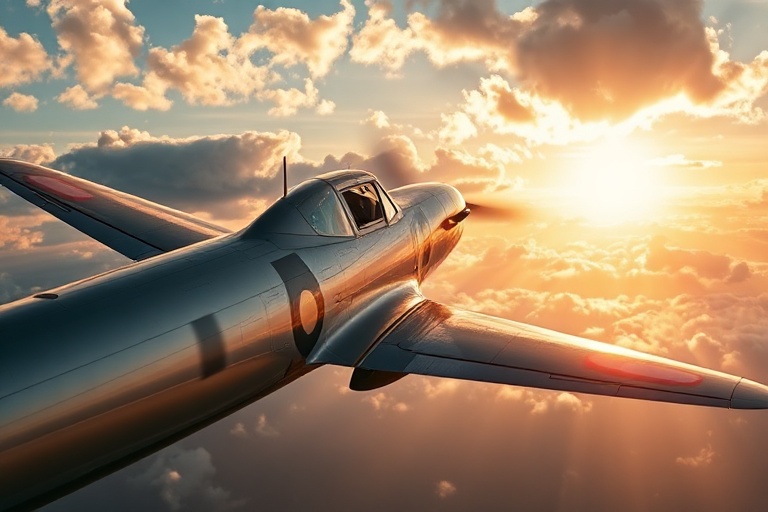
The Supermarine Spitfire stands as one of the most iconic aircraft in aviation history. Designed by R.J. Mitchell and produced by Supermarine Aviation Works, the Spitfire became synonymous with British resilience during World War II. Its elliptical wings, sleek fuselage, and Rolls-Royce Merlin engine made it not only a formidable fighter but also a symbol of national pride.
Entering service in 1938, the Spitfire was designed to counter the growing threat of German air power. Its development was driven by the need for a fast, maneuverable aircraft capable of intercepting high-speed bombers. The Spitfire’s performance in the Battle of Britain cemented its legacy, proving that British engineering could outclass enemy aircraft in critical moments.
The Design and Engineering Behind the Spitfire
The Spitfire’s design was revolutionary for its time. Mitchell’s team at Supermarine focused on aerodynamics, creating an elliptical wing shape that minimized drag while maximizing lift. This design allowed the Spitfire to achieve speeds of up to 360 mph (580 km/h) in later models, making it one of the fastest fighters of the era.
The aircraft’s construction was another innovation. While many fighters of the period used fabric-covered frames, the Spitfire featured an all-metal monocoque structure. This not only improved durability but also reduced weight, enhancing both speed and agility. The Rolls-Royce Merlin engine, paired with a three-bladed propeller, provided the power needed to dominate the skies.
Armament varied across different Spitfire variants. Early models carried eight .303 Browning machine guns, but later versions, such as the Mk.V and Mk.IX, incorporated 20mm Hispano cannons alongside machine guns. This upgrade significantly increased the Spitfire’s firepower, allowing it to engage both fighters and bombers effectively.
Key Spitfire Variants and Their Roles
The Spitfire evolved throughout the war, with each variant tailored to specific combat roles. The Mk.I and Mk.II were the first production models, primarily used for interception and air superiority. The Mk.V, introduced in 1941, became the most-produced variant and saw extensive service in North Africa and the Mediterranean.
For high-altitude combat, the Spitfire Mk.VII and Mk.VIII featured pressurized cabins and improved engines. These models were crucial in intercepting German high-altitude reconnaissance aircraft and bombers. Meanwhile, the Mk.IX, introduced in 1942, was a stopgap measure to counter the Focke-Wulf Fw 190, proving so effective that it remained in production until the war’s end.
The Spitfire’s versatility extended beyond air-to-air combat. The Mk.XII and Mk.XIV were optimized for low-altitude operations, while the Mk.XVI and Mk.XVIII featured bubble canopies for improved pilot visibility. Even after the war, the Spitfire continued to serve in roles such as photo-reconnaissance and training, demonstrating its adaptability.
The Spitfire in Combat: From the Battle of Britain to Global Operations
The Spitfire’s first major test came during the Battle of Britain in 1940. Outnumbered by German Luftwaffe fighters and bombers, the Spitfire and its sister aircraft, the Hawker Hurricane, formed the backbone of Britain’s defense. While the Hurricane accounted for more enemy aircraft, the Spitfire’s superior speed and climb rate made it ideal for intercepting high-performance German fighters like the Messerschmitt Bf 109.
Beyond Europe, the Spitfire saw action in every major theater of the war. In North Africa, it supported Allied ground forces against Rommel’s Afrika Korps, while in the Pacific, it faced off against Japanese Zero fighters. The Spitfire’s ability to operate from makeshift airfields made it invaluable in these diverse environments.
One of the Spitfire’s most notable engagements occurred during Operation Overlord, the D-Day landings. Spitfires provided air cover for the Allied invasion fleet, strafing German positions and disrupting enemy communications. Their presence was a critical factor in securing air superiority over the Normandy beaches.
Pilot Perspectives: What Made the Spitfire Special
For the pilots who flew the Spitfire, the aircraft was more than just a machine—it was a trusted companion in combat. Many pilots praised its responsive controls and forgiving flight characteristics, which made it easier to handle in high-stress situations. The Merlin engine’s smooth power delivery allowed for precise maneuvering, a key advantage in dogfights.
However, the Spitfire was not without its challenges. Early models suffered from poor visibility due to the cockpit’s design, and the aircraft’s narrow landing gear made it prone to ground loops. Despite these drawbacks, pilots admired the Spitfire’s resilience. Many credited the aircraft with saving their lives, whether by outmaneuvering enemy fighters or absorbing battle damage.
Former RAF pilot Tom Neil, who flew Spitfires during the Battle of Britain, recalled, “The Spitfire was a delight to fly. It responded instantly to the controls, and you could feel the power of that Merlin engine beneath you. In a dogfight, it gave you the edge you needed to survive.”
The Spitfire’s Legacy: Beyond World War II
The Spitfire’s impact extended far beyond World War II. Even as jet fighters began to dominate the skies, the Spitfire remained in service with several air forces, including those of Israel, India, and South Africa. Its final operational use in combat came during the 1948 Arab-Israeli War, where Israeli Spitfires clashed with Egyptian and Jordanian aircraft.
Today, the Spitfire is celebrated as a symbol of British engineering and wartime ingenuity. Over 20,000 Spitfires were built, and more than 70 remain airworthy, preserved in museums and private collections worldwide. The aircraft’s legacy is also preserved in modern aviation, where its design principles continue to influence fighter aircraft.
For aviation enthusiasts, the Spitfire represents the pinnacle of piston-engine fighter design. Its combination of speed, agility, and firepower set a standard that few aircraft have matched. Even today, the Spitfire remains a favorite subject for historians, modelers, and pilots alike.
Preserving the Spitfire: Museums and Flying Examples
Several museums around the world house Spitfire exhibits, offering visitors a chance to see these legendary aircraft up close. The Royal Air Force Museum in London, the Smithsonian National Air and Space Museum in Washington, D.C., and the Australian War Memorial in Canberra are among the most notable.
For those seeking a more immersive experience, airworthy Spitfires can still be seen at airshows and aviation events. The Battle of Britain Memorial Flight, operated by the RAF, maintains a fleet of Spitfires that perform at public displays across the UK. These aircraft, still powered by their original Merlin engines, provide a thrilling glimpse into the past.
Restoration efforts continue to bring Spitfires back to flying condition. Organizations like the Spitfire Preservation Society and private collectors dedicate years to rebuilding these aircraft, ensuring that future generations can experience the Spitfire’s magic firsthand.
To learn more about historic fighter aircraft and their roles in aviation history, explore our Aviation History section. For deeper insights into World War II aircraft, visit our WWII category.