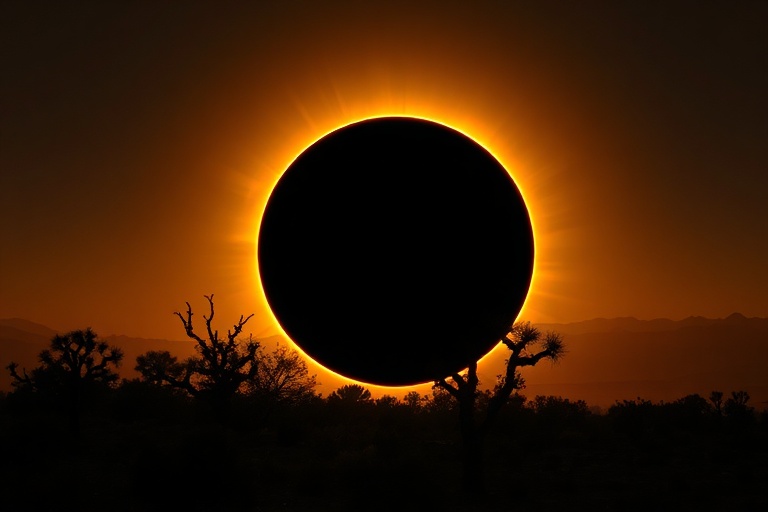
eclipse solar
“`html
Eclipse Solar: When the Moon Steals the Sun’s Light
Total, partial, and annular solar eclipses explained — plus how they’ve shaped science, culture, and human curiosity for centuries.
The Science Behind a Solar Eclipse
A solar eclipse occurs when the Moon passes between the Earth and the Sun, casting a shadow on Earth and temporarily blocking the Sun’s light. This alignment must be nearly perfect, with the Moon’s apparent size matching or slightly exceeding the Sun’s. When it does, the result is one of nature’s most dramatic visual phenomena.
There are three main types of solar eclipses. A total solar eclipse happens when the Moon completely covers the Sun, revealing the solar corona — a halo of plasma that appears as a shimmering crown around the darkened disk. This rare event is only visible from a narrow path on Earth’s surface. A partial solar eclipse occurs when only part of the Sun is obscured, creating a crescent shape. An annular solar eclipse happens when the Moon is too far from Earth to fully cover the Sun, leaving a bright “ring of fire” around the Moon’s silhouette.
The frequency of solar eclipses is surprisingly high — typically two to five occur each year. However, total eclipses are much rarer from any single location. On average, a total solar eclipse returns to the same spot only once every 375 years. The mechanics are governed by celestial geometry: the Moon’s orbit is tilted about 5 degrees relative to Earth’s, so eclipses only occur when the Sun, Moon, and Earth align near the nodes of the Moon’s orbit.
Historical and Cultural Impact of Solar Eclipses
For millennia, solar eclipses were seen as omens, warnings, or divine messages. Ancient Chinese records describe eclipses as dragons devouring the Sun, prompting drumming and ritual to scare the beast away. In Hindu mythology, the demon Rahu was said to swallow the Sun during eclipses, only to have it released when the Sun passed through his severed head.
The ancient Greeks, including Aristotle and Ptolemy, used eclipses to refine their understanding of the cosmos. The philosopher Thales of Miletus is said to have predicted a solar eclipse in 585 BCE, which reportedly halted a war between the Lydians and Medes. This moment is often cited as one of the first instances of science influencing geopolitics.
In more recent history, the 1919 total solar eclipse provided crucial evidence for Einstein’s theory of general relativity. British astronomers observed the bending of starlight near the Sun during the eclipse, confirming Einstein’s prediction that massive objects warp spacetime. This discovery catapulted Einstein to global fame and reshaped modern physics.
What Happens During a Solar Eclipse — and What to Watch For
A solar eclipse unfolds in stages, each offering unique sights and sensations. The event begins with the first contact, when the Moon’s edge first touches the Sun. Over the next hour, the Sun gradually disappears, and shadows sharpen into crescents. As totality approaches, the environment changes dramatically: temperatures drop, birds fall silent, and a hush falls over the landscape.
During totality — the brief period when the Sun is fully obscured — the sky darkens to twilight levels. The solar corona, normally invisible, becomes visible as a pearly-white halo stretching several solar diameters. Planets and bright stars may appear in the darkened sky. The moment of totality is fleeting, often lasting only a few minutes, depending on the geometry of the eclipse.
After totality, the process reverses: the Sun gradually re-emerges, and daylight returns. The final stage, fourth contact, marks the end of the eclipse as the Moon’s shadow moves away.
Key Observing Tips
- Safety first: Never look directly at the Sun without proper eye protection. Use ISO-certified eclipse glasses or a solar filter for telescopes and cameras.
- Timing matters: Know the exact start, peak, and end times for your location. Partial phases can last over an hour, but totality is brief.
- Location, location: Total eclipses are only visible along a narrow path. Plan ahead — hotels and roads fill up quickly.
- Capture the moment: Use a tripod and solar filter for photography. Consider bracketing exposures to capture both the corona and surrounding landscape.
- Share the experience: Eclipses are communal events. Join a viewing party or livestream for a shared sense of awe.
The Broader Implications of Solar Eclipses
Beyond their breathtaking beauty, solar eclipses serve as cosmic laboratories. Scientists use them to study the Sun’s corona, which is millions of degrees hotter than the surface below — a long-standing solar mystery. During an eclipse, researchers can observe solar flares, coronal mass ejections, and the dynamics of the solar wind with unparalleled clarity.
Eclipses also play a role in climate science. The sudden drop in solar radiation during a total eclipse creates a mini-cooling effect, offering a rare opportunity to study how Earth’s atmosphere responds to rapid changes in energy input. Instruments on satellites and aircraft have measured temperature drops of several degrees during past eclipses.
Culturally, eclipses continue to inspire awe and creativity. Artists, writers, and filmmakers have used them as symbols of transformation, endings, or cosmic balance. From Shakespeare’s references in King Lear to modern sci-fi films like Sunshine, eclipses carry a weight of symbolism that transcends science.
They also remind us of our place in the universe. A solar eclipse is a reminder that we live on a small planet orbiting an ordinary star — and that the mechanics of the cosmos are precise, predictable, and occasionally spectacular.
—
METADATA
{
“title”: “What Is a Solar Eclipse? Types, Science & When to See One”,
“metaDescription”: “Learn how solar eclipses work, their types, historical significance, and how to safely observe them during upcoming events.”,
“categories”: [“Science”, “Technology”],
“tags”: [“solar eclipse”, “total eclipse”, “annular eclipse”, “astronomy”, “celestial events”],
“imageDescription”: “A high-resolution photograph of a total solar eclipse showing the Moon completely covering the Sun, revealing the glowing solar corona against a dark sky, with the horizon bathed in twilight and silhouetted observers on a hilltop.”
}
—END METADATA—
“`