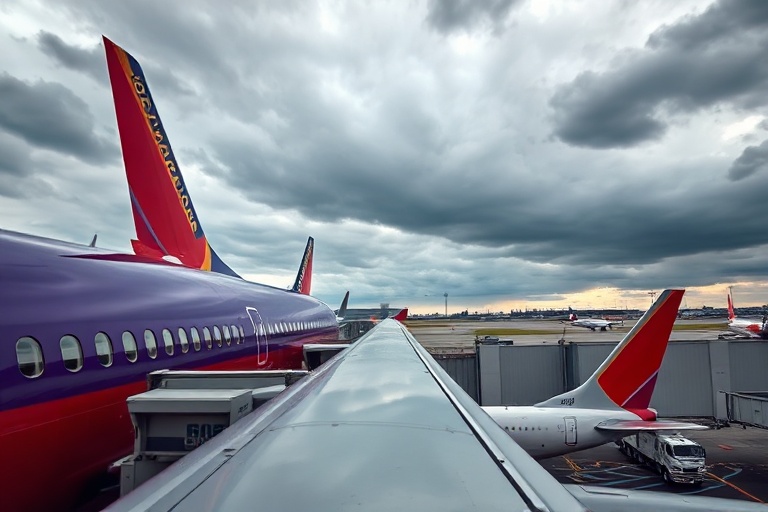
The incident at Baltimore/Washington International Thurgood Marshall Airport (BWI) involving a Southwest Airlines aircraft has become a focal point for discussions about airline safety, passenger rights, and the pressures facing aviation staff. On a routine Tuesday morning, a Southwest flight bound for Orlando encountered an unexpected situation that left passengers shaken and raised broader questions about aviation protocols.
The event began when ground crew noticed a wing clip—an unexpected contact between the aircraft’s wing and a boarding bridge. While such incidents are rare, they serve as stark reminders of the precision required in airport operations. Eyewitness accounts described a loud metallic sound followed by visible damage to both the aircraft and the boarding equipment. No injuries were reported, but the disruption was immediate and significant.
The Immediate Aftermath: Grounded Flights and Passenger Reactions
Southwest Airlines quickly grounded the affected aircraft and initiated an investigation. Passengers described scenes of confusion and concern as flight attendants worked to reassure them. One traveler, who requested anonymity, recalled the moment: “We heard a loud bang. At first, no one knew what it was. Then we saw the damage to the wing. It was unsettling.”
Airport authorities confirmed that the boarding bridge had been retracted prematurely, a procedure typically coordinated with pilots and ground crew. The timing of the incident—during peak travel season—added to the disruption, causing delays that rippled through BWI’s schedule for several hours.
In response, Southwest Airlines issued a statement emphasizing safety as their top priority. “We are cooperating fully with airport officials and the FAA to understand what occurred,” the airline noted. The FAA later confirmed it would review the incident as part of its ongoing oversight of aviation safety standards.
Aviation Safety in Context: How Common Are Wing Clips?
While the term “wing clip” may evoke images of a minor mishap, aviation experts emphasize that such incidents are taken seriously due to the potential risks involved. According to data from the Federal Aviation Administration (FAA), there are approximately 20 to 30 aircraft damage incidents involving ground equipment each year in the U.S. These range from minor scrapes to more serious collisions that can ground aircraft for repairs.
The BWI incident highlights the critical role of communication between pilots, ground crew, and air traffic control. A misstep in timing—even by seconds—can lead to costly damage and operational delays. Aviation consultant Sarah Chen explained, “Every movement on the tarmac is choreographed. A wing clip isn’t just an inconvenience; it’s a failure in the system that relies on split-second coordination.”
Globally, similar incidents have occurred at major airports, often during high-pressure situations such as adverse weather or rapid turnarounds between flights. In 2022, a wing clip at London Heathrow caused a five-hour delay for an international flight, illustrating how quickly a minor issue can escalate into a major disruption.
Passenger Rights and Compensation: What Travelers Should Know
For passengers caught in such disruptions, understanding their rights is crucial. Under U.S. Department of Transportation regulations, airlines are required to provide compensation for significant delays or cancellations due to airline-caused issues. However, the specifics can vary depending on the circumstances.
In the case of the BWI incident, Southwest Airlines offered affected passengers vouchers for future travel, though not all travelers were satisfied with the response. One passenger noted, “We were given a voucher, but no explanation of what happened. It felt like we were being placated rather than informed.”
Travel experts recommend that passengers document any disruptions and request written explanations from the airline. In cases involving damage to personal property, travelers may also file claims with their travel insurance providers.
For those interested in further reading on airline policies, the Travel section on Dave’s Locker offers detailed guides on navigating flight disruptions and understanding passenger rights.
The Broader Impact: Trust in Aviation and Industry Reforms
Incidents like the BWI wing clip also underscore the importance of continuous improvement in aviation safety. Airlines and airports invest heavily in training and technology to minimize such occurrences. Automated systems, such as proximity sensors on boarding bridges, are increasingly being adopted to reduce human error.
However, the human factor remains a critical component. A study by the International Air Transport Association (IATA) found that nearly 70% of ground incidents are attributed to communication failures or procedural lapses. This has led to calls for standardized training programs across the industry.
From a global perspective, the BWI incident reflects broader challenges in aviation, including the pressure to maintain efficiency in an industry that operates at razor-thin margins. As air travel continues to rebound post-pandemic, the demand for reliable service is higher than ever. Any disruption, no matter how minor, can erode passenger trust—a commodity airlines cannot afford to lose.
Key Takeaways for Travelers
- Always document disruptions and request written explanations from the airline.
- Check your travel insurance for coverage related to flight delays or cancellations.
- Stay informed about your rights under DOT regulations, especially for significant delays.
- Allow extra time during peak travel seasons to account for potential disruptions.
As the aviation industry evolves, incidents like the BWI wing clip serve as important reminders of the need for vigilance, transparency, and continuous improvement. While the immediate impact of such events can be unsettling, they also provide opportunities for the industry to learn and adapt, ensuring safer skies for all.