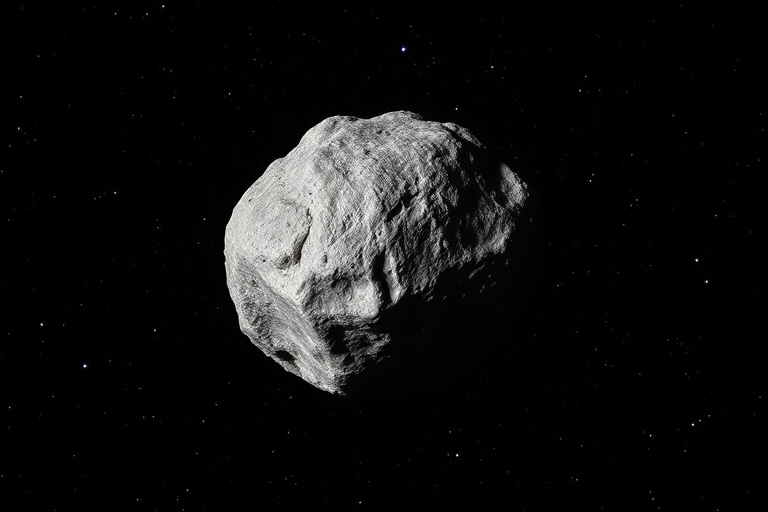
The cosmos has a way of reminding us of its vastness and unpredictability. On July 15, 2026, asteroid 2026 JH2 will make a close approach to Earth, drawing attention from astronomers and space enthusiasts alike. Discovered in May 2026 during a routine survey by the Pan-STARRS telescope in Hawaii, this near-Earth object (NEO) has quickly become the subject of intense observation and speculation.
At approximately 150 meters in diameter—roughly the size of the Great Pyramid of Giza—2026 JH2 falls into the category of a potentially hazardous asteroid (PHA). While NASA and other space agencies have tracked its trajectory with remarkable precision, the encounter offers both a scientific opportunity and a reminder of the importance of planetary defense.
Tracking the Trajectory: How Close Will It Get?
Current orbital calculations from NASA’s Center for Near-Earth Object Studies (CNEOS) indicate that asteroid 2026 JH2 will pass within 0.03 astronomical units (AU) of Earth—about 4.5 million kilometers, or roughly 11 times the distance between Earth and the Moon. While this sounds like a significant gap, in astronomical terms, it’s considered a close approach.
What makes this flyby particularly noteworthy is the asteroid’s speed: it will travel at approximately 12 kilometers per second relative to Earth. That’s fast enough to cross the continental United States in under 10 minutes. For context, the Chelyabinsk meteor that exploded over Russia in 2013 was only about 20 meters wide and entered the atmosphere at roughly half this speed.
The orbital mechanics behind 2026 JH2’s path are complex. Its elliptical orbit around the Sun intersects Earth’s orbit at a slight angle, creating a rare alignment that occurs only once every few decades. Astronomers have been refining its trajectory since its discovery, using data from multiple observatories worldwide. As of June 2026, the uncertainty in its position is less than 100 kilometers—an impressive feat of precision for an object millions of kilometers away.
Why This Close Approach Matters
Close approaches like this one are invaluable for several reasons. First, they provide astronomers with a chance to study an asteroid in detail using radar. The Goldstone Deep Space Communications Complex in California and the Arecibo Observatory (before its recent decommissioning) have both been tasked with pinging 2026 JH2 with radar waves to map its surface and determine its composition. These observations can reveal whether it’s a solid rock, a loose rubble pile, or something in between.
Second, such events help scientists test and refine planetary defense strategies. While 2026 JH2 poses no threat of impact in 2026, studying its behavior allows researchers to validate models used to predict the paths of other, more hazardous asteroids. This includes assessing how solar radiation and gravitational interactions with planets might alter an asteroid’s trajectory over time.
Finally, close approaches generate public interest in space science. Events like this often lead to increased engagement with astronomy programs and citizen science initiatives. Organizations like Dave’s Locker Science have seen surges in participation during similar flybys, with enthusiasts setting up backyard telescopes or following live streams from major observatories.
The Science Behind the Space Rock
Asteroid 2026 JH2 belongs to the Apollo group of near-Earth asteroids, which are characterized by orbits that cross Earth’s path. These objects are of particular interest because they represent a potential long-term threat. While none of the known Apollos are on a collision course with Earth in the foreseeable future, their orbits can evolve over centuries due to gravitational influences from Jupiter and other planets.
Spectroscopic analysis suggests that 2026 JH2 is likely an S-type asteroid, composed primarily of silicate minerals and nickel-iron. S-types are the second most common class of asteroids in the inner solar system and are thought to originate from the fragmentation of larger bodies in the asteroid belt. This composition makes them reflective enough to be visible in optical telescopes, though radar remains the best tool for detailed study.
One of the most intriguing aspects of 2026 JH2 is its rotation period. Initial observations indicate it spins once every 4.2 hours, which is relatively slow for an asteroid of its size. Fast-spinning asteroids often have a “rubble pile” structure, held together loosely by gravity. The slower spin of 2026 JH2 suggests it could be a more solid body—or that it has a companion asteroid influencing its rotation, a phenomenon known as a binary system.
Could It Be a Binary Asteroid?
Astronomers haven’t ruled out the possibility that 2026 JH2 is part of a binary system. Roughly 15% of near-Earth asteroids larger than 200 meters are estimated to have a moonlet, or smaller companion. If 2026 JH2 does have a satellite, it would appear as a “blip” in radar data, moving in a distinct pattern around the primary asteroid.
Binary asteroids are fascinating for several reasons. They provide clues about the formation and evolution of the solar system, as their existence suggests past collisions or gravitational captures. Additionally, they pose unique challenges for planetary defense. A binary system could behave unpredictably if perturbed by Earth’s gravity, potentially altering the orbit of the smaller body in ways that are difficult to model.
As of June 2026, no definitive evidence of a moonlet has been detected, but observations are ongoing. The European Space Agency’s upcoming Hera mission, scheduled to launch in 2027, will study the binary asteroid Didymos in detail. While Didymos is unrelated to 2026 JH2, the data gathered from that mission could offer insights into the dynamics of binary systems and help refine models for future asteroid encounters.
Planetary Defense: Are We Ready?
The close approach of 2026 JH2 serves as a timely reminder of humanity’s growing but still imperfect ability to detect and mitigate asteroid threats. NASA’s Planetary Defense Coordination Office (PDCO) has made significant strides in recent years, including the successful DART mission, which intentionally collided with the asteroid Dimorphos in 2022 and altered its orbit. That mission proved that, in principle, we can deflect an asteroid if given enough warning.
However, detection remains a challenge. While large asteroids like 2026 JH2 are relatively easy to spot, smaller objects—those capable of causing regional damage—can evade detection until they’re very close. The Vera C. Rubin Observatory, set to begin operations in 2025, will dramatically improve our ability to find these smaller, darker asteroids by conducting a 10-year survey of the sky. Until then, programs like NASA’s NEOWISE and the upcoming NEO Surveyor mission rely on infrared telescopes to spot objects that reflect little visible light.
For 2026 JH2, the risk of impact is effectively zero. Its orbit has been calculated with a high degree of confidence, and there’s no chance of it entering Earth’s atmosphere in the foreseeable future. Still, its flyby provides a valuable opportunity to test our detection and tracking capabilities. Here’s what the close approach will enable:
- Radar imaging: Detailed surface maps can reveal craters, boulders, and other features that might affect future deflection missions.
- Thermal analysis: Infrared observations can help determine the asteroid’s thermal inertia, which influences how it absorbs and radiates heat—critical for understanding its long-term orbital evolution.
- Shape modeling: High-resolution data can reveal whether the asteroid is elongated, spherical, or irregular, which affects how sunlight might nudge its orbit over time (a phenomenon known as the Yarkovsky effect).
- Public engagement: Close approaches like this one are a chance to educate the public about the science of asteroids and the importance of space exploration.
What’s Next for Asteroid 2026 JH2?
After its 2026 flyby, asteroid 2026 JH2 will continue its journey around the Sun, returning to the inner solar system in the 2070s. While no further close approaches are predicted for the 21st century, its orbit will be monitored closely. The next generation of telescopes, including the upcoming Vera C. Rubin Observatory and the NEO Surveyor, will refine its trajectory and search for any subtle changes that could indicate unseen gravitational influences.
For now, the focus is on the 2026 encounter. Amateur astronomers with access to telescopes 14 inches or larger may be able to spot 2026 JH2 as it streaks across the sky at a magnitude of 12 or brighter. Major observatories will use radar to study its shape, rotation, and composition, while space agencies will use the data to validate their planetary defense models.
This event is more than just a scientific curiosity—it’s a reminder of our place in the universe and the dynamic forces that shape it. Asteroids like 2026 JH2 have been striking Earth for billions of years, and they will continue to do so long after humanity is gone. The difference today is that we have the technology to detect them, study them, and—if necessary—deflect them. As we watch 2026 JH2 sail past our planet, we’re not just observing a space rock. We’re witnessing a testament to human ingenuity and a call to action for the future of planetary defense.
For those interested in learning more about near-Earth objects and how scientists track them, explore our Space Exploration section for in-depth guides, interviews with astronomers, and updates on upcoming missions.