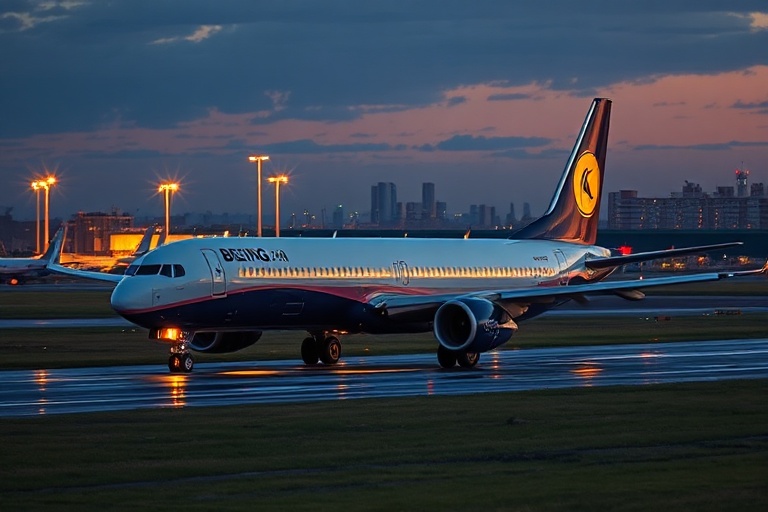
Boeing 737: Engineering Triumphs and Ongoing Challenges
“`html
The Boeing 737: A Legacy of Innovation and Ongoing Challenges
The Boeing 737 stands as one of the most recognizable and widely used commercial aircraft in history. Since its debut in the late 1960s, the 737 has evolved through multiple generations, each iteration pushing the boundaries of efficiency, range, and passenger capacity. Its enduring appeal lies in its adaptability, serving airlines across the globe in short-haul, medium-haul, and even some long-haul routes. Yet, the 737’s journey has not been without controversy, particularly in recent years. From production delays to safety concerns, the aircraft’s legacy is a complex tapestry of engineering triumphs and operational challenges.
The Origins and Evolution of the 737
Boeing launched the 737 program in the mid-1960s as a response to the growing demand for a short-to-medium range jet airliner. The aircraft’s first flight took place on April 9, 1967, and it entered service with Lufthansa later that year. What set the 737 apart from competitors like the Douglas DC-9 was its use of a fuselage diameter wide enough to accommodate six-abreast seating, a feature that became a standard for narrow-body jets. Over the decades, the 737 has undergone several major updates, culminating in the latest variants: the 737 MAX series.
The 737’s evolution can be divided into four distinct generations:
- Original Series (737-100/-200): The first models, powered by Pratt & Whitney JT8D engines, were relatively small and served primarily domestic markets. The -200 variant, introduced in 1968, became the backbone of many airlines’ fleets.
- Classic Series (737-300/-400/-500): Launched in the 1980s, these models featured more efficient CFM56 engines, improved aerodynamics, and increased capacity. The Classic series expanded Boeing’s dominance in the narrow-body market.
- Next Generation (737 NG -600/-700/-800/-900): Introduced in the late 1990s, the NG series incorporated advanced avionics, a redesigned wing, and greater fuel efficiency. The -800 variant became particularly popular, serving as the workhorse for airlines like Southwest and Ryanair.
- MAX Series (737 MAX 7/-8/-9/-10): The latest iteration, introduced in 2017, features CFM LEAP-1B engines, improved aerodynamics, and enhanced passenger comfort. However, the MAX series has also been marred by two fatal crashes and a global grounding.
The 737’s ability to adapt to changing market demands has been key to its longevity. Airlines prize its common type rating, which allows pilots to fly multiple 737 variants without additional training. This flexibility has made the 737 a favorite for low-cost carriers and legacy airlines alike.
Engineering Innovations and Design Challenges
One of the most significant engineering challenges in the 737’s history was the transition from the NG series to the MAX. To compete with Airbus’ A320neo, Boeing opted for larger, more fuel-efficient engines. However, mounting these engines further forward and higher on the wing created stability issues, leading to the development of the Maneuvering Characteristics Augmentation System (MCAS). MCAS was designed to automatically adjust the aircraft’s pitch to prevent stalls, but flaws in its design and implementation contributed to two fatal crashes in 2018 and 2019.
The MAX’s grounding from March 2019 to December 2020 was a rare setback for Boeing, a company synonymous with aviation safety and innovation. The incident highlighted the risks of prioritizing cost-cutting and rapid production over thorough testing. Boeing’s reputation, already strained by production inefficiencies and supply chain issues, took a significant hit. The MAX’s return to service came with stringent regulatory scrutiny and a series of software and hardware updates.
Beyond the MAX’s controversies, the 737 line has consistently pushed the envelope in aerodynamics and materials. The use of composite materials in later generations has reduced weight and improved fuel efficiency, while advanced avionics systems have enhanced safety and operational capability. These innovations have kept the 737 competitive against Airbus’ A320 family, which has similarly evolved to meet modern demands.
The Broader Implications for Aviation and Industry
The 737’s story is not just about an aircraft; it reflects the broader trends and pressures shaping the aviation industry. The race to build more fuel-efficient jets has intensified competition between Boeing and Airbus, with both companies investing heavily in next-generation narrow-body aircraft. The 737 MAX and Airbus A320neo represent the latest chapter in this rivalry, with airlines increasingly opting for these fuel-efficient models to reduce operating costs.
The MAX’s grounding also underscored the fragility of global supply chains. Boeing’s reliance on outsourced components, particularly from Spirit AeroSystems, revealed vulnerabilities in its production model. The company’s efforts to ramp up MAX production post-grounding have been hampered by supply chain bottlenecks, labor shortages, and quality control issues. These challenges have forced Boeing to rethink its manufacturing processes and supplier relationships.
Another critical implication is the increasing role of software in aviation safety. The MCAS system’s failure highlighted the need for rigorous software testing and transparency. Regulatory bodies like the FAA have since tightened oversight of software-driven systems, ensuring that future aircraft designs prioritize redundancy and fail-safe mechanisms.
The 737’s legacy also extends to the environment. As airlines face growing pressure to reduce carbon emissions, the 737 MAX’s improved fuel efficiency has made it a key player in sustainability efforts. However, the MAX’s troubled history serves as a reminder that technological advancements must be balanced with safety and reliability.
Looking Ahead: The Future of the 737
Despite its challenges, the 737 remains a cornerstone of Boeing’s commercial aircraft lineup. The company continues to refine the MAX series, with plans for further variants like the 737 MAX 10. Boeing is also exploring hybrid-electric and sustainable aviation fuel (SAF) compatibility for future 737 models, aligning with industry-wide efforts to achieve net-zero emissions by 2050.
However, the 737 faces increasing competition from Airbus’ A320neo family and emerging players like China’s Comac C919. The narrow-body market is becoming more crowded, and Boeing must innovate to maintain its leadership. Potential future developments could include further engine advancements, autonomous flight systems, or even hydrogen-powered variants.
The 737’s story is far from over. Its ability to adapt and endure will determine whether it remains the backbone of global aviation for decades to come. For now, Boeing’s focus is on restoring trust in the MAX and ensuring that the 737’s legacy is defined by more than just its recent challenges.
For aviation enthusiasts and industry professionals, the 737 serves as a fascinating case study in engineering, business, and the complexities of modern manufacturing. It is a testament to human ingenuity—and a reminder of the high stakes involved in pushing the boundaries of what is possible.
To explore more about aviation trends and industry news, visit our Technology and News sections for in-depth coverage.