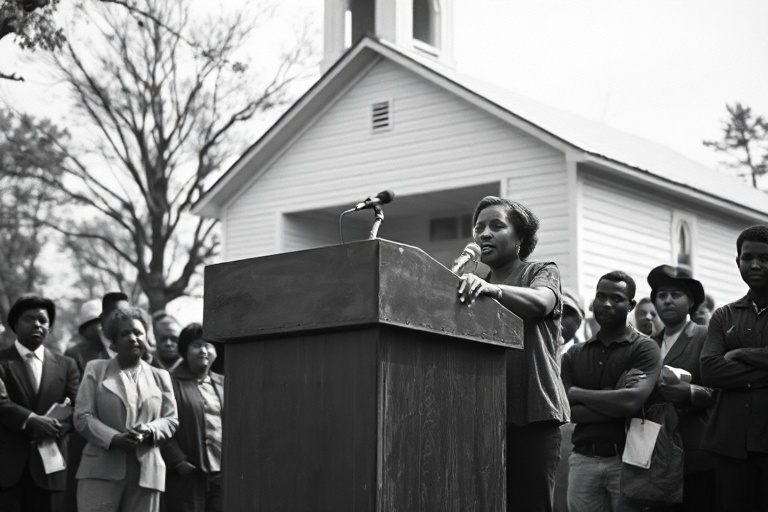
Brenda Travis remains one of the most compelling yet underrecognized figures in the American civil rights movement. Her story is not just one of resistance but of strategic defiance against systemic oppression in the Jim Crow South. Born in 1942 in Mississippi, Travis grew up in a state where racial segregation dictated every aspect of life. Yet, rather than accept this reality, she became a catalyst for change, joining the Student Nonviolent Coordinating Committee (SNCC) at just 16 years old and participating in pivotal protests that challenged the status quo.
Her activism was not performative; it was deeply personal and often came at great personal cost. Travis’s courage in the face of violent opposition helped expose the brutality of segregation and inspired a generation of young Black Americans to demand justice. Through sit-ins, voter registration drives, and confrontations with law enforcement, she embodied the relentless spirit of the civil rights era. Today, her legacy serves as a reminder of how young voices, when united and determined, can reshape history.
Early Life and the Seeds of Activism
Brenda Travis was born and raised in Palmer’s Crossing, a small community near Hattiesburg, Mississippi. Growing up in a segregated society, she experienced firsthand the indignities of Jim Crow laws, which enforced racial separation in schools, public spaces, and transportation. These experiences fueled her sense of injustice and set the stage for her lifelong commitment to civil rights.
Her awakening to activism began in high school when she joined the NAACP Youth Council. The organization provided her with a platform to challenge segregation and discrimination, but it was her involvement with SNCC that transformed her into a national figure. SNCC, founded in 1960, was at the forefront of the sit-in movement, and its emphasis on grassroots organizing resonated with Travis. She quickly rose through the ranks, becoming a key organizer in Mississippi’s voter registration efforts—a dangerous endeavor in a state where Black citizens were systematically denied the right to vote.
The 1961 McComb Sit-Ins and Travis’s Arrest
In August 1961, Brenda Travis joined a group of SNCC activists in McComb, Mississippi, to stage a sit-in at a local bus station. The protest was part of a broader campaign to desegregate public facilities, a direct challenge to the state’s entrenched segregationist policies. The sit-in was peaceful, but the response from local authorities was anything but. Travis and the other protesters were arrested and charged with disturbing the peace.
What followed was a pivotal moment in her activism. Rather than accepting a plea deal that would have ended the charges, Travis chose to serve a 30-day jail sentence. Her decision to stand firm, even in the face of harsh conditions, sent a powerful message to her community and the broader civil rights movement. It demonstrated that resistance to oppression was not just a moral imperative but a strategic necessity.
Her imprisonment did not go unnoticed. The case drew national attention, and figures like Fannie Lou Hamer and Ella Baker publicly supported her. However, the backlash from local segregationists was severe. Travis was expelled from high school—a tactic meant to silence her—but she refused to back down. Instead, she continued her work with SNCC, organizing voter registration drives and encouraging Black Mississippians to register to vote despite the risks.
Exile and the Long Road to Justice
After her release from jail, Travis faced increasing hostility in Mississippi. Segregationists targeted her with threats, intimidation, and economic reprisals. In 1962, she was forced into exile, leaving her home state to avoid further persecution. She relocated to New York, where she continued her activism, working with SNCC’s national office and advocating for civil rights on a broader scale.
Her exile was not just a personal loss but a strategic setback for the movement in Mississippi. Without local leaders like Travis, grassroots organizing in the state became more difficult. Yet, her work in New York helped bridge the gap between Southern activists and Northern allies, fostering solidarity across regions. She also became a vocal critic of the federal government’s slow response to civil rights violations, calling out the hypocrisy of a nation that claimed to uphold democracy while denying it to millions of its citizens.
The Broader Implications of Travis’s Activism
Brenda Travis’s story is a testament to the power of individual agency in the face of systemic injustice. Her refusal to compromise, even when it meant personal sacrifice, set a precedent for future generations of activists. Her experiences also highlight the strategic importance of youth leadership in social movements. Young people, often seen as inexperienced, have historically been at the forefront of transformative change, and Travis’s story is a prime example of this dynamic.
Her activism also underscored the intersection of race and gender in the civil rights movement. As a young Black woman, Travis navigated not only the dangers of segregation but also the sexism that often marginalized women’s contributions in the movement. Despite these challenges, she carved out a space for herself as a leader, challenging the male-dominated structures of both SNCC and the broader civil rights movement.
Legacy and Lessons for Today’s Activists
Brenda Travis’s legacy extends far beyond the 1960s. Her story is a reminder of the ongoing struggle for racial justice in America, a fight that continues to this day. In an era where social movements are often reduced to hashtags and viral moments, Travis’s activism serves as a counterpoint—a reminder that real change requires perseverance, sacrifice, and an unyielding commitment to justice.
Today, her story is increasingly recognized as a crucial part of civil rights history. Schools and universities are incorporating her experiences into their curricula, and historians are revisiting her role in the movement. Organizations like the SNCC Legacy Project have worked to preserve her story, ensuring that future generations understand the depth of her contributions.
For modern activists, Brenda Travis’s life offers several key lessons:
- Persistence is essential: Travis’s refusal to back down, even after expulsion and exile, demonstrates that progress often requires sustained effort over time.
- Youth can lead change: Her involvement with SNCC at 16 shows that age is not a barrier to leadership—indeed, young people have often been the driving force behind social movements.
- Sacrifice is part of the process: Her willingness to endure imprisonment and exile highlights the personal costs of activism and the need for collective support.
- Intersectionality matters: As a Black woman in a male-dominated movement, she navigated multiple layers of oppression, a reality that continues to shape modern activism.
Why Brenda Travis’s Story Still Matters
In an age where social justice movements are often reduced to soundbites or social media trends, Brenda Travis’s story is a powerful antidote to complacency. Her activism was not about performative allyship or fleeting trends; it was about survival, dignity, and the relentless pursuit of equality. Her life challenges us to ask difficult questions about our own roles in the ongoing struggle for justice.
For those interested in learning more about the civil rights movement and the figures who shaped it, Brenda Travis’s story is a vital piece of the puzzle. It reminds us that history is not just about the past—it is a living, breathing force that continues to shape our present and future. By studying her life and work, we honor her legacy and reaffirm our commitment to the ideals she fought for.
To explore more about the civil rights movement and its impact on modern activism, visit Dave’s Locker Culture and Dave’s Locker News for in-depth analysis and historical context.
Conclusion: A Call to Remember and Act
Brenda Travis’s life is a testament to the power of resistance and the importance of standing firm in the face of injustice. Her story is not just a relic of the past; it is a living example of how ordinary people can become extraordinary agents of change. As we reflect on her contributions, we are reminded that the fight for civil rights is far from over. From voter suppression to systemic racism, the challenges of today mirror those of the 1960s in many ways.
Travis’s legacy challenges us to move beyond passive acknowledgment of history and toward active engagement with the issues of our time. Whether through voting, organizing, or simply speaking out against injustice, each of us has a role to play in continuing the work she began. By remembering Brenda Travis and the countless others who fought for justice, we honor their sacrifices and ensure that their vision of a more equitable world becomes a reality.