Understanding the Green Party UK: Origins and Evolution
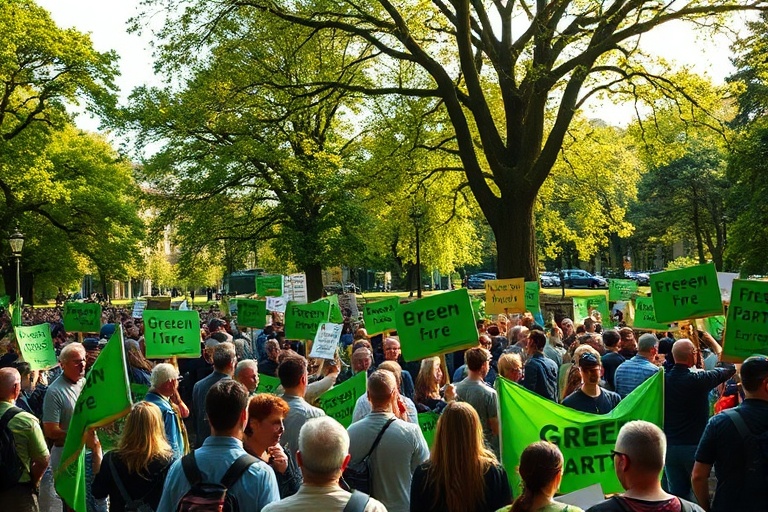
The Green Party of England and Wales, commonly referred to as the Green Party UK, traces its roots back to the early 1970s when environmental concerns began gaining traction in British politics. Initially founded as the Ecology Party in 1973, it rebranded in 1985 to reflect a broader commitment to social justice, peace, and sustainability. Unlike many political movements that focus solely on electoral success, the Greens have consistently prioritized grassroots activism alongside parliamentary participation.
The party’s first significant breakthrough came in 1989 during the European Parliament elections, where it secured over 2 million votes—roughly 15% of the total—despite failing to win a seat. This performance signaled growing public interest in environmental policies. By the 1990s, the Greens had established themselves as a credible alternative within the UK’s political spectrum, advocating for policies such as nuclear disarmament, renewable energy expansion, and progressive taxation.
A Core Ideology Centered on Sustainability
The Green Party UK operates on a set of principles outlined in its Politics platform, which emphasizes ecological wisdom, social justice, and nonviolence. These values are encapsulated in their commitment to a “Green New Deal,” a policy framework aimed at transitioning the UK to a zero-carbon economy while ensuring economic equity. The party’s economic proposals include wealth taxes on the richest individuals and corporations, alongside increased public investment in green infrastructure.
Another pillar of the Greens’ ideology is their opposition to austerity measures. While mainstream parties often prioritize fiscal restraint, the Green Party advocates for higher public spending on welfare, healthcare, and education. Their policies also extend to housing, proposing rent controls and a massive expansion of social housing to address the UK’s affordability crisis. These stances appeal to younger voters and those disillusioned with traditional left-wing parties like Labour.
Electoral Performance and Strategic Challenges
Despite its progressive platform, the Green Party UK has faced challenges in translating its policies into electoral success. In the 2019 general election, the party won just one seat in Parliament—Brighton Pavilion—despite receiving over 800,000 votes nationwide. This outcome highlighted the UK’s first-past-the-post electoral system, which disadvantages smaller parties by making it difficult to secure seats even with significant vote shares.
However, the Greens have found more success in local government and the European Parliament. As of 2024, they control 12 seats on the London Assembly and have representation in several councils, including Brighton and Hove, where they have influenced policies on transport and housing. Their performance in the 2019 European elections, where they won 7 MEPs, further demonstrated their ability to mobilize voters around environmental issues.
One of the party’s key strategies has been to form alliances with other progressive groups. In recent years, they have collaborated with organizations like Extinction Rebellion and the Labour Party on climate justice initiatives. However, tensions remain, particularly with Labour, whose leadership has often diluted or abandoned green policies to appeal to centrist voters.
Policy Priorities and Public Perception
The Green Party UK’s policy agenda is built around several key areas. Climate Action: The party calls for a legally binding target of net-zero emissions by 2030, alongside major investments in wind, solar, and tidal energy. They also propose banning fracking and new oil and gas projects in the North Sea.
Economic Reform: The Greens advocate for a Universal Basic Income (UBI) to replace parts of the welfare system, arguing that it would simplify bureaucracy and reduce poverty. They also support a financial transaction tax to curb speculative trading while funding public services.
Social Justice: Their manifesto includes calls for the decriminalization of drugs, the abolition of tuition fees, and the expansion of LGBTQ+ rights. The party has also been vocal in opposing the hostile environment policy on immigration, which it argues exacerbates racial discrimination.
Public perception of the Greens remains mixed. While younger voters, particularly those under 30, view the party favorably for its bold climate policies, older demographics often associate it with radicalism or impracticality. Polling from 2023 showed that around 5-8% of voters would consider backing the Greens in a general election, a figure that has remained relatively stable over the past decade.
Internal Dynamics and Leadership
The Green Party UK operates under a co-leadership model, with two leaders—one male and one female or non-binary—sharing responsibilities to ensure gender balance. As of 2024, the party is led by Carla Denyer and Adrian Ramsay, who were elected in a tightly contested race following the resignation of former co-leaders Siân Berry and Jonathan Bartley.
Internal debates often center on the party’s direction. Some members advocate for a more confrontational approach, pushing for civil disobedience and direct action to pressure the government. Others prefer a reformist strategy, focusing on winning seats and influencing policy through traditional channels. These tensions occasionally lead to public disagreements, particularly on issues like the party’s stance toward Labour.
The Greens have also faced criticism over allegations of antisemitism within the party, a controversy that has drawn parallels to similar issues in Labour. The party has taken steps to address these concerns, including adopting the International Holocaust Remembrance Alliance (IHRA) definition of antisemitism and implementing training programs for members.
The Future of the Green Party UK
The Green Party UK faces a critical juncture as climate change becomes an increasingly urgent global issue. With the UK government’s net-zero targets widely seen as insufficient, the Greens are positioning themselves as the only major party offering a comprehensive plan to address the crisis. Their ability to mobilize young voters and activists gives them a potential advantage in upcoming elections.
However, the party’s long-term viability depends on its ability to overcome structural barriers, particularly the UK’s electoral system. Discussions about electoral reform, such as adopting proportional representation, could significantly boost the Greens’ prospects. Meanwhile, their influence in local government and grassroots campaigns continues to grow, with activists pushing for policies like car-free zones and community energy projects.
As the climate crisis intensifies and economic inequality deepens, the Green Party UK’s message of systemic change resonates with an increasing number of voters. Whether it can translate this momentum into sustained political power remains an open question—but its role as a disruptor in British politics is undeniable.
Conclusion: A Party of Principles or a Political Force?
The Green Party UK stands at the intersection of activism and electoral politics, offering a radical alternative to the mainstream parties. While it has struggled to break through in Westminster, its influence on local governance and public discourse is undeniable. With climate change and social justice dominating political agendas, the Greens are well-positioned to shape the UK’s future—provided they can navigate internal divisions and the challenges of a hostile electoral system.
For voters disillusioned with the major parties, the Green Party UK represents a compelling option. Its policies are ambitious, its principles are consistent, and its commitment to democratic participation is unwavering. Whether it will ever achieve the power it seeks remains uncertain, but its role in pushing for a greener, fairer society is already significant.