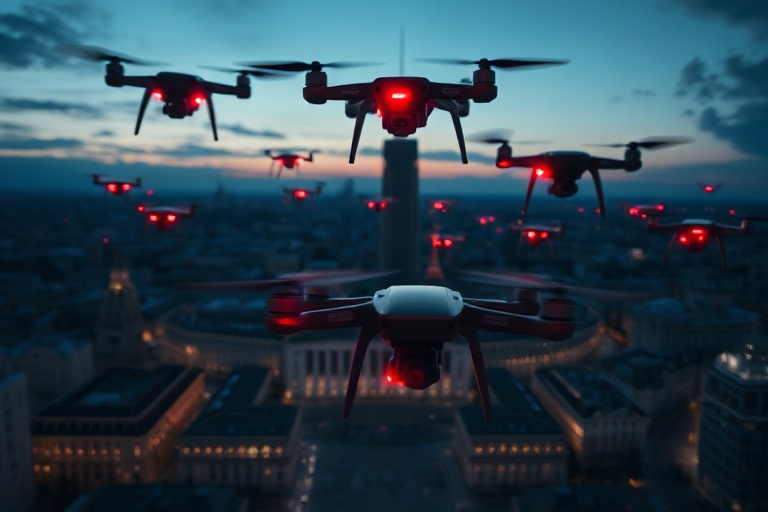
The pattern of overnight drone strikes on Moscow has intensified in recent weeks, marking a significant escalation in Ukraine’s long-range strikes deep inside Russian territory. These attacks, which began sporadically in May 2023, have grown in frequency and sophistication, with Ukrainian forces increasingly deploying modified commercial drones capable of evading Russian air defenses.
The most recent wave, reported on multiple consecutive nights, targeted industrial zones and government buildings, prompting temporary closures and heightened security measures across the city. While Russian officials have downplayed damage reports, the psychological and symbolic impact is undeniable. Moscow, long considered a fortress of Russian military power, now faces the unsettling reality of war at its doorstep.
How the Drone Campaign Has Evolved
Ukraine’s drone program has undergone rapid transformation since its inception. Initially limited to smaller, short-range UAVs used for reconnaissance and harassment, the arsenal has expanded to include long-range systems like the Ukrainian-modified “Mugin-5” and Turkish-supplied Bayraktar TB2, both capable of striking targets over 150 kilometers from the front line.
The effectiveness of these systems has forced Russia to divert air defense resources from the front, stretching already strained supply lines. According to Ukrainian military analysts, the recent Moscow strikes were executed using a combination of first-person-view (FPV) racing drones and larger loitering munitions, demonstrating layered attack profiles designed to overwhelm Russian radar and interceptors.
Key factors in the campaign’s success include:
- Decentralized production: Ukrainian workshops and volunteer groups rapidly prototype and adapt commercial drones, making the supply chain resilient to targeted strikes.
- Precision navigation: Modified GPS modules and pre-programmed waypoints allow drones to reach urban centers with minimal electronic signature.
- Russian air defense limitations: Moscow’s S-400 and S-500 systems, while formidable, were designed to counter aircraft and ballistic missiles—not swarms of slow, low-flying drones.
- Psychological warfare: Even failed strikes reinforce the perception of vulnerability, eroding public confidence in state assurances of security.
Strategic Implications for the War
These strikes are not merely tactical diversions—they represent a strategic inflection point. By targeting Moscow, Ukraine is challenging a core narrative of the Kremlin: that distance and military power ensure safety for Russian civilians. Such attacks undermine the Kremlin’s control over public perception, forcing a reevaluation of how the war is framed domestically.
For Russia, the response has been twofold: increased military censorship and accelerated production of indigenous counter-drone systems. State media has minimized coverage of the attacks, while officials blame “terrorist provocations” rather than acknowledging Ukrainian capabilities. Meanwhile, Russian defense contractors are reportedly fast-tracking development of drone-killing lasers and electronic warfare units.
The broader geopolitical consequences are equally significant. NATO allies, including the United States and United Kingdom, have quietly provided technical support for drone detection and electronic warfare. While these nations deny involvement in strike planning, the transfer of intelligence and electronic countermeasures suggests tacit approval of Ukraine’s long-range campaign.
Yet the strategy carries risks. Russian retaliation has escalated in southern Ukraine, with intensified artillery barrages and airstrikes on civilian infrastructure. Analysts warn that prolonged drone strikes could provoke a disproportionate response, potentially drawing NATO further into the conflict through proxy involvement.
What Comes Next: Scenarios and Outcomes
Three potential trajectories emerge from this evolving dynamic:
- Escalation to full-scale strikes: If Ukraine deploys larger drones or cruise missiles, Russia may respond with nuclear threats or large-scale ground offensives to regain deterrence.
- Stalemate through technological parity: As both sides improve counter-drone systems, the frequency of strikes may decrease, leading to a new phase of electronic warfare dominance.
- Negotiated de-escalation: International pressure, particularly from China and Turkey, could push both sides toward a conditional ceasefire focused on limiting long-range strikes.
The coming months will reveal whether Ukraine’s drone campaign is a calculated gambit to force negotiations or a desperate attempt to break Russian morale. One thing is certain: the era of war remaining confined to the battlefield is over. Civilians in Moscow now live under the shadow of drones—not as distant spectators, but as targets.
Conclusion: A New Kind of Warfare
The drone strikes on Moscow signal more than a tactical shift—they mark the normalization of asymmetric warfare in Europe. In an age where precision weapons no longer require air superiority or massive budgets, even mid-sized nations can project power into the heart of their adversaries. Ukraine’s campaign demonstrates how technological democratization, combined with relentless innovation, can challenge entrenched military hierarchies.
Yet with this power comes responsibility. As urban centers become potential battlegrounds, the international community must confront uncomfortable questions: What limits exist on long-range strikes? How do we prevent escalation into urban terror campaigns? And who sets the rules when drones become the new artillery?
One conclusion is clear: the war in Ukraine is no longer confined to trenches and front lines. It has entered the realm of the sky—and the consequences will be felt far beyond the battlefield.
For more on the evolving landscape of modern conflict, visit our News and Analysis sections, where we explore the intersection of technology, strategy, and geopolitics.