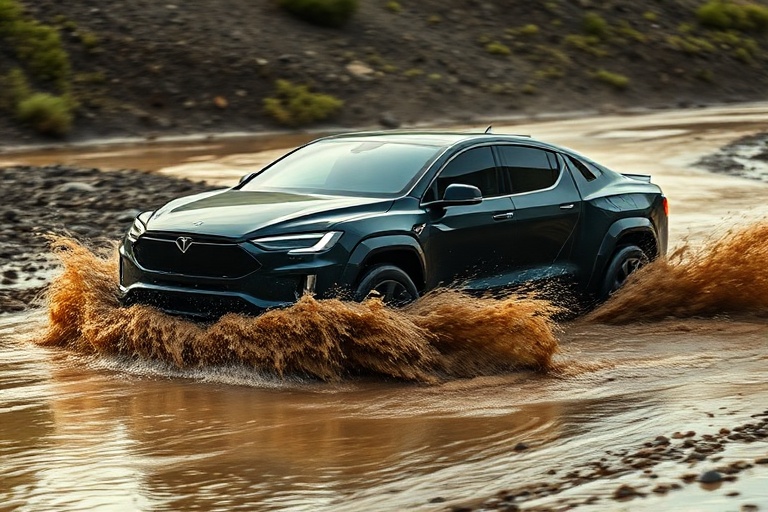
The Tesla Cybertruck has redefined expectations for electric vehicles since its debut, but it’s the vehicle’s advanced off-road capabilities that are turning heads among enthusiasts and critics alike. Among these features, Wade Mode stands out as a particularly innovative solution for navigating challenging terrains. This technology transforms the Cybertruck from a conventional electric pickup into a capable off-road machine.
Wade Mode isn’t just another marketing buzzword. It represents a sophisticated integration of hardware and software that allows the Cybertruck to traverse water depths up to three feet without damage to critical components. This capability sets it apart in an automotive landscape where most electric vehicles remain firmly on paved roads.
How Wade Mode Works: Engineering Behind the Innovation
At its core, Wade Mode leverages several key technological advancements that work in unison. The system begins with the Cybertruck’s air suspension, which can raise the vehicle by up to four inches when activated. This additional clearance provides the necessary space between the undercarriage and water surface.
Tesla’s engineers implemented a multi-layered waterproofing strategy. All critical electrical components, including the battery pack and drive units, are sealed within watertight compartments. The vehicle’s cameras and sensors are protected by hydrophobic coatings and retractable covers that deploy automatically when Wade Mode is engaged.
The system also includes:
- Active air vents: These allow pressure equalization while preventing water ingress during submersion.
- Waterproof door seals: Enhanced gaskets prevent water from entering the cabin during fording operations.
- Real-time monitoring: Multiple water sensors continuously assess depth and adjust vehicle parameters accordingly.
When activated, Wade Mode automatically configures the Cybertruck’s systems for water traversal. The vehicle’s touchscreen displays a water depth gauge and provides guidance on safe traversal techniques. This level of integration demonstrates Tesla’s commitment to creating a truly versatile electric vehicle.
Practical Applications: When Wade Mode Shines
While Wade Mode might seem like a novelty, it addresses real-world scenarios where traditional vehicles struggle. Consider the following situations where this capability proves invaluable:
- Emergency response: In flood-prone areas, the Cybertruck can navigate submerged roads when traditional emergency vehicles cannot.
- Recreational use: Off-road enthusiasts can explore river crossings and shallow water trails with confidence.
- Agricultural applications: Farmers can access flooded fields during planting or harvest seasons without vehicle damage.
- Military and utility: Organizations requiring all-terrain capability benefit from vehicles that can operate in diverse conditions.
The Cybertruck’s ability to handle water depths up to three feet opens up previously inaccessible terrain for electric vehicle adoption. This capability challenges the perception that electric vehicles are inherently limited to paved surfaces.
During testing in various environments, the Cybertruck demonstrated impressive performance. In one particularly challenging scenario, the vehicle successfully traversed a flooded roadway where conventional trucks would have risked engine damage. The air suspension adjustment prevented water from reaching the battery pack, while the sealed drive units continued operating without issues.
Comparing Wade Mode to Traditional Off-Road Solutions
Most traditional off-road vehicles rely on mechanical solutions rather than electronic systems like Wade Mode. While four-wheel-drive systems and locking differentials remain essential for torque distribution, they don’t address water traversal specifically. Traditional vehicles typically require additional modifications, such as snorkels and raised air intakes, to handle deep water.
In contrast, the Cybertruck’s integrated approach offers several advantages:
- No aftermarket modifications needed: Wade Mode works out of the box without requiring additional parts or modifications.
- Automatic operation: The system activates with a single touch, eliminating complex preparation procedures.
- Reversible operation: Once water traversal is complete, the vehicle returns to normal operation instantly.
This level of integration represents a paradigm shift in off-road vehicle design. Rather than adding accessories after purchase, Tesla built this capability into the vehicle’s fundamental architecture. The result is a vehicle that’s equally capable in urban environments and challenging off-road conditions.
When compared to specialized off-road vehicles like the Jeep Wrangler Rubicon or Ford Bronco Rapture, the Cybertruck’s Wade Mode offers unique advantages in water traversal scenarios. While traditional off-road vehicles excel in rock crawling and sand dunes, the Cybertruck provides capabilities that most competitors simply cannot match.
Future Implications: What Wade Mode Means for Electric Vehicles
The introduction of Wade Mode extends beyond the Cybertruck itself. This technology demonstrates that electric vehicles can match or exceed the capabilities of internal combustion engine vehicles in off-road scenarios. As battery technology continues to advance, we can expect to see similar features in other electric vehicles.
Tesla’s approach to Wade Mode also sets a new standard for vehicle engineering. By integrating waterproofing at the design stage rather than as an afterthought, Tesla has proven that electric vehicles can be as capable in extreme conditions as their gasoline-powered counterparts. This innovation could influence future vehicle designs across the automotive industry.
Looking ahead, several developments could enhance Wade Mode’s capabilities:
- Increased water depth rating: Future iterations might allow for deeper water traversal with additional engineering.
- Improved sensor integration: Enhanced real-time feedback could provide even more precise water depth assessment.
- Autonomous operation: Future versions might include self-driving capabilities for water traversal scenarios.
The success of Wade Mode could encourage other manufacturers to invest in similar technologies. As the electric vehicle market continues to expand, capabilities that were once considered exclusive to specialized off-road vehicles will become standard features. This shift could accelerate the adoption of electric vehicles in industries that require all-terrain capability.
For consumers, Wade Mode represents an exciting development in electric vehicle technology. It proves that electric vehicles can be versatile and capable in ways that were previously unimaginable. As charging infrastructure continues to improve, vehicles like the Cybertruck could redefine what’s possible in both urban and off-road environments.
Conclusion: Wade Mode as a Game-Changer in Vehicle Capability
Tesla’s Wade Mode represents more than just a technical achievement—it’s a demonstration of how electric vehicles can surpass traditional limitations. By integrating advanced waterproofing and real-time monitoring systems, Tesla has created a vehicle that’s equally capable in urban environments and challenging off-road conditions. This innovation challenges preconceptions about electric vehicle capabilities and sets a new standard for the industry.
The practical applications of Wade Mode extend beyond recreational use. From emergency response to agricultural applications, this technology addresses real-world scenarios where traditional vehicles struggle. As electric vehicles continue to evolve, capabilities like Wade Mode will become increasingly important in demonstrating their versatility.
For off-road enthusiasts, the Cybertruck offers a compelling alternative to traditional vehicles. While it may lack some of the specialized features found in dedicated off-road machines, its integrated approach to water traversal provides capabilities that most competitors cannot match. This technology proves that electric vehicles can be as capable in extreme conditions as their gasoline-powered counterparts.
As the automotive industry continues to transition toward electric propulsion, innovations like Wade Mode will play a crucial role in shaping consumer perceptions. Tesla’s approach demonstrates that electric vehicles can be versatile, capable, and innovative—not just in urban environments, but in challenging off-road conditions as well. This development could accelerate the adoption of electric vehicles across diverse applications and industries.
For those considering the Cybertruck, Wade Mode represents an exciting feature that expands the vehicle’s capabilities far beyond traditional electric pickup trucks. It’s a testament to Tesla’s commitment to innovation and a glimpse into the future of automotive technology.
For more on electric vehicle innovations, visit our Technology section. To explore other cutting-edge automotive features, check out our Automotive category.