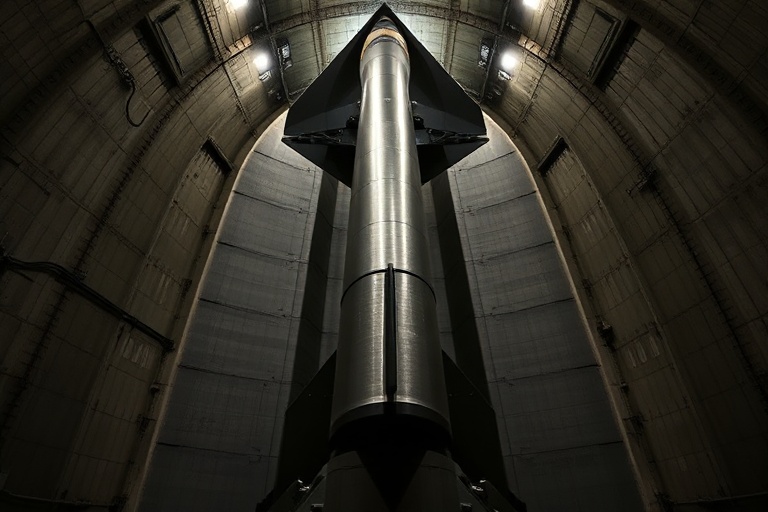
The Minuteman III: America’s Silent Sentinel of Deterrence
The Minuteman III intercontinental ballistic missile (ICBM) has stood as a cornerstone of the United States’ nuclear deterrent for over half a century. First deployed in 1970, this land-based missile system remains one of the most recognizable symbols of strategic defense in the modern world. With a range exceeding 15,000 kilometers and the ability to carry multiple independently targetable reentry vehicles (MIRVs), the Minuteman III is more than just a weapon—it is a carefully calibrated instrument of geopolitical stability.
Its name pays homage to the colonial Minutemen of the American Revolution, who were ready to mobilize at a moment’s notice. Similarly, the Minuteman III is designed for rapid deployment, ensuring that the U.S. maintains a credible second-strike capability. In an era where global tensions fluctuate and nuclear modernization programs reshape strategic landscapes, the Minuteman III’s role continues to evolve.
The Engineering Behind the Missile: Precision and Power
The Minuteman III is a three-stage, solid-fueled ICBM developed by Boeing under contract to the U.S. Air Force. Unlike liquid-fueled missiles, which require lengthy preparation before launch, the Minuteman III can be stored fully fueled and launched within minutes. This operational readiness is critical for maintaining a credible deterrent.
The missile’s guidance system relies on an inertial navigation unit (INU) developed by Northrop Grumman, which uses gyroscopes and accelerometers to calculate its trajectory with extraordinary accuracy. Modern upgrades have integrated GPS-aided navigation, further reducing potential errors. Each missile can deliver up to three nuclear warheads to separate targets, a feature that enhances its strategic flexibility.
- Stage 1: Solid rocket motor propels the missile out of the silo.
- Stage 2: Continues acceleration toward space.
- Stage 3: Achieves orbital velocity before releasing warheads.
- Post-Boost Vehicle: Maneuvers warheads toward designated targets.
The silos themselves are hardened structures buried deep underground, protected against conventional and nuclear blasts. Each launch control center is staffed 24/7 by missileers, highly trained Air Force personnel who monitor the system and stand ready to execute launch orders. This human element adds a layer of accountability that underscores the system’s role not just as a weapon, but as a controlled mechanism of national security.
Global Reach and Strategic Role in Modern Defense
The Minuteman III is deployed across three U.S. Air Force bases: F.E. Warren in Wyoming, Minot in North Dakota, and Malmstrom in Montana. Together, these bases house approximately 400 operational missiles—far fewer than the 800 deployed at the system’s peak during the Cold War. The reduction reflects arms control agreements such as New START, which aim to limit the number of deployed strategic nuclear warheads.
Despite the numerical decline, the Minuteman III remains central to the U.S. nuclear triad, alongside submarine-launched ballistic missiles (SLBMs) like the Trident II and strategic bombers such as the B-2 Spirit and upcoming B-21 Raider. This triad ensures that even if one leg is compromised, the others provide a survivable deterrent—a principle known as “mutually assured destruction” (MAD), though modern doctrine emphasizes flexibility and escalation control.
Internationally, the Minuteman III serves as a visible reminder of U.S. defense commitments, particularly to NATO allies in Europe. Its presence in the European theater was reinforced during the Cold War and has periodically resurfaced in debates about nuclear sharing and burden-sharing within the alliance. While the U.S. has withdrawn its nuclear-armed missiles from Europe in past decades, the Minuteman III remains a key element of extended deterrence strategies.
In Asia, the missile’s range allows it to cover targets across China and North Korea, though its primary focus remains on Russia. The evolving nuclear postures of Beijing and Pyongyang have prompted discussions within the Pentagon about whether the Minuteman III will remain sufficient or if a new generation of ICBMs—such as the Ground-Based Strategic Deterrent (GBSD), slated to replace the Minuteman III by the late 2020s—is needed to address emerging threats.
Cultural and Political Symbolism: More Than Just a Weapon
The Minuteman III is not only a technological marvel but also a cultural artifact. It has appeared in countless films, documentaries, and video games, often depicted as a harbinger of doom or a symbol of technological supremacy. Its silhouette, emerging from a silo in slow motion, has become a visual shorthand for nuclear anxiety and military readiness.
In American political discourse, the missile system is frequently invoked during debates about defense spending, arms control, and nuclear non-proliferation. Advocates for modernization argue that aging systems require investment to maintain reliability and safety. Critics, however, question the moral and strategic necessity of such weapons, especially as global consciousness shifts toward disarmament and non-proliferation.
At the same time, the missileers who operate the Minuteman III occupy a unique space in military culture. Their service is marked by intense secrecy, rigorous training, and a profound sense of responsibility. Unlike pilots or infantry, missileers rarely see combat, yet their role is critical to national survival. This paradox has inspired both respect and scrutiny, particularly in an era where remote and automated systems increasingly define modern warfare.
Public perception of the Minuteman III is also shaped by Hollywood and media portrayals. Films like WarGames and Dr. Strangelove have cemented its image in the public imagination as a potential catalyst for global annihilation. Meanwhile, documentaries such as The Atomic Café and Countdown to Zero explore its historical and ethical dimensions, framing the missile not just as a tool of war, but as a relic of an era defined by existential risk.
The Future: Modernization and the End of an Era
The Minuteman III is approaching the end of its service life. The Air Force has begun fielding the Ground-Based Strategic Deterrent (GBSD), a next-generation ICBM system designed to replace the Minuteman III by the mid-2030s. The GBSD promises enhanced accuracy, improved cybersecurity, and greater flexibility to counter evolving threats.
However, the transition has not been without controversy. Critics argue that the $100 billion program is unnecessary and that the U.S. could reduce its nuclear arsenal without compromising security. Others warn that abandoning ICBMs entirely could weaken deterrence by eliminating a visible and survivable leg of the triad.
Meanwhile, international reactions to U.S. nuclear modernization vary widely. Russia has accused the U.S. of violating arms control agreements, while China continues to expand its own nuclear arsenal, citing U.S. advances as justification. The global nuclear landscape is increasingly multipolar, with new players like North Korea and potential future nuclear states reshaping strategic calculations.
As the Minuteman III nears retirement, its legacy endures—not only as a weapon of war, but as a symbol of the Cold War’s enduring influence on global security. It reminds us that deterrence is not just a military strategy, but a complex interplay of technology, politics, and human judgment.
The Minuteman III’s silent vigil in the American heartland serves as a quiet testament to the enduring—and often uneasy—pursuit of peace through strength. Its story is not yet over, but the next chapter is already being written.
—