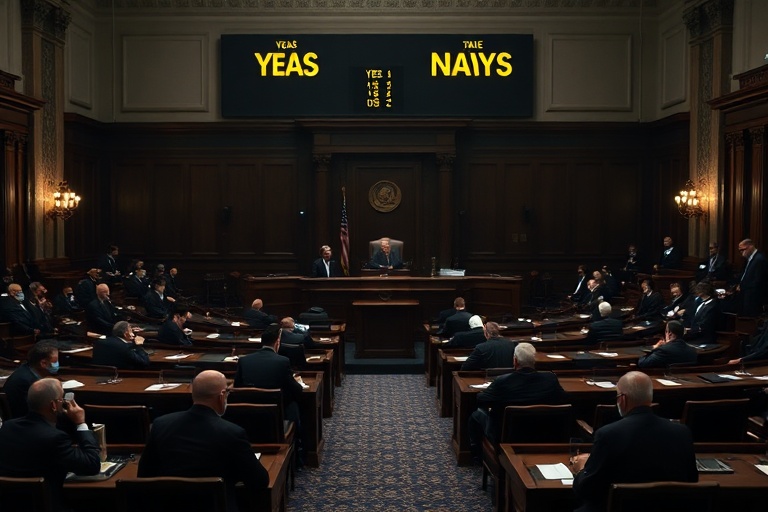
The U.S. Senate’s recent vote on war powers has reignited a long-standing debate about the balance between executive authority and congressional oversight in matters of military engagement. This vote, which took place on June 5, 2024, sought to limit U.S. involvement in a specific overseas conflict. While the measure ultimately failed to advance, it underscored deep divisions within Congress and highlighted the evolving role of the legislative branch in shaping foreign policy.
The resolution in question aimed to curtail U.S. military support in a region embroiled in conflict, reflecting growing public and political unease about prolonged entanglements abroad. Senators on both sides of the aisle raised concerns about the lack of clear objectives and the potential for mission creep. The vote’s outcome, while not legally binding, sent a strong signal about the Senate’s willingness to assert its constitutional authority over war-making decisions.
The Origins of the War Powers Resolution
The modern debate over war powers traces back to the Vietnam War, which exposed the dangers of executive overreach without congressional approval. In response, Congress passed the War Powers Resolution of 1973, a law designed to check the president’s ability to commit U.S. forces to armed conflict without explicit authorization. The resolution requires the president to consult with Congress before deploying troops and mandates periodic reports on military actions.
However, the law has been widely criticized for its ambiguity. Presidents from both parties have argued that its provisions infringe on their constitutional authority as commander-in-chief. The recent Senate vote reflects this ongoing tension, as lawmakers grapple with how to enforce the War Powers Resolution in an era of evolving military engagements, including drone strikes and covert operations.
Critics of the resolution point out that it has rarely been invoked successfully. Since its passage, presidents have often bypassed congressional consultation, citing national security concerns or the need for rapid response. The Senate’s June vote, while symbolic, serves as a reminder that the law remains a contentious and underutilized tool for congressional oversight.
Key Players and Their Positions
The Senate vote on June 5, 2024, saw a coalition of progressive Democrats and libertarian-leaning Republicans push for the resolution. Led by Senator Chris Murphy (D-CT) and Senator Rand Paul (R-KY), the bipartisan group argued that continued military support in the conflict lacked clear objectives and risked dragging the U.S. into a deeper quagmire. Their resolution called for an immediate end to U.S. involvement unless Congress formally authorized it.
Opponents, including Senate Majority Leader Chuck Schumer (D-NY) and Senate Minority Leader Mitch McConnell (R-KY), contended that withdrawing support prematurely could embolden adversaries and undermine U.S. allies. They emphasized the need for a measured approach, warning that abrupt disengagement could destabilize the region. The debate highlighted the stark divide between those prioritizing restraint and those advocating for strategic patience.
Key figures such as Secretary of State Antony Blinken and Chairman of the Joint Chiefs of Staff General Charles Q. Brown Jr. also weighed in, testifying before Congress about the risks of cutting off military aid. Their testimony underscored the complexity of the issue, as they framed the debate in terms of both national security and geopolitical strategy.
Breakdown of the Vote
The resolution failed to advance by a narrow margin of 52-48, with six Republicans joining all Democrats in support. While the vote fell short of the 60 votes needed to proceed, it demonstrated the growing influence of the anti-interventionist wing within the Senate. The breakdown revealed deep partisan fissures, with most Republicans opposing the measure and nearly all Democrats supporting it.
The vote also exposed generational divides within the parties. Younger senators, particularly those elected in the post-9/11 era, were more likely to support the resolution, reflecting a broader shift in public opinion toward skepticism of military interventions. Older lawmakers, many of whom came of age during the Cold War, tended to prioritize stability and deterrence over immediate withdrawal.
Implications for U.S. Foreign Policy
The Senate’s vote on war powers carries significant implications for how the U.S. engages with conflicts abroad. For one, it signals a potential shift in the balance of power between the executive and legislative branches. If future resolutions gain traction, presidents may face greater pressure to justify military actions and seek congressional approval.
The vote also reflects broader public sentiment. Polls indicate that a majority of Americans are weary of prolonged military engagements, particularly in regions where U.S. interests are not immediately at stake. This sentiment has been fueled by decades of war in the Middle East and the financial and human costs associated with them. Lawmakers, in turn, are increasingly responsive to these concerns, as evidenced by the growing support for measures like the recent Senate resolution.
However, the vote also raises questions about the effectiveness of congressional oversight in an era of shadow wars and covert operations. Many military engagements today involve drone strikes, cyber warfare, and support for proxy forces—activities that often fall outside the traditional definitions of war. This ambiguity complicates efforts to apply the War Powers Resolution in a meaningful way.
What’s Next for War Powers Reform?
The failure of the June 5 resolution does not mark the end of the debate. Advocates for reform are already exploring alternative strategies, including legislative efforts to clarify the War Powers Resolution and strengthen its enforcement mechanisms. Some lawmakers have proposed amendments to require congressional approval for specific types of military actions, such as drone strikes or the deployment of special forces.
There is also growing interest in leveraging the National Defense Authorization Act (NDAA) as a vehicle for reform. The annual defense bill often includes provisions related to military operations, providing an opportunity for lawmakers to insert language that limits executive authority. For example, last year’s NDAA included a provision requiring the Pentagon to submit a report on civilian casualties in U.S. airstrikes.
Grassroots organizations and advocacy groups are also playing a role in pushing for change. Organizations like the Quincy Institute for Responsible Statecraft and Win Without War have been vocal in their calls for greater congressional oversight. Their efforts have helped to shift the Overton window, making once-radical ideas—such as ending forever wars—more mainstream.
Looking ahead, the Senate’s war powers vote may serve as a bellwether for future debates. As the U.S. grapples with shifting global dynamics, including the rise of China and the war in Ukraine, the question of how to balance military engagement with democratic accountability will only grow more pressing. The outcome of these debates will shape not only U.S. foreign policy but also the very nature of its democracy.
For those interested in exploring the broader context of U.S. military engagements, our News section offers in-depth coverage of defense policies and their global implications. Additionally, our Politics section provides analysis on the evolving relationship between the branches of government.
The Senate’s war powers vote may have ended in a stalemate, but the conversation is far from over. As the U.S. navigates an increasingly complex world, the debate over who decides when and how to go to war will remain one of the most consequential in American politics.