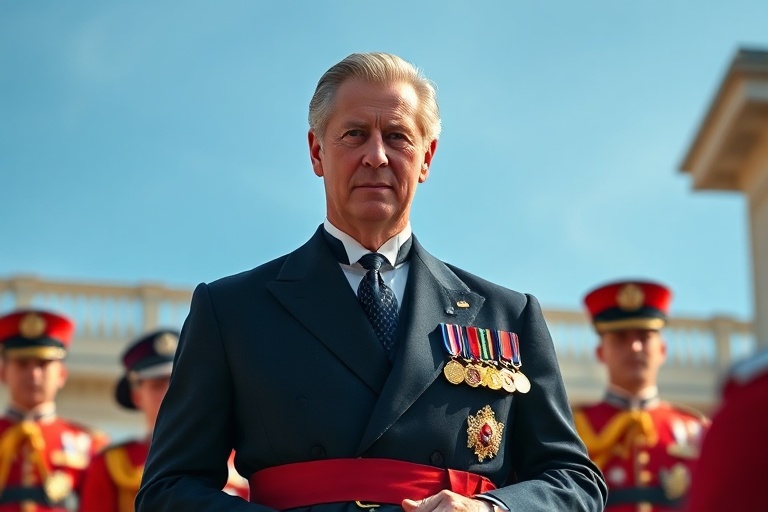
Charles III: How Britain’s King is Redefining Modern Monarchy
“`html
Charles III: The Reign of a Modern Monarch
King Charles III ascended to the British throne on September 8, 2022, following the death of his mother, Queen Elizabeth II, after a 70-year reign. His coronation on May 6, 2023, marked the beginning of a new era for the monarchy, blending tradition with the demands of a rapidly changing world. At 74, Charles became the oldest monarch to assume the British throne, bringing decades of preparation and a distinct vision for his role.
The transition from prince to king was not merely ceremonial. Charles had spent over 70 years in the public eye, serving as the longest-serving Prince of Wales before his ascension. His reign began during a period of national reflection, as the UK grappled with economic uncertainty, political upheaval, and the legacy of colonialism. Unlike his mother, whose reign was defined by stability, Charles faced the challenge of redefining the monarchy’s relevance in the 21st century.
The Early Years and Education of a Future King
Born on November 14, 1948, Charles Philip Arthur George was the eldest child of Queen Elizabeth II and Prince Philip. His early years were marked by the strict expectations of royal upbringing. He was the first heir apparent to attend school rather than be educated by private tutors, attending Gordonstoun in Scotland—a decision his father had also experienced. This choice reflected a desire to ground Charles in the experiences of ordinary people, though it also subjected him to criticism for the school’s harsh disciplinary methods.
His education continued at Cambridge University, where he read archaeology and anthropology before switching to history. He became the first heir apparent to earn a bachelor’s degree. Later, he served in the Royal Navy and Royal Air Force, further distinguishing himself from previous heirs who had not completed military service. These formative years shaped his identity as a monarch-in-waiting who valued duty, education, and public service.
Charles’s early interests also revealed his intellectual curiosity. He developed a passion for architecture, urban planning, and environmental conservation—interests that would later define his public advocacy. His 1980s television documentary, Royalty, showcased his views on modern monarchy, blending his royal duties with his personal convictions.
The Challenges of Transitioning to the Throne
The death of Queen Elizabeth II on September 8, 2022, thrust Charles into the spotlight as he assumed the title of king. The transition was met with a mix of reverence and scrutiny. While many Britons held deep respect for the monarchy, others questioned the institution’s future in an era of declining deference. Charles’s reign began amid economic instability, political divisions, and debates over the monarchy’s role in a multicultural Britain.
One of the most immediate challenges was the public’s reaction to his ascension. Polls conducted in late 2022 and early 2023 showed mixed feelings about Charles’s suitability for the role. Some critics pointed to his outspoken views on subjects like architecture, organic farming, and alternative medicine as evidence of a monarch overstepping his constitutional boundaries. Others, however, praised his willingness to engage with modern issues, such as climate change and social inequality.
The coronation itself was a carefully balanced affair. Unlike his mother’s coronation in 1953, which was a grand spectacle broadcast to a global audience, Charles’s coronation was scaled back in some respects. The ceremony retained centuries-old traditions but included nods to modernity, such as the presence of representatives from non-Christian faiths. The event also highlighted Charles’s commitment to interfaith dialogue, a cause he had championed throughout his life.
Public Perception and the Monarchy’s Future
Charles’s reign has been marked by efforts to modernize the monarchy while preserving its core values. His support for environmental causes aligns with the growing public concern over climate change. In 2021, he established the Sustainable Markets Initiative, which encourages businesses to adopt eco-friendly practices. His advocacy has earned him respect among younger generations, who are often skeptical of traditional institutions.
However, the monarchy still faces significant challenges. The cost of maintaining the royal family has come under scrutiny, particularly in light of the UK’s economic struggles. Charles has taken steps to reduce the monarchy’s expenses, including scaling back the number of working royals and promoting efficiency in royal household operations. Yet, debates persist over whether the monarchy is a worthwhile expenditure for taxpayers.
Another issue is Charles’s relationship with the public. Unlike his mother, who maintained a carefully cultivated image of neutrality, Charles has often been outspoken on political and social issues. His interventions have sometimes sparked controversy, particularly when they touched on devolved matters in Scotland, Wales, and Northern Ireland. The monarchy’s role in a devolved UK remains a subject of ongoing debate.
Charles III’s Legacy and the Road Ahead
As Charles III navigates his reign, his legacy will likely be defined by his ability to adapt the monarchy to the 21st century. His early actions suggest a monarch who values progressiveness but also respects tradition. The coronation’s blend of ancient rituals and modern inclusivity reflects this approach. His commitment to charitable causes, particularly those related to the environment and social justice, has also resonated with many.
Yet, the monarchy’s long-term future remains uncertain. The question of Charles’s successor, Prince William, looms large. William’s popularity and modern outlook could help revitalize the institution, but the transition will require careful management. Charles’s reign may well be seen as a bridge between the monarchy of the past and its potential future in a changing Britain.
Key Moments in Charles III’s Reign So Far
The first two years of Charles’s reign have been marked by several defining moments:
- Accession and Proclamation: Charles was officially proclaimed king on September 10, 2022, two days after his mother’s death. His first address to the nation emphasized continuity and service.
- Coronation Ceremony: Held on May 6, 2023, the coronation included modern elements such as the presence of representatives from different faiths and a reduced guest list to reflect fiscal responsibility.
- State Visits and Diplomacy: Charles has undertaken several high-profile state visits, including trips to France and Germany, where he emphasized the importance of international cooperation and reconciliation.
- Environmental Advocacy: He has continued to champion environmental causes, including his role in the COP28 climate conference in 2023, where he delivered a keynote address on sustainable finance.
- Health and Longevity: At 75, Charles is the oldest British monarch at the start of his reign. His longevity has sparked discussions about the monarchy’s future beyond his reign, particularly regarding Prince William’s preparedness.
Conclusion: A Monarchy in Transition
Charles III’s reign represents a period of transition for the British monarchy. His efforts to modernize the institution while honoring tradition reflect the challenges of leading a centuries-old institution into an uncertain future. Whether his reign will be remembered as a period of renewal or one of continued struggle remains to be seen.
The monarchy’s survival in the 21st century will depend on its ability to adapt to changing public expectations and political realities. Charles’s personal convictions, particularly his environmental advocacy, have positioned him as a monarch in tune with the concerns of younger generations. Yet, the institution must also navigate the complexities of a devolved UK and the ongoing debates over its relevance and cost.
As Charles III continues his reign, the world watches to see how the monarchy evolves under his leadership. His success will not only shape the legacy of his own reign but also determine the future of the British monarchy for generations to come.