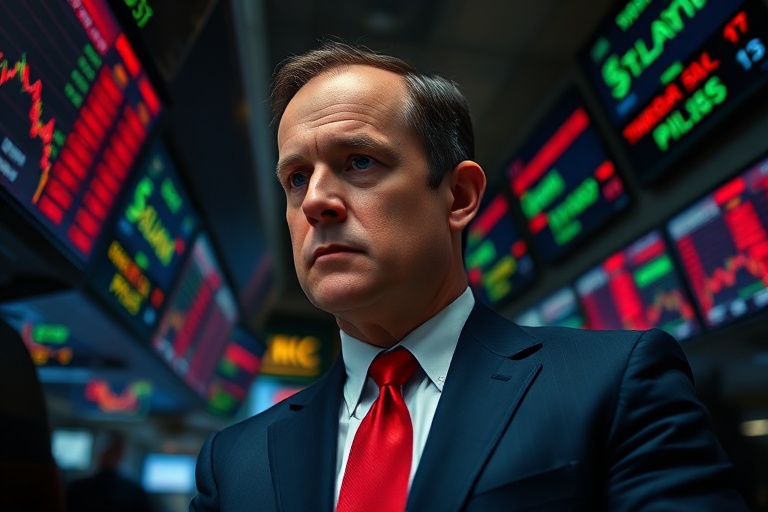
Paul Tudor Jones II stands as one of the most influential figures in modern finance, a man whose career spans more than four decades and whose strategies have reshaped how institutions approach risk and market timing. Born in Memphis, Tennessee, in 1954, Jones began his journey not in the rarefied halls of Wall Street, but in the trenches of commodity trading—where instinct, discipline, and a contrarian mindset would become his trademarks. Over the years, he built Tudor Investment Corporation into a multi-billion-dollar hedge fund empire, while earning a reputation as both a shrewd market operator and a philosophical thinker about capitalism and human behavior.
The son of a commodities broker, Jones was exposed early to the rhythms of supply and demand. He studied economics at the University of Virginia, where he developed an interest in futures markets. After graduating, he worked briefly as a trader before serving in the Army National Guard. By the late 1970s, he had joined the trading floor of E.F. Hutton, where he honed his skills under the mentorship of cotton trader Eli Tullis. It was there that Jones began to form the principles that would define his career: patience, risk control, and an acute sensitivity to macroeconomic shifts.
From Commodities to Global Macro: The Rise of Tudor Investments
In 1980, Jones founded Tudor Investment Corporation with $30,000 of his own money and a bold vision: to exploit mispricings in global financial markets using a disciplined, systematic approach. His early focus on commodities—especially cotton and sugar—gave way to a broader macro strategy as he began to track inflation, currency movements, and geopolitical risk. The 1980s proved pivotal. Jones correctly predicted the 1987 stock market crash, famously shorting equities ahead of Black Monday and turning a 200% profit for his fund. This event cemented his reputation as a prescient market timer and a student of crowd psychology.
Jones’ investment philosophy is rooted in three core tenets: macroeconomic analysis, risk management, and behavioral insight. He has long argued that markets are less efficient than classical economics suggests, and that emotions—fear and greed—drive irrational pricing. His approach blends top-down analysis of global trends with bottom-up execution, often using macro models to identify themes (like the rise of China or the inflation cycle) and tactical trades (like currency hedges or commodity spreads) to express those views.
Unlike many hedge fund managers who rely on quantitative models, Jones maintains a discretionary edge. He famously keeps a “panic button” in his office—literally a button he can press to close all positions if market conditions deteriorate. This emphasis on downside protection has helped Tudor’s flagship fund, Tudor BVI Global Fund, deliver consistent returns with relatively low volatility over decades. As of recent reports, the firm manages over $50 billion in assets across multiple strategies.
A Legacy Built on Contrarian Thinking and Crisis Anticipation
Jones’ career is punctuated by moments where his contrarian stance paid off handsomely. In 1992, he correctly anticipated the collapse of the British pound during the European Exchange Rate Mechanism crisis, earning hundreds of millions and earning him a place in financial history as one of the architects of the “Soros attack” on sterling. More recently, he has been vocal about the risks of unchecked monetary expansion, warning in 2021 and 2022 that aggressive central bank policies could fuel inflation and asset bubbles—a view that aligned with market realities in 2023.
His investment in Bitcoin in 2021, though initially controversial, reflected his long-standing belief in alternative stores of value and skepticism toward traditional fiat systems. While not a crypto maximalist, Jones has argued that decentralized assets could play a role in diversified portfolios, especially in environments of currency debasement. This adaptability—shifting from commodities to equities to digital assets—demonstrates a rare intellectual agility.
Beyond trading, Jones has become a thought leader in philanthropy and education. He founded the Robin Hood Foundation in 1988, a nonprofit dedicated to fighting poverty in New York City. Through innovative funding models and data-driven grantmaking, the foundation has raised over $3 billion and improved the lives of millions. Jones views poverty alleviation not as charity, but as a moral and economic imperative—an extension of his belief in systemic risk management applied to society.
Core Principles of Paul Tudor Jones’ Trading and Investment Strategy
To understand Jones’ enduring success, it’s essential to examine the principles that guide his decisions. While he adapts to changing markets, the foundation remains consistent:
- Risk First: Jones famously said, “Losers average losers.” He prioritizes capital preservation over aggressive growth, often exiting positions quickly if they move against him.
- Macro Over Micro: He focuses on large-scale trends—interest rates, inflation, geopolitics—rather than individual stocks or companies.
- Contrarian Timing: He thrives in environments of extreme sentiment, often positioning against the crowd during periods of euphoria or despair.
- Psychological Discipline: He studies crowd behavior, using tools like investor sentiment surveys and media sentiment analysis to gauge market psychology.
- Flexible Capital Allocation: He rotates between asset classes—equities, bonds, currencies, commodities, and even crypto—based on relative value and risk-adjusted returns.
These principles are not static formulas but living frameworks. Jones has repeatedly emphasized that markets evolve, and so must the trader. His ability to pivot—from inflation trades in the 1980s to tech stocks in the 1990s to global macro in the 2000s—reflects a deep understanding of structural change.
The Broader Implications: What Tudor Jones Teaches About Markets and Leadership
Paul Tudor Jones’ influence extends far beyond his fund’s performance. He represents a bridge between the speculative energy of trading floors and the strategic foresight of macroeconomic analysis. In an era dominated by algorithmic trading and passive investing, his emphasis on human judgment and macro narrative stands out. He reminds investors that markets are ultimately driven by people—by hope, fear, and herd behavior—and that understanding those forces is just as important as crunching numbers.
Moreover, Jones’ career challenges the myth of the “lone genius” trader. While he is undeniably brilliant, his success is rooted in systems: risk controls, research teams, and a culture of intellectual humility. He has spoken openly about learning from mistakes, including a painful drawdown in the late 1990s that forced him to rethink his approach to emerging markets.
His broader impact is also visible in philanthropy. The Robin Hood Foundation didn’t just raise money—it pioneered outcomes-based funding, proving that social problems could be tackled with the same rigor as financial ones. This ethos—applying market discipline to societal challenges—has influenced a generation of impact investors and social entrepreneurs.
In an age of increasing financial inequality and climate uncertainty, Jones’ dual focus on wealth creation and social responsibility offers a compelling model. He demonstrates that capitalism can be both competitive and compassionate—if guided by thoughtful leadership.
Conclusion: The Enduring Relevance of a Market Maverick
Now in his late 60s, Paul Tudor Jones remains active in markets, though he has gradually reduced his personal trading role to focus more on mentorship and philanthropy. His legacy, however, is already secure. He is not just a trader who made billions; he is a market philosopher who decoded the rhythms of risk and reward. His principles—risk control, contrarian timing, macro awareness—are studied by aspiring traders worldwide.
More importantly, Jones represents a vision of finance that values stability over speculation, substance over hype. In an industry often criticized for short-termism and speculation, his long-term orientation and ethical commitments offer a counterpoint. Whether through Tudor Investment Corporation or the Robin Hood Foundation, he has shown that financial acumen can coexist with social impact.
As markets continue to evolve—amidst artificial intelligence, climate change, and geopolitical fragmentation—the lessons of Paul Tudor Jones remain vital. He teaches that success in finance isn’t about predicting the future perfectly, but about managing uncertainty, protecting capital, and staying adaptable. In a world of noise and volatility, that clarity is rare—and invaluable.
For those seeking further insight into trading philosophies and market strategies, explore more on Trading and Finance at Dave’s Locker.