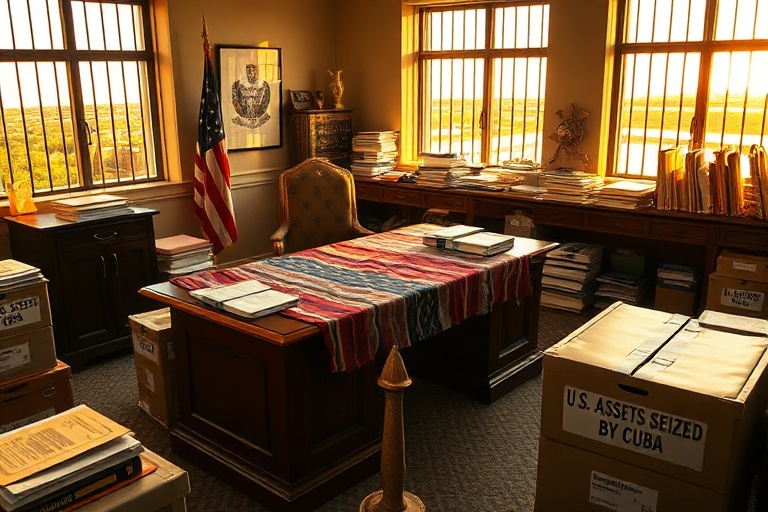
U.S. Assets Seized by Cuba: Six Decades of Unresolved Claims
“`html
U.S. Assets Seized by Cuba: A Half-Century of Legal and Political Fallout
The U.S. government has long maintained a complex legal stance on Cuban expropriations. Since the early 1960s, American-owned properties and assets were nationalized by the Cuban government following the revolution led by Fidel Castro. These seizures affected hundreds of U.S. companies and individuals, totaling an estimated $1.9 billion in uncompensated losses, according to the U.S. Foreign Claims Settlement Commission.
The Cuban government’s actions were codified through a series of laws beginning with the Agrarian Reform Law of 1959, which authorized the state takeover of large landholdings, including those owned by American corporations. By 1960, additional laws expanded the scope of expropriation to include utilities, banks, and industrial facilities. These measures were framed as part of Cuba’s broader socialist transformation, but they directly targeted U.S. interests, leading to immediate diplomatic tensions.
The Legal Framework Behind the Seizures
The Cuban government’s seizure of U.S. assets was not arbitrary. It was executed through a series of decrees that systematically transferred ownership from foreign investors to Cuban state enterprises. The first major wave occurred in May 1959, when the Agrarian Reform Law empowered the government to confiscate land exceeding 1,000 acres. Many of these properties belonged to U.S. sugar companies such as Texaco, Coca-Cola, and United Fruit Company.
By 1960, the Cuban government expanded its reach through Law No. 851, which authorized the nationalization of all U.S.-owned enterprises. This law allowed the government to seize assets without compensation under the pretext of countering imperialism. The U.S. responded with economic sanctions, including the embargo that remains in place today. These sanctions have since become a cornerstone of U.S. policy toward Cuba, reinforcing the legal and political dimensions of the dispute.
The U.S. position has been consistent: the seizures were illegal under international law, violating bilateral treaties and customary norms of property rights. The U.S. government has repeatedly called for compensation, but Cuba has dismissed these claims, arguing that the expropriations were a sovereign act of a revolutionary state reclaiming its resources.
Notable Cases and Affected Entities
Several high-profile cases illustrate the breadth and impact of these seizures. One of the most significant involved the National Sugar Refining Company of New Jersey, which operated the largest sugar mill in Cuba. In 1960, its assets were expropriated, leading to a decades-long legal battle. The company filed claims with the U.S. Foreign Claims Settlement Commission, which valued its losses at over $100 million at the time—a figure that has since grown with interest and inflation.
Another prominent case involved the Texaco oil company. After refusing to process Soviet crude oil, Texaco’s Cuban refinery was seized in 1960. The company pursued legal action in U.S. courts, but enforcement proved difficult due to the embargo and Cuba’s refusal to engage in arbitration. Similar fates befell International Telephone and Telegraph (ITT), which owned Cuba’s telephone system. By 1961, ITT’s operations were fully nationalized, leaving shareholders with no recourse.
The impact was not limited to corporations. Thousands of individual Americans—many of them Cuban-born exiles—lost homes, businesses, and personal property. The U.S. government has recognized these claims as well, though compensation remains elusive. A list of some of the most affected entities includes:
- Coca-Cola Bottling Company of Cuba
- United Fruit Company (now Chiquita Brands International)
- Mining companies such as Freeport Sulphur
- Banks including First National City Bank (now Citibank)
- Real estate holdings of Cuban-American families in Havana
Diplomatic and Economic Consequences
The seizures triggered an immediate breakdown in U.S.-Cuba relations. In 1961, the U.S. severed diplomatic ties and imposed a full economic embargo, which has endured for over six decades. The embargo prohibits most trade and financial transactions between the two countries, making it nearly impossible for U.S. claimants to recover their assets through normal legal channels.
Cuba, in turn, has used the embargo as justification for its refusal to compensate U.S. claimants. Cuban officials argue that the embargo violates international law and that the U.S. is hypocritical in demanding compensation while simultaneously isolating Cuba economically. This stance has been echoed in international forums, including the United Nations, where Cuba has repeatedly called for an end to the embargo.
Economically, the seizures reshaped Cuba’s industrial and agricultural sectors. Sugar production, once dominated by U.S. companies, became a state-run industry. The loss of American investment led to inefficiencies and long-term stagnation in key sectors. Meanwhile, the U.S. lost access to a significant market, particularly for agricultural exports such as rice and wheat, which Cuba had previously imported in large quantities.
The embargo has also had unintended consequences for U.S. businesses. While the embargo targets trade with Cuba, it includes exceptions for certain exports, such as food and medicine. However, the legal risks and bureaucratic hurdles have deterred many companies from pursuing these opportunities. The result is a paradox: the embargo restricts trade while simultaneously preventing claimants from recovering their losses through engagement.
Ongoing Efforts for Compensation and Restitution
Despite the passage of time, the issue of compensation remains alive in U.S. policy circles. The Helms-Burton Act of 1996 codified the embargo and reinforced the U.S. government’s stance on compensation. Title III of the act allows U.S. nationals to sue foreign companies that “traffic” in confiscated properties, a provision that has been sporadically enforced and has drawn international criticism.
In recent years, the U.S. has intensified pressure on Cuba to address the claims. The Trump administration expanded sanctions and added new restrictions, while the Biden administration has maintained a hardline stance. In 2021, the U.S. Department of State reiterated its call for Cuba to negotiate compensation, citing the ongoing harm to American claimants.
Meanwhile, some claimants have turned to alternative strategies. A small number of lawsuits have been filed in U.S. courts against third-country entities that have invested in former U.S. properties. These cases have met with mixed success, as courts often dismiss them on the grounds of sovereign immunity or lack of jurisdiction. However, they reflect the persistence of claimants who continue to seek justice decades after the seizures occurred.
For many Cuban-Americans, the issue is deeply personal. Families who lost homes in Havana or businesses in Santiago de Cuba still hold deeds and photographs as proof of their losses. Organizations such as the Cuban American National Foundation have lobbied Congress for decades to push for restitution. Their efforts have kept the issue in the public eye, even as broader U.S.-Cuba relations remain frozen.
Conclusion: A Frozen Dispute with No End in Sight
The seizure of U.S. assets by Cuba remains one of the longest-running and most contentious disputes in U.S. foreign policy. It is a story of revolution, ideology, and the enduring clash between sovereignty and property rights. While the Cold War context that gave rise to these seizures has faded, the legal and economic consequences endure.
The embargo, now over sixty years old, has failed to achieve its stated goals of restoring democracy or securing compensation for U.S. claimants. Instead, it has entrenched a stalemate that benefits neither country. For the U.S., the embargo has become a symbol of resistance to authoritarianism, but it has also isolated American businesses and limited diplomatic flexibility. For Cuba, the seizures remain a point of national pride, a rejection of imperialism, and a justification for its economic model.
Until both sides are willing to engage in meaningful dialogue, the fate of these claims will remain unresolved. The U.S. government continues to assert its legal position, while Cuba insists on the legitimacy of its actions. In the meantime, the families and corporations affected by the seizures carry on, their grievances passed down through generations. The story of U.S. assets seized by Cuba is not just a historical footnote—it is a living dispute with no clear resolution in sight.
For further reading on related geopolitical disputes, visit our News and Politics sections.