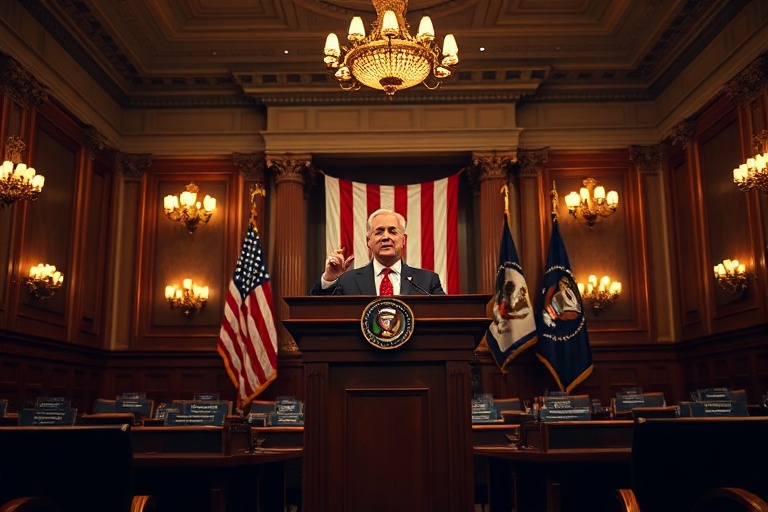
The United States Senate relies on a unique figure to maintain order and procedural integrity: the Parliamentarian. This non-partisan official serves as the Senate’s chief advisor on rules and procedures, ensuring that legislative debates and votes proceed according to established norms. While often operating behind the scenes, the Parliamentarian plays a pivotal role in shaping the Senate’s legislative output and preserving its institutional traditions.
The position traces its origins to the early 20th century, when the Senate formalized the role to provide consistent guidance on parliamentary procedure. Unlike elected officials, the Parliamentarian is a career civil servant appointed by the Vice President, who also serves as the Senate’s presiding officer. This arrangement underscores the non-political nature of the position, as the Parliamentarian must apply rules impartially regardless of which party controls the chamber.
The Constitutional and Historical Foundations
The U.S. Constitution grants each chamber of Congress the authority to establish its own rules. The Senate formalized its procedures through various standing rules and precedents, creating a complex framework that governs everything from debate length to the introduction of amendments. The Parliamentarian’s office emerged to interpret these rules consistently, preventing procedural disputes from derailing legislative business.
Historically, the Senate’s first Parliamentarian was Charles L. Watkins, who served from 1935 until his retirement in 1964. Watkins’ tenure coincided with significant expansion of the federal government during the New Deal era, when the Senate frequently relied on his expertise to navigate complex legislative packages. His successors have continued this tradition, adapting the office to meet the evolving needs of a 100-member body.
The Parliamentarian’s role became particularly crucial during periods of divided government, when partisan tensions often manifest in procedural disputes. During the 1980s and 1990s, the office gained prominence as both parties sought advantages in budget reconciliation processes and other filibuster-related procedures. This evolution reflects how institutional roles can gain importance during periods of political polarization.
Key Responsibilities and Daily Operations
The Parliamentarian’s office performs several critical functions that keep the Senate functioning efficiently. During legislative sessions, a Parliamentarian or assistant is always present on the Senate floor to provide immediate guidance on procedural questions. This real-time advice helps senators navigate complex situations, from determining whether an amendment is germane to identifying which motions are in order.
The office also plays a vital role in interpreting the Senate’s standing rules, which number over 400 pages. These rules govern everything from the recognition of senators to speak, to the proper way to offer amendments, to the procedures for invoking cloture to end debate. The Parliamentarian’s interpretations often become precedents that shape future Senate practice.
Beyond floor proceedings, the Parliamentarian’s office advises on committee procedures and helps draft new rules when necessary. For example, during the COVID-19 pandemic, the Parliamentarian provided crucial guidance on remote deliberations and voting procedures, helping the Senate adapt to unprecedented circumstances while maintaining constitutional requirements.
- Floor Procedure Advisor: Provides immediate guidance during Senate sessions on points of order and parliamentary inquiries
- Rules Interpreter: Applies standing rules and precedents to current legislative situations
- Committee Advisor: Offers guidance on proper committee procedures and organization
- Institutional Memory: Maintains historical knowledge of Senate precedents and traditions
- Rule-Making Assistant: Helps draft changes to Senate rules when requested by leadership
The Appointment Process and Non-Partisan Nature
The Parliamentarian is appointed by the Vice President, who serves as the Senate’s presiding officer. While the Vice President may consult with party leaders, the selection process prioritizes institutional knowledge and impartiality over partisan loyalty. Most Parliamentarians have served as assistant parliamentarians or in other Senate procedural roles before assuming the top position.
This non-partisan tradition has been maintained even as partisan tensions have increased in recent decades. The current Parliamentarian, Elizabeth MacDonough, was appointed in 2012 by Vice President Joe Biden and has served through multiple administrations and party control of the Senate. Her ability to maintain the respect of both parties demonstrates the value of an impartial institutional officer.
The non-partisan nature of the position is reinforced by the Parliamentarian’s role in advising on procedures like budget reconciliation, where the rules allow certain legislation to pass with a simple majority. The Parliamentarian’s guidance on what provisions can be included in reconciliation bills often determines whether major legislative initiatives can proceed without facing a filibuster. This power, while exercised impartially, makes the Parliamentarian’s office a frequent target of criticism from both parties when their preferred outcomes are not achieved.
Controversies and Challenges in Modern Times
The Parliamentarian’s office has faced increasing scrutiny in recent years as partisan divisions have deepened. During the Trump administration, the Parliamentarian’s ruling that certain immigration provisions could not be included in a reconciliation bill drew criticism from both parties. Similarly, during the Biden administration, rulings on tax and spending provisions have generated controversy.
These controversies highlight a fundamental tension in the Senate’s design: the Parliamentarian must balance institutional traditions with the political imperatives of the moment. When the office’s rulings prevent a party from achieving its legislative goals, there is often pressure to replace the Parliamentarian or change the rules. However, such actions risk undermining the Senate’s institutional stability.
Another challenge facing the Parliamentarian is the increasing complexity of Senate procedures. Modern legislation often spans thousands of pages and addresses complex policy areas, requiring the Parliamentarian to interpret rules in ways that were not anticipated when they were written. The rise of filibuster-related procedures, like the “talking filibuster” and novel ways to bypass traditional procedures, has added to the complexity of the Parliamentarian’s work.
Despite these challenges, the Senate has generally resisted calls to politicize the Parliamentarian’s office. The tradition of impartiality has helped maintain the Senate’s reputation as a more deliberative body than the House of Representatives, where the majority party has more control over procedures. This institutional stability has allowed the Parliamentarian to serve as a stabilizing force in times of political turmoil.
Conclusion: An Essential but Often Overlooked Institution
The Parliamentarian of the United States Senate occupies a unique position at the intersection of law, tradition, and politics. While the role rarely receives public attention, its impact on the Senate’s legislative output is profound. By providing impartial guidance on complex procedural questions, the Parliamentarian helps maintain the Senate’s institutional integrity while allowing it to adapt to changing circumstances.
As the Senate continues to grapple with issues like partisan polarization, filibuster reform, and the challenges of modern governance, the Parliamentarian’s role will likely grow in importance. The office serves as a reminder that effective legislatures require not just elected representatives, but also skilled institutional experts who can navigate the complexities of parliamentary procedure. In an era of increasing political division, the Parliamentarian’s commitment to impartiality and institutional stability may prove more valuable than ever.
For those interested in exploring how the Senate’s procedures affect specific legislative outcomes, our Politics and News sections provide additional analysis and reporting on these important institutional dynamics.