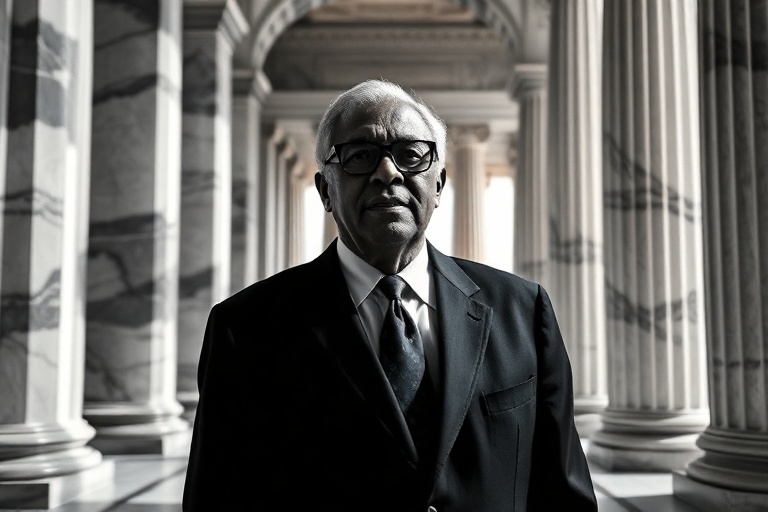
Clarence Thomas: Controversial Supreme Court Justice’s Legacy Explained
“`html
Clarence Thomas: A Supreme Court Legacy of Controversy and Influence
For three decades, Justice Clarence Thomas has shaped the United States Supreme Court with unparalleled consistency and ideological conviction. Appointed by President George H.W. Bush in 1991, Thomas became the second African American justice in the Court’s history and the longest-serving current member. His jurisprudence—rooted in originalism and textualism—has left an indelible mark on constitutional interpretation, particularly in cases involving civil rights, federal power, and individual liberties. Yet, his tenure has also been defined by persistent controversy, from ethics scandals to contentious confirmation hearings that nearly derailed his ascension.
The Confirmation Battle: A Nation Divided in 1991
Clarence Thomas’s confirmation process remains one of the most polarizing moments in modern judicial history. Nominated to replace Thurgood Marshall, the first African American justice, Thomas was initially seen as a relatively uncontroversial choice. That changed dramatically when Anita Hill, a former colleague, accused him of sexual harassment during his time at the Equal Employment Opportunity Commission. The Senate Judiciary Committee hearings became a national spectacle, broadcast live and dissected in newsrooms across the country.
What followed was a weeks-long debate that laid bare deep divisions in American society. Thomas famously referred to the proceedings as a “high-tech lynching,” a phrase that resonated with many African Americans who saw the allegations as racially motivated. The Senate ultimately confirmed him by a narrow 52-48 vote, the closest margin for a Supreme Court justice in more than a century. The hearings did not resolve the question of Thomas’s character but instead cemented his image as a figure willing to challenge the establishment, regardless of the personal cost.
Key Moments from the 1991 Confirmation Hearings
- Anita Hill’s Testimony: On October 11, Hill testified before the Senate Judiciary Committee, alleging that Thomas had subjected her to unwanted sexual comments and behavior while she worked under him at the EEOC and Department of Education.
- Thomas’s Denial: Thomas dismissed the allegations as a “circus” and “a national disgrace,” framing them as part of a smear campaign against a Black conservative.
- Public Reaction: The hearings sparked a national conversation about race, gender, and power, with polls showing deep divisions along racial and partisan lines.
- Final Vote: Despite the controversy, Thomas was confirmed on October 15, 1991, and took his seat on the Court one week later.
A Jurisprudence of Originalism and Textualism
Since joining the Court, Thomas has emerged as one of its most consistent and outspoken justices, often siding with the conservative bloc in closely divided cases. His judicial philosophy is firmly rooted in originalism—the idea that the Constitution should be interpreted as it was understood at the time of its ratification—and textualism, which emphasizes the plain meaning of legal texts. This approach has led him to take positions that sometimes place him at odds with both liberal and conservative colleagues.
For example, Thomas has been a vocal critic of affirmative action, arguing that racial classifications—even those intended to remedy past discrimination—violate the Equal Protection Clause. His dissent in Grutter v. Bollinger (2003), which upheld the University of Michigan Law School’s affirmative action program, became a touchstone for opponents of race-conscious admissions policies. Similarly, in Shelby County v. Holder (2013), Thomas joined the majority in striking down a key provision of the Voting Rights Act, arguing that the law’s coverage formula was outdated and unconstitutional.
Yet Thomas’s originalism has also led him to take positions that defy conventional conservative orthodoxy. He has been a persistent critic of the federal government’s expansive use of power, arguing in cases like United States v. Lopez (1995) that Congress had overstepped its authority under the Commerce Clause. This willingness to challenge both liberal and conservative policies has earned him respect even among some of his ideological adversaries, though it has also isolated him at times within the Court’s conservative majority.
The Ethics Scandals: A Career Overshadowed by Controversy
While Thomas’s judicial record has cemented his influence on the Court, his personal conduct has frequently drawn scrutiny. Over the years, a series of ethics controversies have raised questions about his integrity and transparency. The most significant involved the revelation that he had failed to report hundreds of thousands of dollars in gifts from billionaire Harlan Crow, including luxury vacations, real estate deals, and even the purchase of Thomas’s mother’s home.
These revelations, first reported by ProPublica in 2023, led to calls for Thomas’s resignation or impeachment. Critics argued that the gifts created an appearance of impropriety, particularly given Crow’s ties to conservative legal and political circles. Thomas defended himself by stating that he had relied on the advice of his staff and that the reporting requirements were unclear. The controversy reignited debates about the lack of a formal ethics code for Supreme Court justices, a gap that has persisted despite growing public concern.
The ethics scandals have not only tarnished Thomas’s legacy but have also fueled broader discussions about accountability in the judiciary. Unlike lower-court judges, Supreme Court justices are not bound by the same ethical rules, and Congress has shown little appetite for imposing stricter oversight. This has left Thomas—and the Court as a whole—vulnerable to criticism that it operates without adequate checks on its power.
The Broader Implications: A Court Transformed
Clarence Thomas’s tenure on the Supreme Court has coincided with a fundamental shift in the Court’s ideological balance. His confirmation, along with those of Justices Scalia, Alito, Gorsuch, Kavanaugh, and Barrett, has solidified a conservative supermajority that has overturned long-standing precedents on issues like abortion, gun rights, and religious liberty. Thomas, in particular, has been a driving force behind this transformation, often writing or joining opinions that push the boundaries of constitutional law.
For instance, in Dobbs v. Jackson Women’s Health Organization (2022), Thomas joined the majority in overturning Roe v. Wade, arguing that the Constitution does not confer a right to abortion. His concurring opinion went further, suggesting that the Court should reconsider other substantive due process precedents, including those protecting contraception, same-sex relationships, and same-sex marriage. While Chief Justice Roberts and other conservative justices declined to join this broader critique, Thomas’s willingness to revisit settled law has raised alarms among progressives about the potential erosion of fundamental rights.
Beyond his judicial record, Thomas’s influence extends to the legal profession itself. His originalist approach has inspired a generation of conservative lawyers and judges, many of whom now occupy key positions in the federal judiciary. Organizations like the Federalist Society have championed his ideas, helping to reshape the legal landscape in ways that will likely endure for decades.
A Lasting Legacy—For Better or Worse
Clarence Thomas’s career is a study in contradictions. He is a Black man who rose to the pinnacle of the legal profession in a system that has historically marginalized people of color, yet his rulings have often been at odds with the interests of minority communities. He is a staunch defender of individual liberty, yet his ethical lapses have raised serious questions about his judgment. He is a jurist of unparalleled consistency, yet his willingness to challenge both liberal and conservative orthodoxies has left him isolated at times.
As Thomas enters his fourth decade on the Court, his legacy remains a subject of intense debate. Supporters view him as a principled originalist who has stayed true to his judicial philosophy, regardless of political pressure. Critics see him as a symbol of the Court’s growing politicization, a justice whose rulings and conduct have eroded public trust in the judiciary. What is undeniable, however, is that his influence on the Court—and on American law—will be felt for generations to come.
For those interested in exploring the broader context of Thomas’s career, Dave’s Locker’s Politics section offers in-depth analysis of judicial appointments and their impact on national policy. Additionally, for a deeper look at the ethical challenges facing the Supreme Court, visit the Analysis category, where experts dissect the intersection of law, power, and accountability.