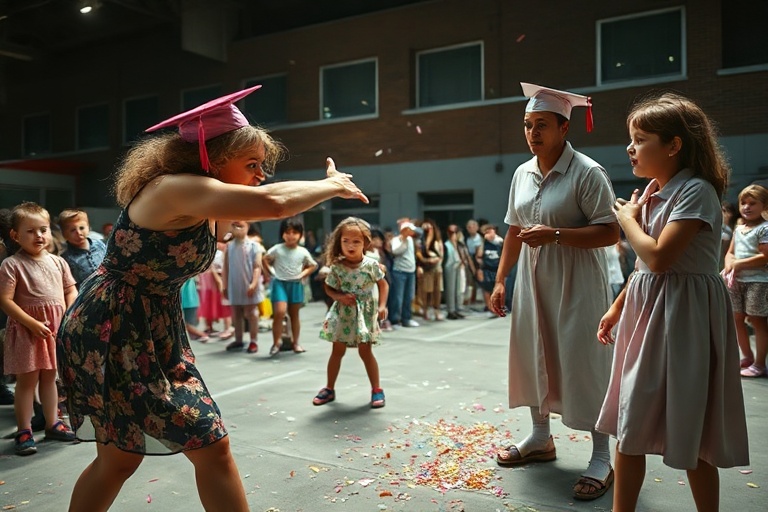
The final day of kindergarten should be a celebration of small victories—first letters mastered, first friendships formed, first steps toward formal education. Yet in recent years, what began as heartwarming ceremonies has occasionally escalated into emotional confrontations between parents, teachers, and even children. These “kindergarten graduation fights” have become a curious cultural phenomenon, spreading from American PTA meetings to viral videos in Asia, Europe, and beyond.
The trend reflects broader shifts in parenting culture, education policy, and social media’s role in amplifying everyday moments. While most ceremonies pass without incident, the occasional flare-ups reveal deeper tensions about achievement, recognition, and the meaning of “graduation” at age five.
The Anatomy of a Kindergarten Graduation Scuffle
Most kindergarten graduation fights follow a familiar pattern: a child is denied a diploma, or receives a “participation” certificate instead of a full “graduation” one. Parents react with anger, teachers defend their academic standards, and emotions—often suppressed during the school year—erupt in a public forum.
In 2023, a viral video from a suburban school in Texas showed a mother confronting a teacher after her son was told he hadn’t met behavioral expectations. The altercation was filmed by another parent and shared online, sparking outrage and debate over whether kindergarten should even have “graduation” ceremonies. Similar incidents have been reported in Florida, California, and even internationally in countries like South Korea and the UK.
What makes these moments so compelling is their absurdity. A five-year-old is not expected to write a thesis or solve quadratic equations. Yet the symbolism of a cap and gown carries weight—it signifies transition, progress, and parental pride. When that symbol is withheld, it feels like a rejection of years of unseen effort.
What Do the Certificates Actually Mean?
Across the United States, kindergarten graduation policies vary widely. Some schools issue diplomas to every child, framing the event as a milestone regardless of academic performance. Others treat it as a formal transition point, requiring students to demonstrate early literacy or social skills.
- In highly competitive education systems like South Korea, kindergarten graduation is tied to early academic tracking and parental status.
- In Finland, where formal schooling begins at seven, kindergarten graduation is a playful ceremony with no academic stakes.
- In many U.S. districts, the ceremony is more about social-emotional development than academic achievement.
This disparity creates confusion. Parents who grew up in systems where kindergarten was purely play-based may expect a celebration. Others, influenced by academic pressure from an early age, anticipate measurable benchmarks. When expectations clash, conflict follows.
From PTA Meetings to TikTok: The Viral Spread of Tiny Controversies
Social media has transformed local disputes into global conversations. A single video of a frustrated parent or a tearful child can be clipped, captioned, and shared within hours. Hashtags like #KindergartenWars or #CapAndGownDrama have surfaced on TikTok and Instagram, drawing millions of views.
In China, a widely circulated video showed a mother berating a teacher after her child was not chosen to “lead” the graduation procession. The clip was reposted on Weibo, where it amassed over 20 million views and sparked debates about “tiger parenting” and educational equity.
This digital amplification raises a question: Are these fights about the diplomas—or about the way we document childhood itself? In an age where every moment can be filmed and judged, even tiny ceremonies become performances.
The Psychology Behind the Tears and Tantrums
Child development experts suggest that the intensity of these reactions often stems from parental projection. A kindergarten graduation is one of the first public affirmations a child receives. When that affirmation is conditional, parents may feel their own worth is being questioned.
Dr. Lisa Feldman Barrett, a neuroscientist and author, notes that emotions are constructed in the moment based on context. For parents, the context of a graduation stage can trigger deep-seated fears about their child’s future. A denied diploma becomes a symbol of failure—not in kindergarten, but in life.
Children, meanwhile, often mirror these emotions. A five-year-old who is told they “didn’t earn” their cap may not understand why, but they feel the weight of disappointment—and may act out in confusion or frustration.
What’s the Right Way Forward?
Many educators now advocate for inclusive graduation models. Some schools have replaced diplomas with “celebration certificates” given to every child, emphasizing participation over performance. Others hold separate academic and social-emotional ceremonies, allowing both achievement and growth to be honored.
In countries like Sweden, kindergarten graduation is treated as a community event with storytelling, songs, and group recognition—no individual awards, no competition. This approach aligns with the Scandinavian emphasis on collective well-being over individual accolades.
Still, the demand for visible milestones persists. Parents want markers. Children want caps. And schools are caught in the middle, trying to balance celebration with realistic expectations.
A Global Perspective: When Kindergarten Becomes a Status Symbol
In some cultures, kindergarten graduation is less about learning and more about social signaling. In urban centers across China, India, and the Gulf States, elite kindergartens market themselves as gateways to top international schools. Graduation ceremonies resemble mini-commencements, complete with professional photography and designer gowns.
This commercialization has led to criticism of “kindergarten elitism,” where families spend thousands on uniforms, photoshoots, and private ceremonies—all before a child can tie their own shoes. The pressure to perform at age five has real consequences, including increased anxiety in young children and strained parent-teacher relationships.
In contrast, countries like Canada and New Zealand have moved toward play-based kindergarten models that emphasize exploration over achievement. Their graduation ceremonies are whimsical, featuring costumes made from recycled materials and group dances—not individual recognition.
These differences highlight a global tension: Is early childhood education about preparation or presence? About competition or connection?
Lessons from the Playground
Perhaps the most telling aspect of these fights is not the diplomas themselves, but what they reveal about adult expectations. Kindergarten was designed to be a gentle introduction to school—not a proving ground. When we turn it into one, we lose sight of its original purpose: to nurture curiosity, not certify performance.
Maybe the real lesson isn’t whether a child graduates, but how they feel walking across that stage. With dignity. With joy. Regardless of the certificate in hand.
As society continues to rethink education in the 21st century, the kindergarten graduation fight serves as a small but telling reminder: the smallest ceremonies can carry the heaviest meanings.